Overview
Fuel testing and analysis
Chem-Tech Laboratories provides fuel analysis across a range of liquid and solid fuels for performance, compliance and contamination-control requirements. The selected scope is matched to the fuel type, applicable specification and testing objective.
Fuel testing can support investigation of adulteration, water ingress, particulate contamination, corrosion tendency, microbial concerns, degradation and changes in calorific value. Results should be reviewed with the sample identity, storage and operating context.
End-to-end support
From field collection to technical reporting
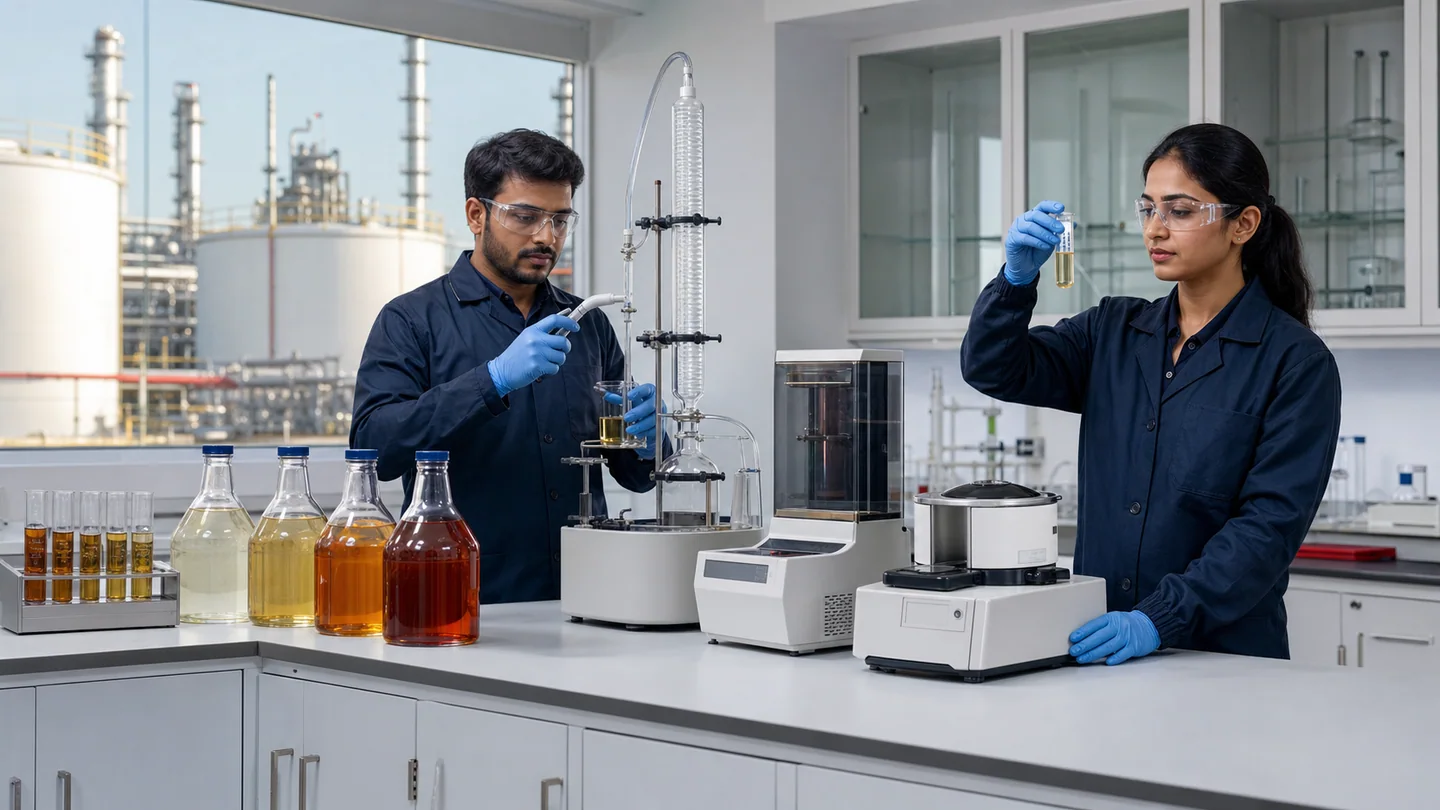
Chem-Tech can support the complete fuel-testing workflow—from planning and representative sample collection through laboratory analysis, investigation and secure online report access.
Coordinated sample collection
Collection can be coordinated from customer sites across India, subject to location, sample type, container, quantity, transport-safety and courier-serviceability checks.
Detailed fuel analysis
Test scopes can be built around specification conformity, contamination, storage condition, combustion characteristics and the identified operational concern.
Fuel investigation and failure analysis
Laboratory evidence can be combined with batch, tank, filter, equipment and operating information to investigate a fuel-related incident or recurring problem.
Fuel adulteration concerns
A tiered investigation can compare identity, volatility, density, distillation, flash point, sulphur and other relevant evidence with the applicable reference fuel.
Online reporting through Zylon
Authorised users can submit sample information, monitor progress, access reports and review historical laboratory data through the Zylon LIMS portal.
Field sampling kits
Suitable containers, labels, tamper-evident seals and dispatch guidance can be arranged for representative fuel collection and traceable submission.
Testing directory
Fuel and solid-fuel testing by product
Select the fuel type or monitoring requirement that matches the sample and testing objective.
Automotive, fleet, power-generation and industrial diesel
Diesel Testing
Diesel-fuel assessment against the applicable IS, ASTM, EN or customer-supplied requirement.
Learn moreBiodiesel and biodiesel-blend quality assessment
BioDiesel Testing
Testing of biodiesel and related blends against the applicable published specification.
Learn moreMarine fuel and bunker-delivery applications
Bunker Fuel Testing
Marine bunker-fuel assessment with reference to the selected ISO 8217 requirement.
Learn moreIndustrial burners, generators and process applications
Light Diesel Oil Testing
Light diesel oil testing against the applicable IS or customer-supplied specification.
Learn moreBoilers, furnaces and industrial combustion systems
Furnace Oil Testing
Furnace-oil testing with reference to IS 1593 and the agreed testing objective.
Learn moreAutomotive gasoline and petrol quality assessment
Gasoline Testing
Gasoline testing against the applicable IS, EN, ASTM or customer-supplied requirement.
Learn moreAviation turbine-fuel quality and specification review
Aviation Turbine Fuel Testing
Controlled aviation-fuel testing against the agreed applicable specification and scope.
Learn morePower generation, cement, metals and process heat
Coal Testing
Proximate and ultimate analysis of coal for the applicable quality or process requirement.
Learn moreBiomass briquettes and alternative solid fuels
Briquette Testing
Testing of briquette and biomass samples used as boiler and process fuels.
Learn moreRoutine fuel-quality monitoring and investigation
Fuel Quality Analysis Program
A structured route for defining monitoring, contamination or specification-testing requirements.
Learn moreApplication context
Where fuel testing is used
- Transport, logistics and fleet operations
- Power generation and backup-power systems
- Marine and port operations
- Aviation fuel-quality requirements
- Cement, metals and industrial process heat
- Fuel suppliers, storage facilities and bulk consumers
Testing rationale
Why fuel analysis is required
Fuel analysis can support delivery checks, routine monitoring, specification assessment and investigation of storage or operating concerns. The test scope should be selected for the fuel, its intended use and the decision the result must support.
When used within a predictive-maintenance programme, fuel results can inform decisions relating to servicing, treatment, filtration and the protection of fuel-system components. The results must be considered with storage, handling and equipment history.
Analytical scope
Detailed fuel analysis matched to the decision
A detailed programme is assembled for the identified fuel, applicable specification, sample condition and business or engineering question. Not every parameter is appropriate for every fuel.
Identity and specification
Appearance, density, viscosity, distillation, flash point, cetane-related or octane-related properties and other specification parameters as applicable.
Contamination and cleanliness
Water, sediment, particulate contamination, microbial indicators, ash, metals and other contaminants selected for the fuel and concern.
Combustion and energy
Calorific value, carbon residue, sulphur, ignition or combustion-related properties and fuel-specific performance indicators.
Storage stability and degradation
Oxidation stability, acidity, gums, insolubles, compatibility and other evidence relevant to storage history and product deterioration.
Methods may include applicable IS, ASTM, ISO, EN or IP procedures. Chem-Tech confirms method availability, accreditation status where relevant, quantity and reporting limits for the final agreed scope.
Problem solving
Fuel investigations and failure analysis
Fuel-related failures rarely have one laboratory value as their complete explanation. A defensible investigation connects analytical results with representative comparison samples and the storage, handling and equipment history.
Define the incident
Record the symptom, affected equipment, fuel grade, supplier or batch, timeline, storage arrangement and action already taken.
Plan representative samples
Identify source, delivery, tank, dispensing point, filter, equipment and retained-reference samples needed for comparison.
Select a staged test scope
Begin with discriminating screening parameters and extend to confirmatory or comparative analysis where the evidence warrants it.
Correlate the evidence
Review laboratory results with specifications, maintenance observations, filter or deposit evidence and operating history.
Report findings and limitations
Document results, deviations and technically supportable observations without claiming a cause beyond the available evidence.
Technical review
Common fuel-quality and contamination concerns
Adulteration and specification conformity
The selected test scope can support comparison with an agreed fuel specification and investigation of suspected adulteration.
Water and particulate contamination
Water, suspended matter and sediment can affect storage quality and should be reviewed using the agreed fuel-testing scope.
Storage degradation and microbial concerns
Storage history, handling conditions and the point of collection are important when degradation or microbial activity is suspected.
Combustion and energy characteristics
Combustion-related and calorific-value results must be interpreted against the fuel type, applicable specification and intended application.
Evidence-led assessment
Investigating suspected fuel adulteration
No single test universally proves every form of fuel adulteration. Chem-Tech selects a group of discriminating parameters based on the declared fuel, suspected material, reference specification and available comparison sample.
Density, distillation behaviour, flash point, viscosity, sulphur, hydrocarbon-pattern or other fuel-specific evidence may indicate inconsistency. Conclusions remain limited by sample representativeness, natural product variability, uncertainty and the information supplied.
Nationwide coordination
Sample collection, field kits and online reporting
Sample collection
Coordinate representative collection from customer locations
- Share the fuel type, collection location, number of samples and purpose of testing.
- Chem-Tech confirms the test scope, sample quantity, appropriate container and any transport restrictions.
- Collection or dispatch is coordinated subject to serviceability and safe-transport requirements at the location.
- Samples are labelled with source, batch, date, time and sampling point and submitted with relevant background information.
Collection is subject to location, courier serviceability, safe-transport rules and the agreed sampling responsibility. Certain fuels may require customer-led collection or specialised logistics.
Field sampling kits
Use the right container and identification controls
Kits can be configured with compatible sample containers—including aluminium containers where required for the agreed fuel scope—labels, seals, secondary packaging and submission guidance.
Review sampling guidanceZylon LIMS
Access reports and historical information online
Authorised customer users can submit sample information, follow laboratory progress, access completed reports and review available historical or trend information in Zylon.
Explore online reportingBefore dispatch
Sample-submission guidance
- Identify the fuel or solid-fuel type, grade, source, batch and exact sampling location.
- State whether the requirement is a delivery check, routine monitoring, specification assessment or investigation.
- Use only the bottle, container and collection arrangement confirmed for the selected tests.
- For non-homogeneous material or solid fuel, agree the sampling plan with Chem-Tech before collection.
Technical output
Reporting and interpretation
The report records the agreed test results and methods for the selected scope.
Results should be reviewed against the applicable specification or supplied reference together with the fuel identity, storage, handling and operating information.
Technical resources
Brochures and controlled test lists
Review the available division literature, then confirm the current scope and sample requirement with Chem-Tech before dispatch.Discuss your requirement