
Overview
What is axle oil testing?
Axle oil testing focuses on lubricants used in differentials, final drives and other heavily loaded geared assemblies.
Testing parameters are selected according to the lubricant type, equipment, operating condition, customer objective and any applicable specification supplied for review.
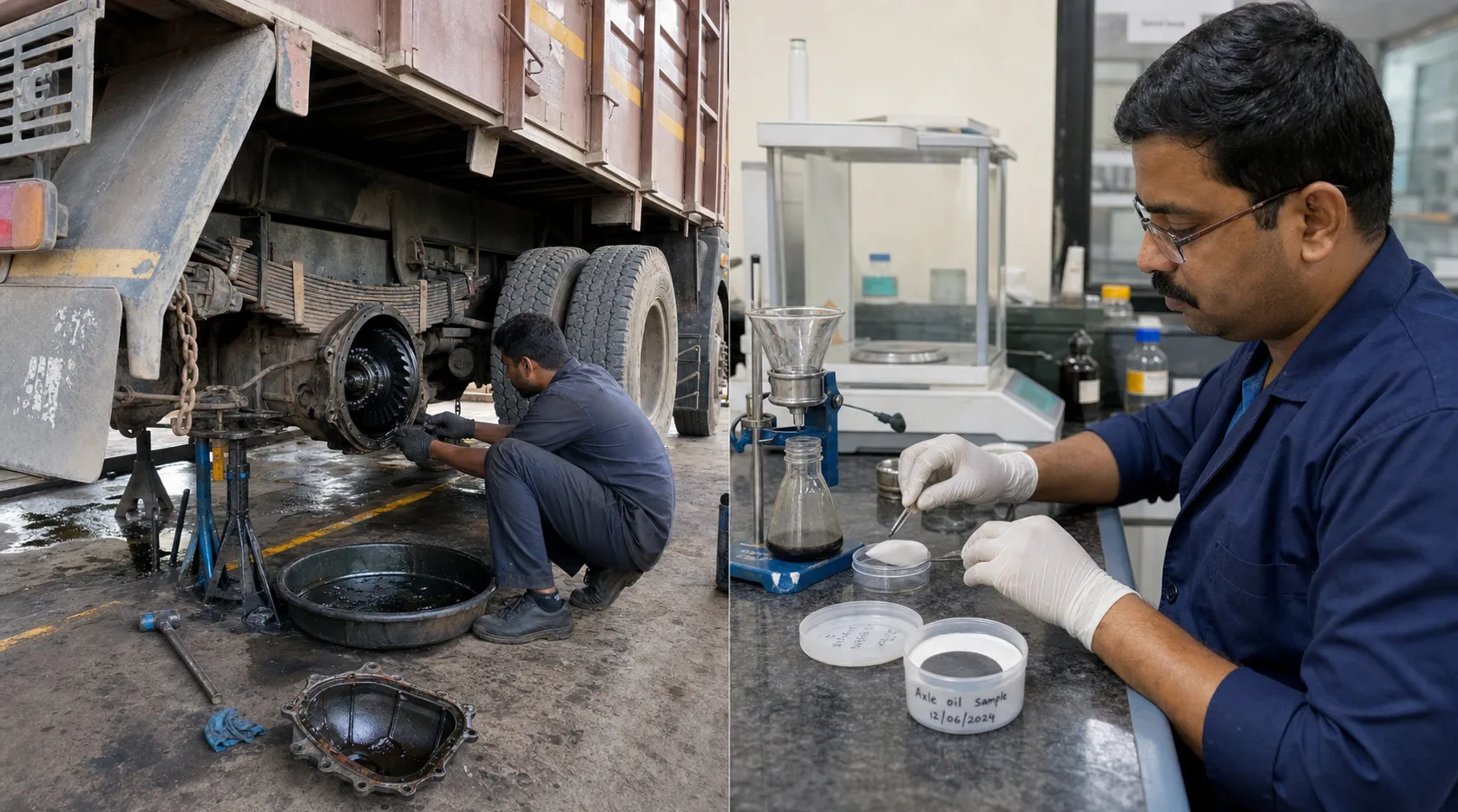
Application context
Applications and equipment
Vehicle axles and differentials
Final-drive systems
Heavy-duty mobile equipment
Fresh and in-service axle oils
Testing rationale
Why axle oil testing is required
Laboratory analysis can provide evidence about lubricant condition, contamination and wear-related change. Results should be interpreted together with equipment history, operating conditions, maintenance information and previous data where available.
A single result does not establish root cause or remaining service life. The testing scope should be agreed for the specific lubricant and investigation.
Technical review
Common condition and contamination concerns
Severe-duty operation
Oil-condition results can be reviewed together with load, service interval and operating environment.
Water and contamination
Water and elemental testing may support investigation of ingress or environmental contamination.
Ferrous wear material
Wear-related information contributes to a wider review when component and trend data are supplied.
Published laboratory capability
Tests and test methods
The methods below are matched to Chem-Tech's controlled technical test lists and published laboratory capability. The final scope is confirmed for the sample, specification and current laboratory capability.
| Test / parameter | Published test method | Technical purpose | Interpretation / high-low context |
|---|---|---|---|
| Appearance | CTP T 112 | Records visible sample condition. | May identify haze, sediment, discolouration or an unexpected physical change. |
| Kinematic viscosity | ASTM D445 / ASTM D7042 | Measures resistance to flow at the agreed temperature. | Supports review of degradation, contamination or mixed-fluid concerns. |
| Total Acid Number | ASTM D664 / ASTM D974 | Measures acidic constituents under the selected method. | May support review of oxidation or contamination-related change. |
| Water content | ASTM E203 / ASTM D1744 / ASTM D6304 | Quantifies water in the lubricant sample. | Supports investigation of ingress, condensation or handling contamination. |
| Elemental analysis | ASTM D5185 / ASTM D6595 | Reports selected wear, contaminant and additive elements. | Supports assessment with equipment materials, oil formulation and trend history. |
Before dispatch
Sample-submission guidance
- Use a clean, secure and appropriately labelled container. Identify the sample, lubricant grade and the equipment or system from which it was collected.
- Where available, provide operating hours, oil-change history, top-up information, the suspected problem, previous results and the required specification or parameters.
- The required sample quantity and container depend on the selected test scope and oil type. Contact Chem-Tech before dispatch so the laboratory can confirm the requirement.
Technical output
Reporting and interpretation
The report records the agreed test results and the methods used for the selected scope. Customer-supplied limits or specifications can be considered where they are provided before testing.
Results can support condition assessment and investigation when reviewed with equipment history, operating conditions and previous test data. A laboratory result alone should not be treated as a guaranteed root-cause diagnosis or remaining-life prediction.
Read Basics of Oil AnalysisDiscuss your requirement