
Overview
What is grease testing?
Chem-Tech® offer wide range of grease testing services, mainly in the Industrial, Automotive, Mining, Marine and Aviation sector. Grease Testing is a valuable tool for determining the condition of the lubricant and discovering abnormal conditions in equipment that may otherwise lead to unexpected failures. Our customized grease testing programs are designed to identify the specific failure modes that may be damaging the component. Each test report comes with comments and recommendations unique to the component which helps customers identify problems and improve reliability.
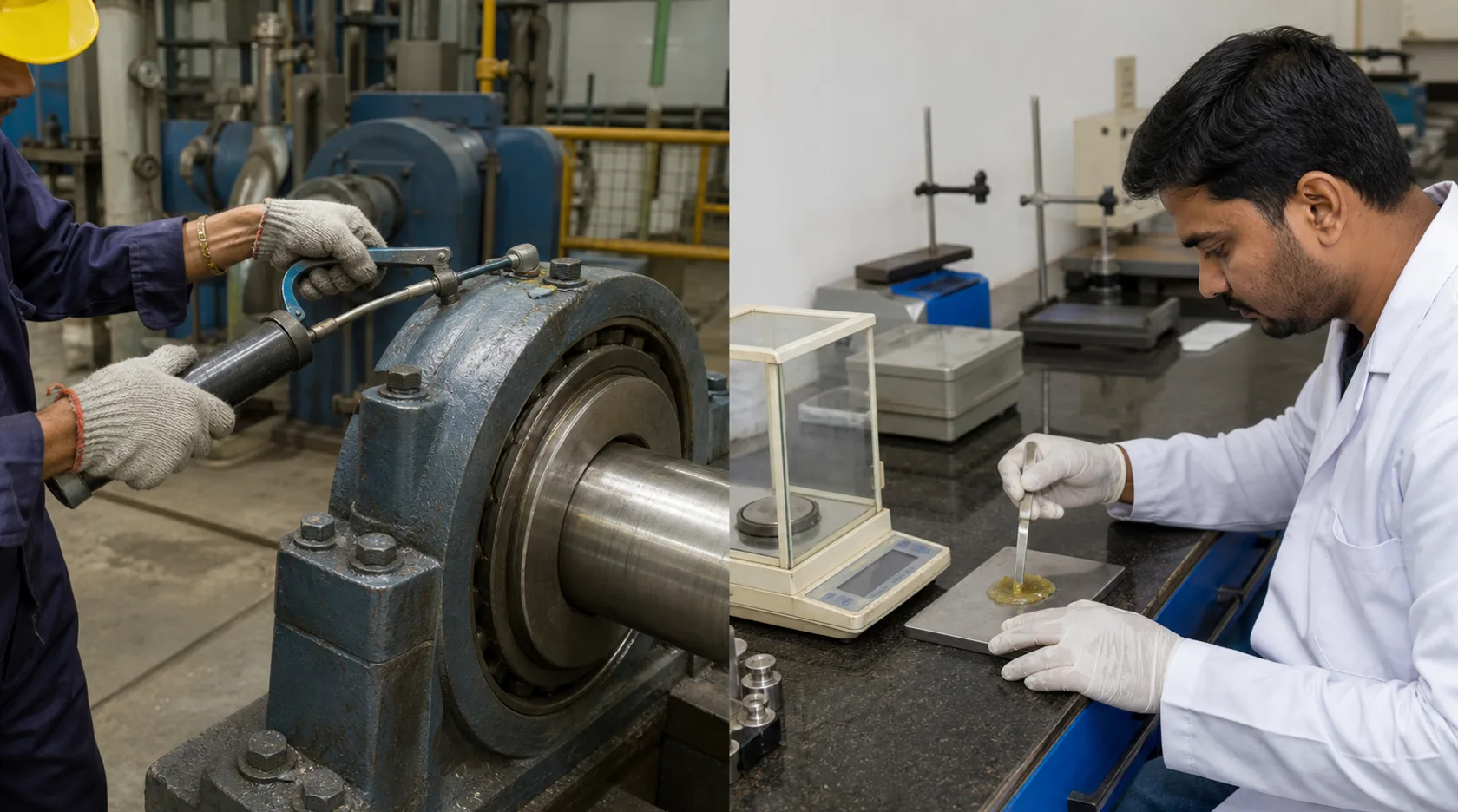
Application context
Applications and equipment
To Check the condition of the grease
To Determine the regreasing amount
To Monitor contaminants
Chem-Tech® Conducts The Following Tests on Grease Samples (as per ASTM and Procedures):
Chem-Tech® Conducts The Following Tests on Grease Samples
(as per ASTM and Procedures):
- Drop Point (Dropping Point)
- NLGI Grade
- Evaporation Loss
- Elemental Analysis
- Moisture Content
- Cone Penetration
- Copper Corrosion
- Four Ball Wear Scar
- Four Ball Weld Load
- Water Resistance Test
- Wheel Bearing Leakage Tendency
- Water Washout Test
Technical review
Common condition and contamination concerns
Consistency change
Worked penetration and related properties support comparison of fresh and in-service grease condition.
Oil separation and stability
Oil-separation and stability checks are selected according to the grease type and investigation.
Water and solid contamination
Water and contaminant material can be reviewed where representative sampling is possible.
Wear-related debris
Elemental or debris analysis is interpreted with the component, relubrication and operating history.
Published laboratory capability
Tests and test methods
The methods below are matched to Chem-Tech's controlled technical test lists and published laboratory capability. The final scope is confirmed for the sample, specification and current laboratory capability.
| Test / parameter | Published test method | Technical purpose | Interpretation / high-low context |
|---|---|---|---|
| Soap or Thickener Type | ICP-OES | Measures or evaluates soap or thickener type under the published method. | A higher or lower result is interpreted against the applicable specification, sample type and available reference data; direction alone does not establish conformity. |
| Base Oil Viscosity at 40 °C | ASTM D445 | Characterises resistance to flow and, where applicable, viscosity response to temperature. | Higher viscosity may accompany oxidation, soot or heavier-product contamination; lower viscosity may accompany dilution, shear or lighter-product mixing. |
| Drop Point | ASTM D566 | Measures or evaluates drop point under the published method. | A higher or lower result is interpreted against the applicable specification, sample type and available reference data; direction alone does not establish conformity. |
| Worked Cone Penetration - 60 Strokes | ASTM D217 | Measures or evaluates worked cone penetration - 60 strokes under the published method. | A higher or lower result is interpreted against the applicable specification, sample type and available reference data; direction alone does not establish conformity. |
| Worked Cone Penetration - Extended Working | ASTM D217 | Measures or evaluates worked cone penetration - extended working under the published method. | A higher or lower result is interpreted against the applicable specification, sample type and available reference data; direction alone does not establish conformity. |
| Copper Corrosion | ASTM D4048 | Measures or evaluates copper corrosion under the published method. | A higher or lower result is interpreted against the applicable specification, sample type and available reference data; direction alone does not establish conformity. |
| Water Content | ASTM D95 / ASTM D1744 | Quantifies water or moisture in the submitted material. | A higher result may indicate ingress, condensation, storage or handling contamination; significance depends on the product and applicable limit. |
| Elemental Analysis by ICP | ASTM D7303 | Reports selected wear, contaminant, additive or composition-related elements. | Higher or lower values require comparison with formulation, metallurgy, process inputs and trend history; one result alone does not establish the source. |
| Water Washout Characteristics | ASTM D1264 | Measures non-combustible residue remaining after controlled combustion. | A higher result indicates more inorganic residue and may affect fuel quality, deposits or specification compliance. |
| Oil Separation | IP 121 / ASTM D1742 | Measures or evaluates oil separation under the published method. | A higher or lower result is interpreted against the applicable specification, sample type and available reference data; direction alone does not establish conformity. |
| Storage Stability | ASTM D1742 | Measures or evaluates storage stability under the published method. | A higher or lower result is interpreted against the applicable specification, sample type and available reference data; direction alone does not establish conformity. |
| Heat Stability | ASTM D6184 | Measures or evaluates heat stability under the published method. | A higher or lower result is interpreted against the applicable specification, sample type and available reference data; direction alone does not establish conformity. |
| Roll Stability | ASTM D1831 | Measures or evaluates roll stability under the published method. | A higher or lower result is interpreted against the applicable specification, sample type and available reference data; direction alone does not establish conformity. |
| Wheel Bearing Leakage Tendency | ASTM D1263 | Measures or evaluates wheel bearing leakage tendency under the published method. | A higher or lower result is interpreted against the applicable specification, sample type and available reference data; direction alone does not establish conformity. |
| Four Ball Weld Load | ASTM D2596 | Measures or evaluates four ball weld load under the published method. | A higher or lower result is interpreted against the applicable specification, sample type and available reference data; direction alone does not establish conformity. |
| Four Ball Wear Scar Diameter | ASTM D2266 | Measures or evaluates four ball wear scar diameter under the published method. | A higher or lower result is interpreted against the applicable specification, sample type and available reference data; direction alone does not establish conformity. |
| Emcor Rust Test | ASTM D6138 | Measures or evaluates emcor rust test under the published method. | A higher or lower result is interpreted against the applicable specification, sample type and available reference data; direction alone does not establish conformity. |
| Oxidation Stability | ASTM D942 | Assesses oxidation stability or condition-related spectral indicators. | Greater oxidation-related change may indicate degradation; stability results and spectral trends must be interpreted using the applicable method and reference. |
| Corrosion Preventive Characteristics | ASTM D1743 | Measures or evaluates corrosion preventive characteristics under the published method. | A higher or lower result is interpreted against the applicable specification, sample type and available reference data; direction alone does not establish conformity. |
Before dispatch
Sample-submission guidance
- Use a clean, secure and appropriately labelled container.
- Provide the sample identity, fluid grade and equipment or system details where applicable.
- Share operating hours, maintenance history, the suspected problem and required specification where available.
- Contact Chem-Tech before dispatch so the laboratory can confirm the sample quantity, container and selected testing scope.
Technical output
Reporting and interpretation
The report records results and methods for the agreed scope. Customer-supplied limits or specifications can be considered when provided before testing.
Results should be reviewed with equipment history, operating conditions and previous data; a laboratory result alone does not guarantee a root-cause diagnosis or remaining service life.
Discuss your requirement
Need more information?
Share the lubricant type, equipment and testing objective with the Chem-Tech team.