
Overview
What is cooling tower water analysis?
Chem-Tech Laboratories offers comprehensive chiller water analysis services, dedicated to optimizing the performance and efficiency of cooling systems. Our advanced testing methodologies and experienced team deliver accurate and reliable results, allowing businesses to maintain optimal operating conditions.
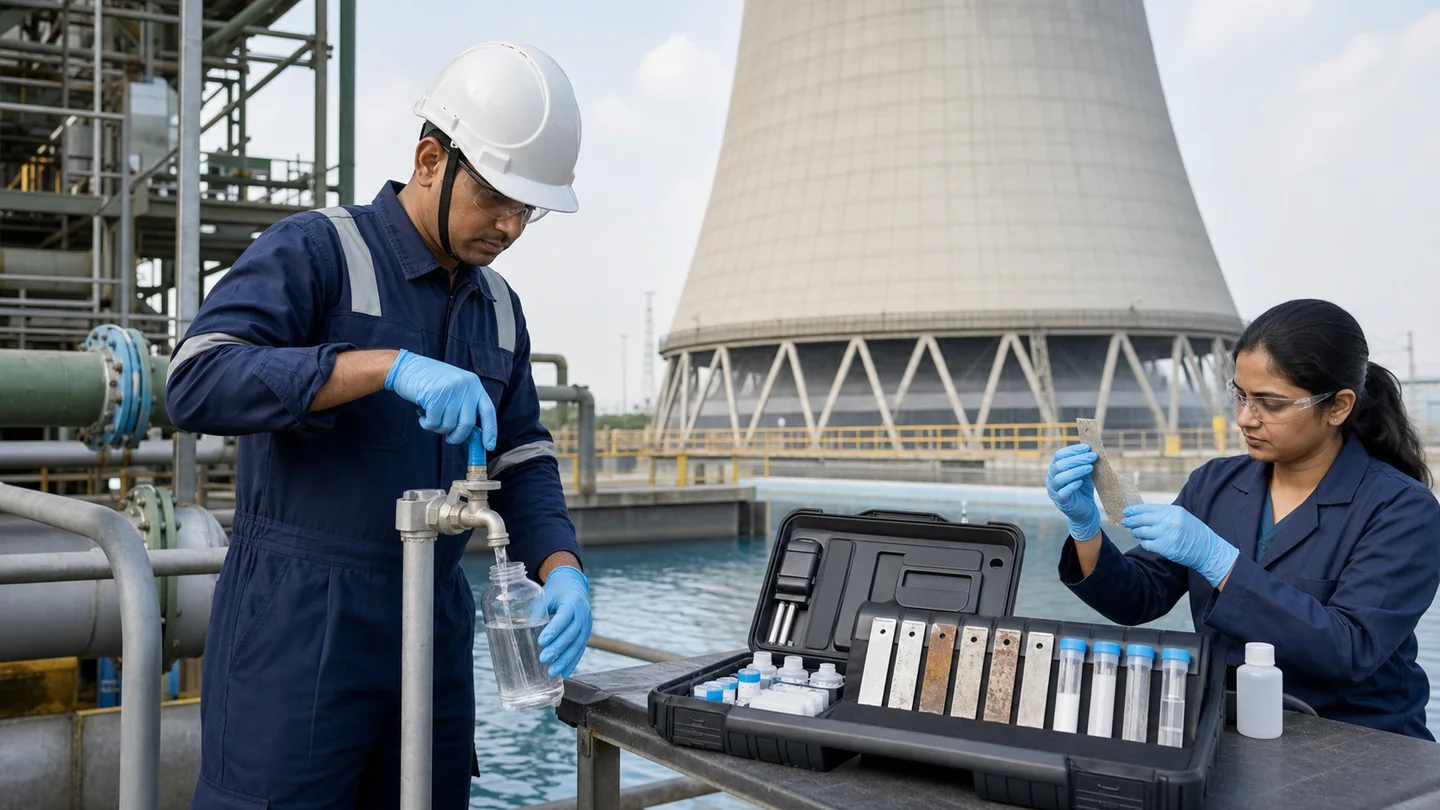
System context
Cooling-water systems and operating applications
Ensuring Optimal Performance:
Identifying Water Quality Parameters:
Preventing Costly Damage:
Optimizing Chemical Treatment:
Regulatory Compliance:
Chiller Water Testing Parameters
- pH
- Conductivity
- Total Dissolved Solids (TDS)
- Total Suspended Solids (TSS)
- Total Hardness
- Alkalinity
- Chloride
- Sulfate
- Calcium
- Magnesium
- Iron
- Microbial Contamination (bacteria, algae, etc.)
- Silicon
Technical review
Common condition and contamination concerns
pH and mineral balance
pH, alkalinity, hardness and dissolved-ion results are reviewed together with the water source and intended use.
Dissolved and suspended material
Dissolved solids, suspended solids and turbidity support review of clarity, treatment and process-related concerns.
Microbiological condition
Microbiological parameters are selected for the water use, sampling point and applicable requirement.
Requirement and sampling context
Interpretation depends on the identified standard, representative sampling, preservation and the time between collection and testing.
Published laboratory capability
Tests and test methods
The methods below are matched to Chem-Tech's controlled technical test lists and published laboratory capability. The final scope is confirmed for the sample, specification and current laboratory capability.
| Test / parameter | Published test method | Technical purpose | Interpretation / high-low context |
|---|---|---|---|
| Elemental Analysis | ASTM D1976 / CTP-T-125 | Reports selected wear, contaminant, additive or composition-related elements. | Higher or lower values require comparison with formulation, metallurgy, process inputs and trend history; one result alone does not establish the source. |
| Calcium | APHA 3500-Ca-B | Measures hardness-forming minerals or their contributing ions. | Higher values can increase scaling tendency; very low values may be relevant to corrosivity or treatment control depending on the application. |
| Total Hardness | APHA 2340-B,C / IS 3025 Part 21 | Measures hardness-forming minerals or their contributing ions. | Higher values can increase scaling tendency; very low values may be relevant to corrosivity or treatment control depending on the application. |
| Chloride | APHA 4500-Cl-B,D / IS 3025 Part 32 | Quantifies the selected dissolved ion or nutrient-related parameter. | A higher or lower result is assessed against the identified water-use requirement and may indicate source, treatment, contamination or process effects. |
| Conductivity | APHA 2510-B / IS 3025 Part 14 | Assesses ionic or dissolved-material content in water. | A higher result generally indicates more dissolved ionic material; significance depends on the water source, treatment and intended use. |
| pH | APHA 4500-H+-B / IS 3025 Part 11 | Measures acidity or alkalinity of the sample under the selected procedure. | A result above or below the required range may affect treatment control, corrosion, scaling, process suitability or product conformity. |
| Sulphate | APHA 4500-SO4-E / IS 3025 Part 24 | Quantifies the selected dissolved ion or nutrient-related parameter. | A higher or lower result is assessed against the identified water-use requirement and may indicate source, treatment, contamination or process effects. |
| Total Alkalinity | APHA 2320-B / IS 3025 Part 23 | Reports selected wear, contaminant, additive or composition-related elements. | Higher or lower values require comparison with formulation, metallurgy, process inputs and trend history; one result alone does not establish the source. |
| Total Dissolved Solids | APHA 2540-C / IS 3025 Part 16 | Assesses ionic or dissolved-material content in water. | A higher result generally indicates more dissolved ionic material; significance depends on the water source, treatment and intended use. |
| Total Suspended Solids | APHA 2540-D / IS 3025 Part 17 | Assesses suspended material or optical cloudiness in water. | A higher result indicates more suspended or light-scattering material and may signal inadequate clarification, contamination or process carryover. |
| Microbial Examination | IS 1622 | Assesses the selected microbiological indicator or organism group. | Detection or a higher count indicates greater microbiological loading; interpretation must follow the applicable water-use requirement and sampling controls. |
Before dispatch
Sample-submission guidance
- Use a clean, secure and appropriately labelled container.
- Provide the sample identity, fluid grade and equipment or system details where applicable.
- Share operating hours, maintenance history, the suspected problem and required specification where available.
- Contact Chem-Tech before dispatch so the laboratory can confirm the sample quantity, container and selected testing scope.
Technical output
Reporting and interpretation
The report records results and methods for the agreed scope. Customer-supplied limits or specifications can be considered when provided before testing.
Results should be reviewed with equipment history, operating conditions and previous data; a laboratory result alone does not guarantee a root-cause diagnosis or remaining service life.
Discuss your requirement
Need more information?
Share the water source, intended use and testing objective with the Chem-Tech team.