
Overview
What is coolant testing?
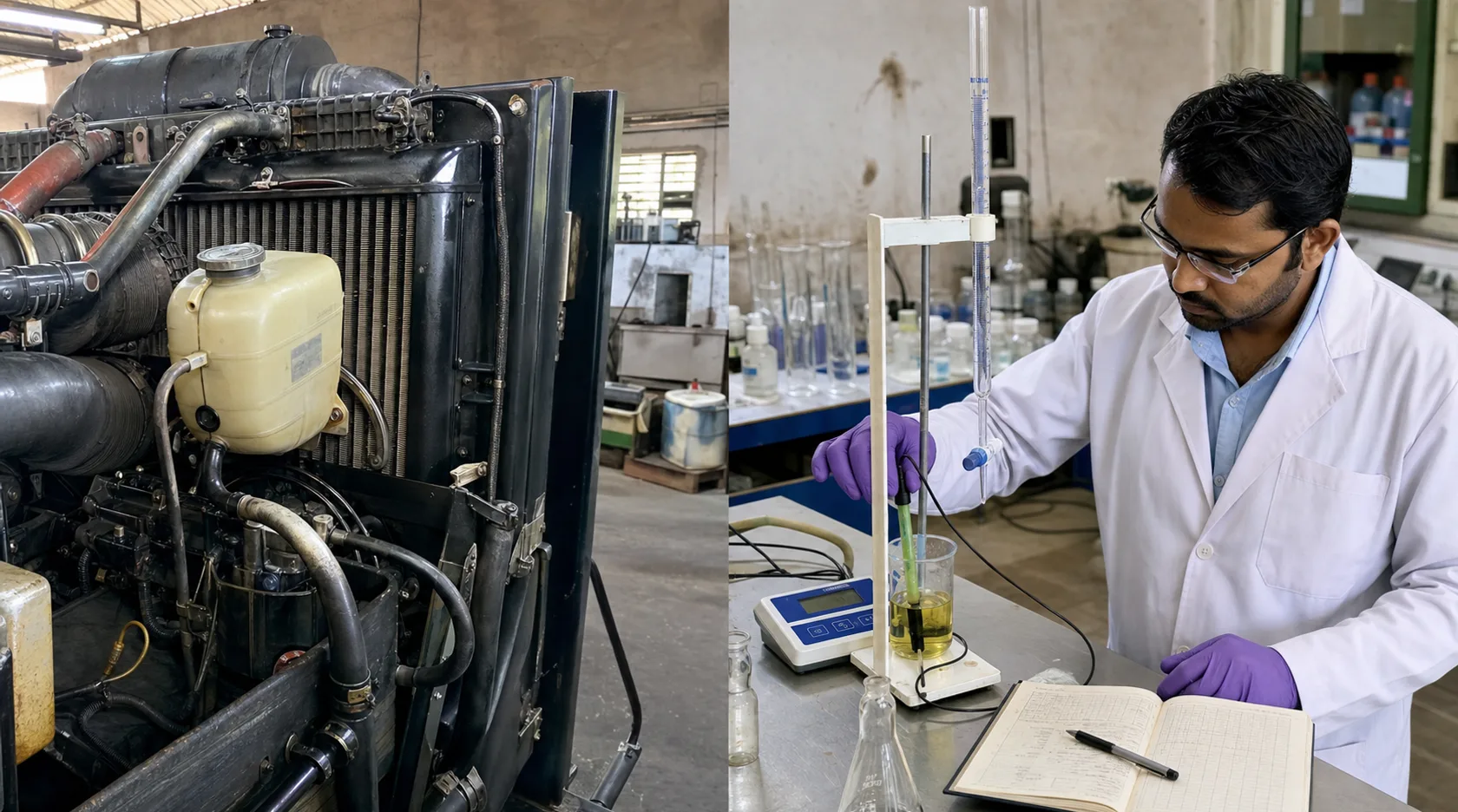
Cooling systems are one of the main constituents of an engine. Their primary function is to protect engines against corrosion, pitting, erosion, and overheating. Thus, the condition and nature of the coolant is of great importance to an engine and can help prevent major problems such as engine failure. Monitoring the physio-chemical properties of a coolant is essential to keep a check on its condition.
Application context
Applications and equipment
Monitor the condition of the coolant under severe operating environments
Check coolant loss
Monitor the quality of water added
Preventive maintenance
Predictive Maintenance
Chem-tech® has the capability to analyse and test:
- Glycol Base Engine Coolants (Antifreeze Coolant) and
- Water Based Engine Coolant
Chem-Tech® conducts Coolant tests in accordance to the internationally accepted ASTM, IS & JIS Specifications.
Technical review
Common condition and contamination concerns
Concentration and dilution
Coolant concentration is reviewed against the product or equipment requirement supplied by the customer.
Reserve alkalinity and pH
pH and reserve-alkalinity results support review of coolant condition and inhibitor reserve.
Contamination
Water quality, dissolved material and cross-contamination are considered according to the selected scope.
Corrosion-related condition
Elemental and appearance checks may support investigation of corrosion-related material in service.
Published laboratory capability
Tests and test methods
The methods below are matched to Chem-Tech's controlled technical test lists and published laboratory capability. The final scope is confirmed for the sample, specification and current laboratory capability.
| Test / parameter | Published test method | Technical purpose | Interpretation / high-low context |
|---|---|---|---|
| Colour | CTP T112 | Records the visible condition and colour of the submitted sample. | Unexpected haze, sediment, separation or colour change may indicate contamination, degradation or sample-handling effects; compare with the product reference. |
| pH | ASTM D1287 | Measures acidity or alkalinity of the sample under the selected procedure. | A result above or below the required range may affect treatment control, corrosion, scaling, process suitability or product conformity. |
| Total Dissolved Solids | CTP T093 | Assesses ionic or dissolved-material content in water. | A higher result generally indicates more dissolved ionic material; significance depends on the water source, treatment and intended use. |
| Chloride Content | ASTM D3634 | Quantifies the selected dissolved ion or nutrient-related parameter. | A higher or lower result is assessed against the identified water-use requirement and may indicate source, treatment, contamination or process effects. |
| Sulphate Content | ASTM D5827 | Quantifies the selected dissolved ion or nutrient-related parameter. | A higher or lower result is assessed against the identified water-use requirement and may indicate source, treatment, contamination or process effects. |
| Nitrate Content | ASTM D5827 | Quantifies the selected dissolved ion or nutrient-related parameter. | A higher or lower result is assessed against the identified water-use requirement and may indicate source, treatment, contamination or process effects. |
| Total Hardness | CTP T164 | Measures hardness-forming minerals or their contributing ions. | Higher values can increase scaling tendency; very low values may be relevant to corrosivity or treatment control depending on the application. |
| Conductivity | CTP T144 | Assesses ionic or dissolved-material content in water. | A higher result generally indicates more dissolved ionic material; significance depends on the water source, treatment and intended use. |
| Elemental Analysis - Wear and Corrosion Metals | ASTM D6130 | Reports selected wear, contaminant, additive or composition-related elements. | Higher or lower values require comparison with formulation, metallurgy, process inputs and trend history; one result alone does not establish the source. |
| Reserve Alkalinity | ASTM D1121 | Reports selected wear, contaminant, additive or composition-related elements. | Higher or lower values require comparison with formulation, metallurgy, process inputs and trend history; one result alone does not establish the source. |
| Foaming Tendency | ASTM D1881 | Assesses foam tendency and, where applicable, foam stability. | Higher foam volume or persistence may indicate poorer air-release behaviour, contamination or additive-related change under the test conditions. |
| Equilibrium Reflux Boiling Point | ASTM D1120 | Characterises volatility and recovery across the boiling range. | Higher or lower recovery temperatures may indicate composition change, contamination or a different product grade when compared with the applicable specification. |
| Freezing Point | ASTM D3321 | Measures or evaluates freezing point under the published method. | A higher or lower result is interpreted against the applicable specification, sample type and available reference data; direction alone does not establish conformity. |
| Water Content | ASTM E203 | Quantifies water or moisture in the submitted material. | A higher result may indicate ingress, condensation, storage or handling contamination; significance depends on the product and applicable limit. |
| Glycol Content | Refractometer | Measures or evaluates glycol content under the published method. | A higher or lower result is interpreted against the applicable specification, sample type and available reference data; direction alone does not establish conformity. |
| Oxalate, Formate and Inorganic Ions | ASTM D5827 | Measures or evaluates oxalate, formate and inorganic ions under the published method. | A higher or lower result is interpreted against the applicable specification, sample type and available reference data; direction alone does not establish conformity. |
Before dispatch
Sample-submission guidance
- Use a clean, secure and appropriately labelled container.
- Provide the sample identity, fluid grade and equipment or system details where applicable.
- Share operating hours, maintenance history, the suspected problem and required specification where available.
- Contact Chem-Tech before dispatch so the laboratory can confirm the sample quantity, container and selected testing scope.
Technical output
Reporting and interpretation
The report records results and methods for the agreed scope. Customer-supplied limits or specifications can be considered when provided before testing.
Results should be reviewed with equipment history, operating conditions and previous data; a laboratory result alone does not guarantee a root-cause diagnosis or remaining service life.
Discuss your requirement
Need more information?
Share the lubricant type, equipment and testing objective with the Chem-Tech team.