
Overview
What is adblue testing?
Testing & Analysis of Adblue is conducted to check the product quality with reference to specifications and potential contamination. DEF or Adblue is required by many modern diesel engine applications. These enginesuse Selective Catalytic Reduction (SCR) technology, to reduce oxides of nitrogen from the exhaust. SCR systems are part of the engine powertrain configuration. Because any contaminants or impurities in the sample will cause the SCR system to malfunction or fail, it is important to maintain DEF quality standards as characterized in the ISO 22241-1 & IS 17042 standards. Chem-Tech® provides a full range of prompt testing and analysis services, conforming to industry standards. Chem-Tech is one of the labs approved by BIS for testing of AdBlue samples as per IS 17042 protocols.
AdBlue Testing as per ISO 22241
AdBlue Testing as per IS 17042
Using our Adblue testing facilities is easy and cost-effective. By using Chem-Tech to routinely test and check the condition of Adblue you can be assured that your material is on specification from production to end user. We can develop individual testing programs to meet your Quality Assurance needs and ensure sample collection, shipping, testing, and reporting is seamless, efficient, and cost-effective.
Chem-Tech’s analysis expertise provides our clients with a multitude of benefits, with world-class testing facilities and global service coverage our independent and impartial specialists can truly satisfy your quality assurance needs with the precision, pace and passion you desire.
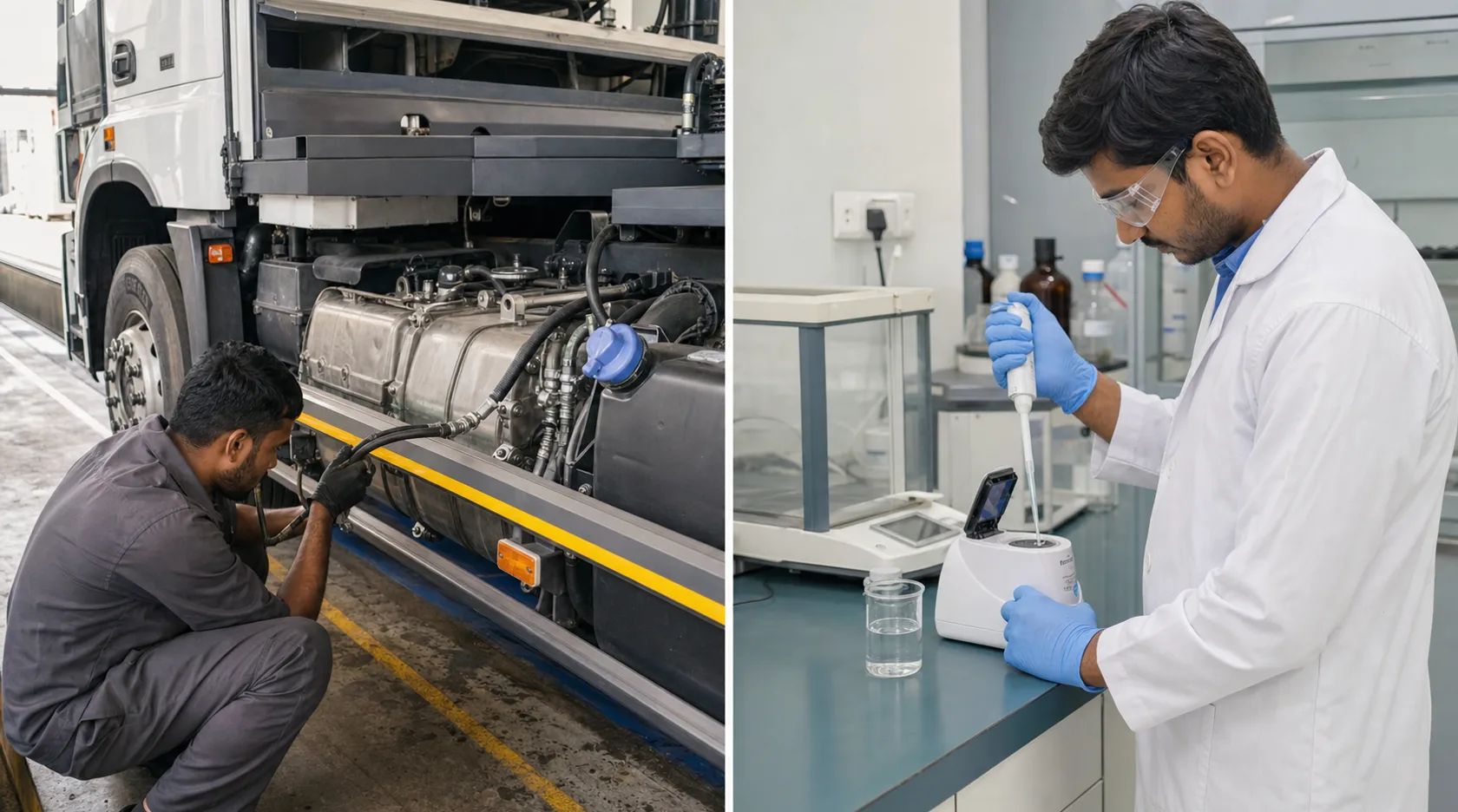
Application context
Applications and equipment
Automotive and heavy-equipment SCR systems
Bulk storage, dispensing and supply-chain quality checks
Product-quality and contamination investigation
Technical review
Common condition and contamination concerns
Urea concentration
Urea concentration is reviewed against the identified AdBlue or AUS 32 specification.
Water quality and dilution
Dilution or unsuitable water can affect composition and is assessed through the confirmed test scope.
Metal and mineral contamination
Trace contamination is reviewed using methods selected for the applicable specification.
Insolubles and product integrity
Insoluble material and related quality parameters support investigation of storage or handling contamination.
Published laboratory capability
Tests and test methods
The methods below are matched to Chem-Tech's controlled technical test lists and published laboratory capability. The final scope is confirmed for the sample, specification and current laboratory capability.
| Test / parameter | Published test method | Technical purpose | Interpretation / high-low context |
|---|---|---|---|
| Urea Content | ISO 22241-2 Annex C | Measures or evaluates urea content under the published method. | A higher or lower result is interpreted against the applicable specification, sample type and available reference data; direction alone does not establish conformity. |
| Refractive Index | ISO 22241-2 Annex C | Measures or evaluates refractive index under the published method. | A higher or lower result is interpreted against the applicable specification, sample type and available reference data; direction alone does not establish conformity. |
| Alkalinity as NH₃ | ISO 22241-2 Annex D | Reports selected wear, contaminant, additive or composition-related elements. | Higher or lower values require comparison with formulation, metallurgy, process inputs and trend history; one result alone does not establish the source. |
| Biuret | ISO 22241-2 Annex E | Measures or evaluates biuret under the published method. | A higher or lower result is interpreted against the applicable specification, sample type and available reference data; direction alone does not establish conformity. |
| Aldehydes | ISO 22241-2 Annex F | Measures or evaluates aldehydes under the published method. | A higher or lower result is interpreted against the applicable specification, sample type and available reference data; direction alone does not establish conformity. |
| Phosphate | ISO 22241-2 Annex H | Measures or evaluates phosphate under the published method. | A higher or lower result is interpreted against the applicable specification, sample type and available reference data; direction alone does not establish conformity. |
| Identity | ISO 22241-2 Annex J | Measures or evaluates identity under the published method. | A higher or lower result is interpreted against the applicable specification, sample type and available reference data; direction alone does not establish conformity. |
Before dispatch
Sample-submission guidance
- Use a clean, secure and appropriately labelled container.
- Provide the sample identity, fluid grade and equipment or system details where applicable.
- Share operating hours, maintenance history, the suspected problem and required specification where available.
- Contact Chem-Tech before dispatch so the laboratory can confirm the sample quantity, container and selected testing scope.
Technical output
Reporting and interpretation
The report records results and methods for the agreed scope. Customer-supplied limits or specifications can be considered when provided before testing.
Results should be reviewed with equipment history, operating conditions and previous data; a laboratory result alone does not guarantee a root-cause diagnosis or remaining service life.
Discuss your requirement
Need more information?
Share the lubricant type, equipment and testing objective with the Chem-Tech team.