
Overview
What is metalworking fluid testing?
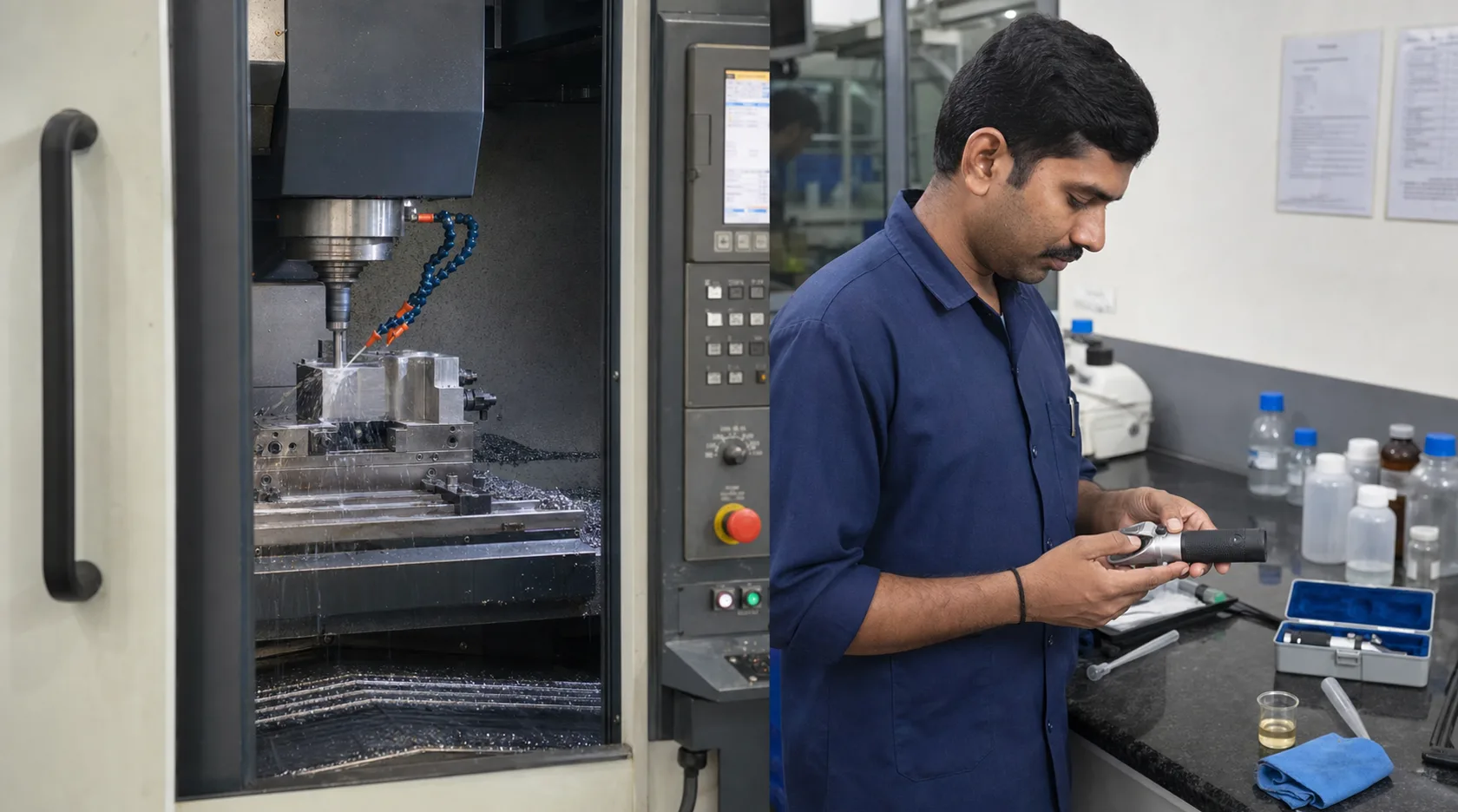
Chem-Tech® Laboratories is a leading provider for Metal Working Fluid analysisServices. Metal Working fluid is a type of coolant and lubricant designed specifically for metalworking and machining processes. There are various kinds of Metal Working fluids, which include oils, oil-water emulsions, pastes, gels, aerosols (mists), etc. Depending on context of use and on which type of cutting fluid is being considered, it may be referred to as Cutting oil, Metal Working Fluid, Coolant, Rust Preventing Oils or Lubricant. Cutting fluids degrade over time due to contaminants entering the lubrication system or sump. Chem-Tech® can test cutting oils for it’s following for its lubrication & rust prevention properties to assist in maintaining the quality of oil.
Application context
Applications and equipment
Neat cutting oils used in machining operations
Water-miscible metalworking fluids and emulsions
In-service fluid monitoring and contamination investigation
Metalworking Products Tested
- Neat Cutting Oil
- Water Soluble Cutting Oil
- Emulsions
Chem-Tech® carries out testing of Metal Working Fluids as per internationally accepted ASTM, ISO & IS Test Standards.
Technical review
Common condition and contamination concerns
Concentration and dilution
Concentration is reviewed against the fluid supplier or process requirement supplied by the customer.
pH and fluid condition
pH and condition indicators support monitoring of water-miscible metalworking fluids.
Tramp oil and contamination
Foreign oil, solids and process contamination are considered according to the investigation objective.
Corrosion and process performance
Corrosion-related testing is selected for the metal, fluid type and process requirement.
Published laboratory capability
Tests and test methods
The methods below are matched to Chem-Tech's controlled technical test lists and published laboratory capability. The final scope is confirmed for the sample, specification and current laboratory capability.
| Test / parameter | Published test method | Technical purpose | Interpretation / high-low context |
|---|---|---|---|
| Kinematic Viscosity at 40 °C and 100 °C | ASTM D445 | Characterises resistance to flow and, where applicable, viscosity response to temperature. | Higher viscosity may accompany oxidation, soot or heavier-product contamination; lower viscosity may accompany dilution, shear or lighter-product mixing. |
| Viscosity Index | ASTM D2270 | Characterises resistance to flow and, where applicable, viscosity response to temperature. | Higher viscosity may accompany oxidation, soot or heavier-product contamination; lower viscosity may accompany dilution, shear or lighter-product mixing. |
| Total Acid Number | ASTM D664 | Measures acidic constituents under the selected method. | An increase from the reference may support oxidation or acidic-contamination review; a single result must be compared with product and service history. |
| Flash Point | ASTM D92 | Determines the temperature at which vapour ignites under the selected procedure. | A lower result may indicate volatile contamination or product change; a higher result is interpreted against the identified grade and method. |
| Moisture Content | ASTM D95 | Quantifies water or moisture in the submitted material. | A higher result may indicate ingress, condensation, storage or handling contamination; significance depends on the product and applicable limit. |
| i-pH Value | ASTM D7946 | Measures acidity or alkalinity of the sample under the selected procedure. | A result above or below the required range may affect treatment control, corrosion, scaling, process suitability or product conformity. |
| Sulphur Content | ASTM D4294 | Quantifies sulphur in the submitted fuel or material. | A higher result may affect specification compliance, emissions-related requirements or process suitability; compare with the identified grade. |
| Elemental Analysis | ASTM D5185 | Reports selected wear, contaminant, additive or composition-related elements. | Higher or lower values require comparison with formulation, metallurgy, process inputs and trend history; one result alone does not establish the source. |
| Copper Strip Corrosion | ASTM D130 | Measures or evaluates copper strip corrosion under the published method. | A higher or lower result is interpreted against the applicable specification, sample type and available reference data; direction alone does not establish conformity. |
| Rust Test | ASTM D665 | Measures or evaluates rust test under the published method. | A higher or lower result is interpreted against the applicable specification, sample type and available reference data; direction alone does not establish conformity. |
| Chlorine Content | ASTM D4929 | Measures or evaluates chlorine content under the published method. | A higher or lower result is interpreted against the applicable specification, sample type and available reference data; direction alone does not establish conformity. |
| Sediments | ASTM D4055 | Assesses particulate, sediment or insoluble contamination in the sample. | A higher result indicates more suspended or insoluble material; acceptability depends on the equipment, product specification and sampling point. |
| Ferrography | ASTM D7680 | Measures or evaluates ferrography under the published method. | A higher or lower result is interpreted against the applicable specification, sample type and available reference data; direction alone does not establish conformity. |
| Particle Count | ISO 4406 / NAS 1638 | Assesses particulate, sediment or insoluble contamination in the sample. | A higher result indicates more suspended or insoluble material; acceptability depends on the equipment, product specification and sampling point. |
| pH | pH Meter | Measures acidity or alkalinity of the sample under the selected procedure. | A result above or below the required range may affect treatment control, corrosion, scaling, process suitability or product conformity. |
| Tramp Oil | Acid Split | Measures or evaluates tramp oil under the published method. | A higher or lower result is interpreted against the applicable specification, sample type and available reference data; direction alone does not establish conformity. |
| Concentration | Acid Split / Refractometer | Measures or evaluates concentration under the published method. | A higher or lower result is interpreted against the applicable specification, sample type and available reference data; direction alone does not establish conformity. |
| Bacteria Count | Kit Method | Assesses the selected microbiological indicator or organism group. | Detection or a higher count indicates greater microbiological loading; interpretation must follow the applicable water-use requirement and sampling controls. |
| Hardness | Titration | Measures hardness-forming minerals or their contributing ions. | Higher values can increase scaling tendency; very low values may be relevant to corrosivity or treatment control depending on the application. |
| Conductivity | Conductivity Meter | Assesses ionic or dissolved-material content in water. | A higher result generally indicates more dissolved ionic material; significance depends on the water source, treatment and intended use. |
Before dispatch
Sample-submission guidance
- Use a clean, secure and appropriately labelled container.
- Provide the sample identity, fluid grade and equipment or system details where applicable.
- Share operating hours, maintenance history, the suspected problem and required specification where available.
- Contact Chem-Tech before dispatch so the laboratory can confirm the sample quantity, container and selected testing scope.
Technical output
Reporting and interpretation
The report records results and methods for the agreed scope. Customer-supplied limits or specifications can be considered when provided before testing.
Results should be reviewed with equipment history, operating conditions and previous data; a laboratory result alone does not guarantee a root-cause diagnosis or remaining service life.
Read Basics of Oil AnalysisDiscuss your requirement
Need more information?
Share the lubricant type, equipment and testing objective with the Chem-Tech team.