
Overview
What is thermic fluid testing?
Chem-Tech® Laboratories is leading laboratory offering Thermic Fluid analysis services to clients all over India. Thermic Fluids or Heat Transfer Fluids are type of Fluid which operates at high operating temperatures to transmit the heat from one point to another. Thermic Fluid analysis is a very crucial part of the manufacturing process or maintenance process to ascertain the quality determine its further usability. Utilizing various sophisticated instruments and test methods Chem-Tech® Laboratories is leading laboratory offering Thermic Fluid analysis services to clients all over India. Thermic Fluids or Heat Transfer Fluids are type of Fluid which operates at high operating temperatures to transmit the heat from one point to another. Thermic Fluid analysis is a very crucial part of the manufacturing process or maintenance process to ascertain the quality determine its further usability. Laboratories carries out analysis of Thermic Fluid , looking for the minute sign of problem or contamination which may lead to breakdown of the fluid and the fluid system.
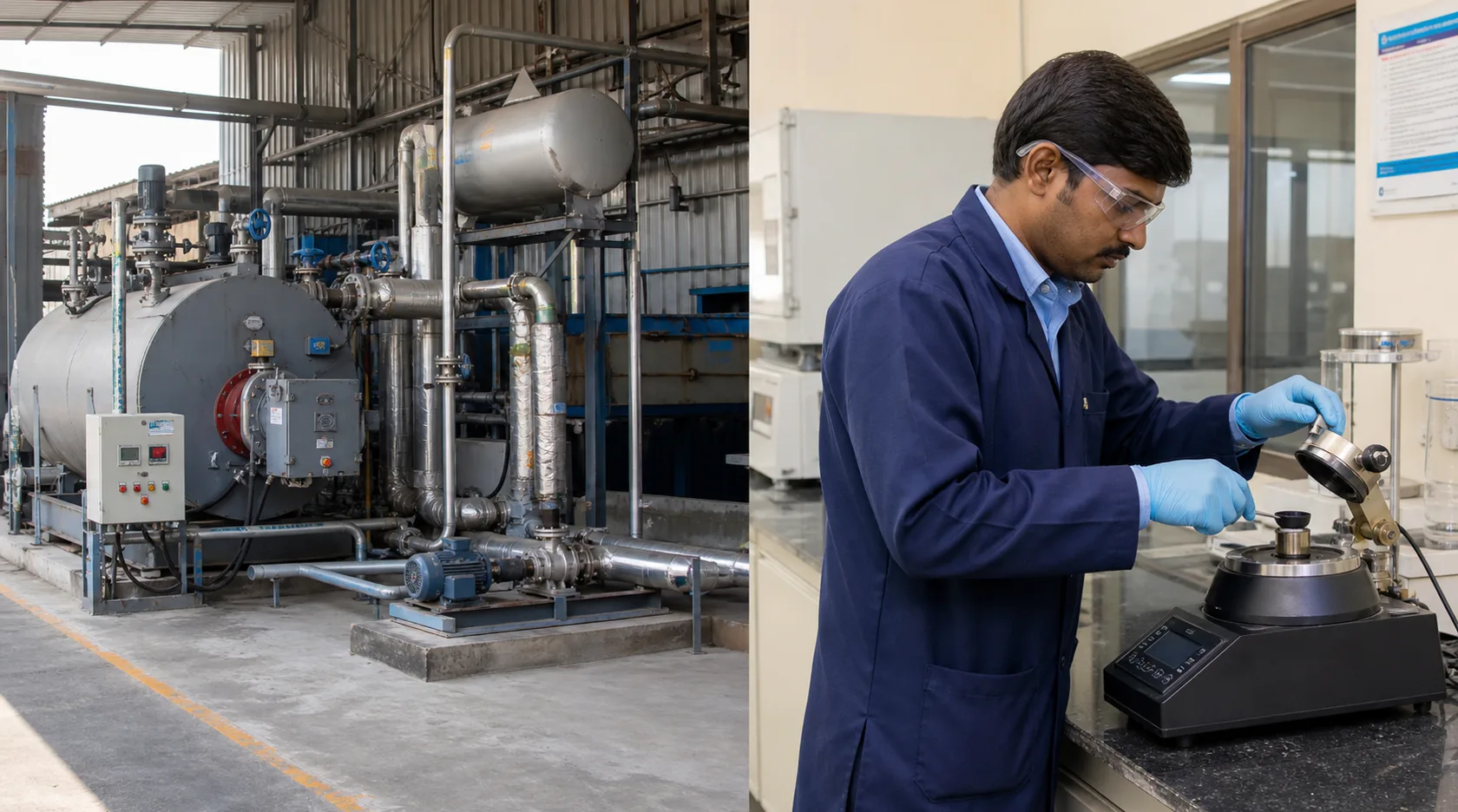
Application context
Applications and equipment
Industrial heat-transfer and thermic-fluid systems
Fresh thermic-fluid quality assessment
In-service monitoring and degradation investigation
Heat transfer fluids in hot oil units degrade over time due to thermal cracking and oxidation. the rate of degradation can be influenced by:
- Improper operating procedures
- Equipment layout
- Malfunctions or contamination from water or other material
- Improper Fluid sumps
Chem-Tech® Oil condition monitoring programs for thermic fluids keeps a check on these factors and improve reliability of the Equipments.
Predictive maintenance of thermic fluids is necessary for:
- Determining condition and further usability of oil
- Determining Thermal Cracking
- Monitoring Oxidation in oil
- Monitoring Water contamination
Technical review
Common condition and contamination concerns
Thermal degradation
Viscosity, acidity and residue parameters support review of heat-transfer-fluid degradation.
Flash-point change
Flash-point testing may indicate changes in light-end content when interpreted with operating history.
Water and insolubles
Water and insoluble material are considered as part of contamination and degradation review.
Continued-service assessment
Results support a condition review but do not by themselves determine remaining service life.
Published laboratory capability
Tests and test methods
The methods below are matched to Chem-Tech's controlled technical test lists and published laboratory capability. The final scope is confirmed for the sample, specification and current laboratory capability.
| Test / parameter | Published test method | Technical purpose | Interpretation / high-low context |
|---|---|---|---|
| Specific Gravity or Density at 15 °C | ASTM D4052 | Measures mass per unit volume and supports product identification or specification review. | A result above or below the applicable range may indicate product mixing, contamination, composition change or an incorrect grade. |
| Kinematic Viscosity at 40 °C | ASTM D7042 | Characterises resistance to flow and, where applicable, viscosity response to temperature. | Higher viscosity may accompany oxidation, soot or heavier-product contamination; lower viscosity may accompany dilution, shear or lighter-product mixing. |
| Kinematic Viscosity at 100 °C | ASTM D7042 | Characterises resistance to flow and, where applicable, viscosity response to temperature. | Higher viscosity may accompany oxidation, soot or heavier-product contamination; lower viscosity may accompany dilution, shear or lighter-product mixing. |
| Viscosity Index | ASTM D2270 | Characterises resistance to flow and, where applicable, viscosity response to temperature. | Higher viscosity may accompany oxidation, soot or heavier-product contamination; lower viscosity may accompany dilution, shear or lighter-product mixing. |
| Ash Content | ASTM D482 | Measures non-combustible residue remaining after controlled combustion. | A higher result indicates more inorganic residue and may affect fuel quality, deposits or specification compliance. |
| Total Acid Number | ASTM D664 | Measures acidic constituents under the selected method. | An increase from the reference may support oxidation or acidic-contamination review; a single result must be compared with product and service history. |
| Flash and Fire Point - COC | ASTM D92 | Determines the temperature at which vapour ignites under the selected procedure. | A lower result may indicate volatile contamination or product change; a higher result is interpreted against the identified grade and method. |
| Conradson Carbon Residue | ASTM D189 | Assesses the tendency to leave carbonaceous residue under the selected procedure. | A higher result indicates greater residue-forming tendency; relevance depends on the fuel grade and application. |
| Insoluble in Hexane | ASTM D893 | Assesses particulate, sediment or insoluble contamination in the sample. | A higher result indicates more suspended or insoluble material; acceptability depends on the equipment, product specification and sampling point. |
| Insoluble in Toluene | ASTM D893 | Assesses particulate, sediment or insoluble contamination in the sample. | A higher result indicates more suspended or insoluble material; acceptability depends on the equipment, product specification and sampling point. |
| Distillation Recovery / Initial Boiling Point | ASTM D86 | Characterises volatility and recovery across the boiling range. | Higher or lower recovery temperatures may indicate composition change, contamination or a different product grade when compared with the applicable specification. |
| Water Content - Potentiometric | ASTM E203 | Quantifies water or moisture in the submitted material. | A higher result may indicate ingress, condensation, storage or handling contamination; significance depends on the product and applicable limit. |
Before dispatch
Sample-submission guidance
- Use a clean, secure and appropriately labelled container.
- Provide the sample identity, fluid grade and equipment or system details where applicable.
- Share operating hours, maintenance history, the suspected problem and required specification where available.
- Contact Chem-Tech before dispatch so the laboratory can confirm the sample quantity, container and selected testing scope.
Technical output
Reporting and interpretation
The report records results and methods for the agreed scope. Customer-supplied limits or specifications can be considered when provided before testing.
Results should be reviewed with equipment history, operating conditions and previous data; a laboratory result alone does not guarantee a root-cause diagnosis or remaining service life.
Read Basics of Oil AnalysisDiscuss your requirement
Need more information?
Share the lubricant type, equipment and testing objective with the Chem-Tech team.