
Overview
What is gasoline testing?
Gasoline testing supports quality, volatility, composition and contamination assessment for automotive fuel and storage investigations. Testing is selected according to the identified gasoline grade and applicable requirement.
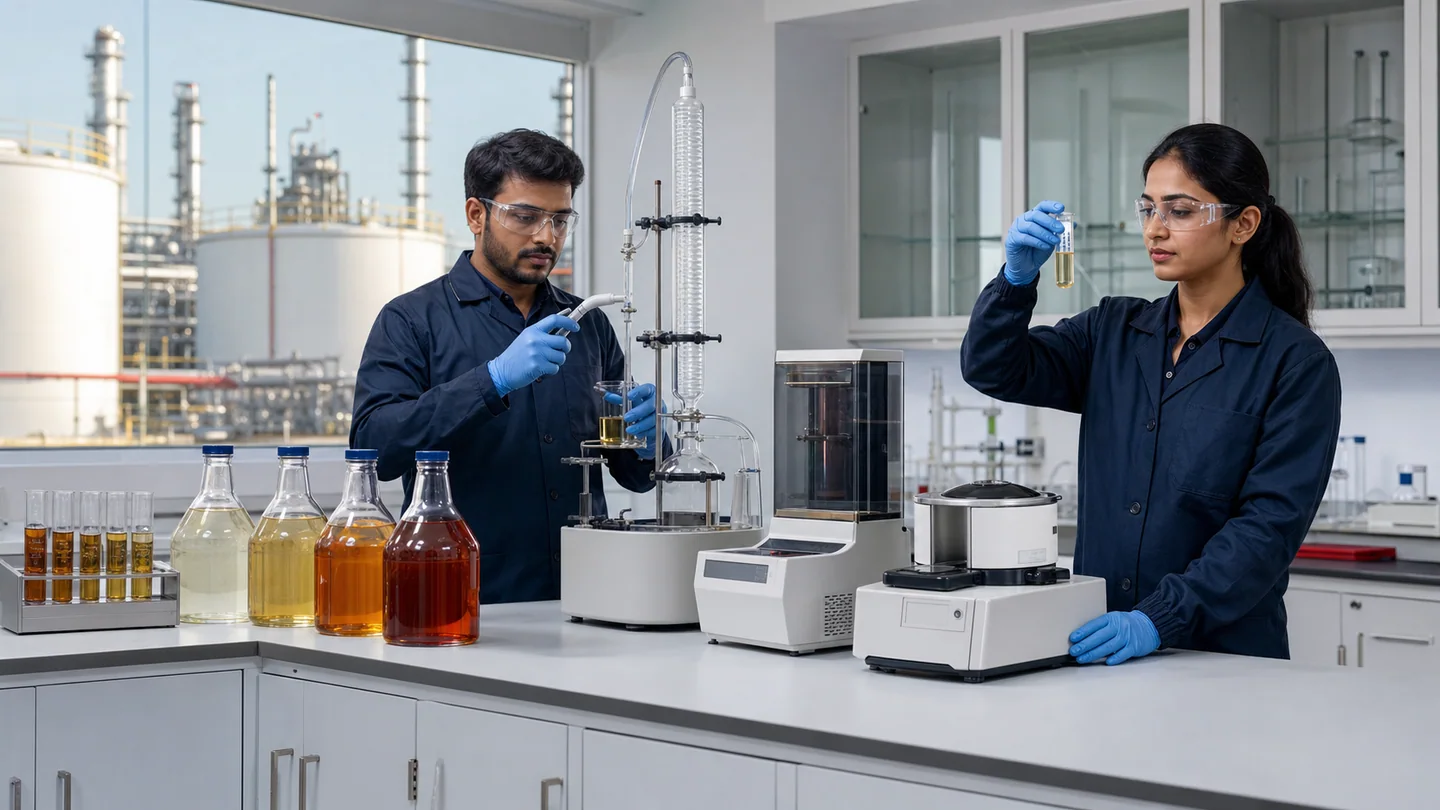
Fuel-use context
Gasoline applications and quality requirements
Automotive gasoline quality assessment
Storage and contamination investigations
Testing against the identified gasoline grade or specification
Technical review
Common condition and contamination concerns
Volatility and distillation
Volatility and distillation parameters are reviewed against the identified gasoline grade.
Octane-related quality
Octane testing is selected where required by the applicable specification or customer objective.
Oxidation and gum formation
Oxidation-stability and gum parameters may support storage-quality investigation.
Water and cross-contamination
Water and composition checks support investigation of contamination or product mixing.
Published laboratory capability
Tests and test methods
The methods below are matched to Chem-Tech's controlled technical test lists and published laboratory capability. The final scope is confirmed for the sample, specification and current laboratory capability.
| Test / parameter | Published test method | Technical purpose | Interpretation / high-low context |
|---|---|---|---|
| Copper Strip Corrosion | ASTM D130 / IS 1448 (P15) | Measures or evaluates copper strip corrosion under the published method. | A higher or lower result is interpreted against the applicable specification, sample type and available reference data; direction alone does not establish conformity. |
| Distillation Recovery with IBP / FBP | ASTM D86 / IS 1448 (P18) | Characterises volatility and recovery across the boiling range. | Higher or lower recovery temperatures may indicate composition change, contamination or a different product grade when compared with the applicable specification. |
| Density / Specific Gravity | ASTM D1298 / ASTM D4052 | Measures mass per unit volume and supports product identification or specification review. | A result above or below the applicable range may indicate product mixing, contamination, composition change or an incorrect grade. |
| Total Sulphur | ASTM D4294 / ASTM D5453 | Quantifies sulphur in the submitted fuel or material. | A higher result may affect specification compliance, emissions-related requirements or process suitability; compare with the identified grade. |
| Water Content | ASTM D6304 / ISO 12937 | Quantifies water or moisture in the submitted material. | A higher result may indicate ingress, condensation, storage or handling contamination; significance depends on the product and applicable limit. |
Before dispatch
Sample-submission guidance
- Use a clean, secure and appropriately labelled container.
- Provide the sample identity, fluid grade and equipment or system details where applicable.
- Share operating hours, maintenance history, the suspected problem and required specification where available.
- Contact Chem-Tech before dispatch so the laboratory can confirm the sample quantity, container and selected testing scope.
Technical output
Reporting and interpretation
The report records results and methods for the agreed scope. Customer-supplied limits or specifications can be considered when provided before testing.
Results should be reviewed with equipment history, operating conditions and previous data; a laboratory result alone does not guarantee a root-cause diagnosis or remaining service life.
Discuss your requirement
Need more information?
Share the fuel type, specification and testing objective with the Chem-Tech team.