
Overview
What is oil condition monitoring and used-oil analysis?
Chem-Tech Laboratories Oil Condition Monitoring (OCM) programmes help clients avoid costly machinery downtime, equipment failures, loss of equipments by tracking changes in equipment lubricant quality. The key to the health of the equipment lies to the effective predictive maintenance programmes that are in place, which ultimately will help increase reliability and reduce cost of ownership. As part of such routine programmes the monitoring of the vessels lubricants will assist Operators and Maintenance workers in making timely decisions relating to the servicing of equipment, maximising the lifespan of engine parts & machinery through Oil testing, grease testing programmes
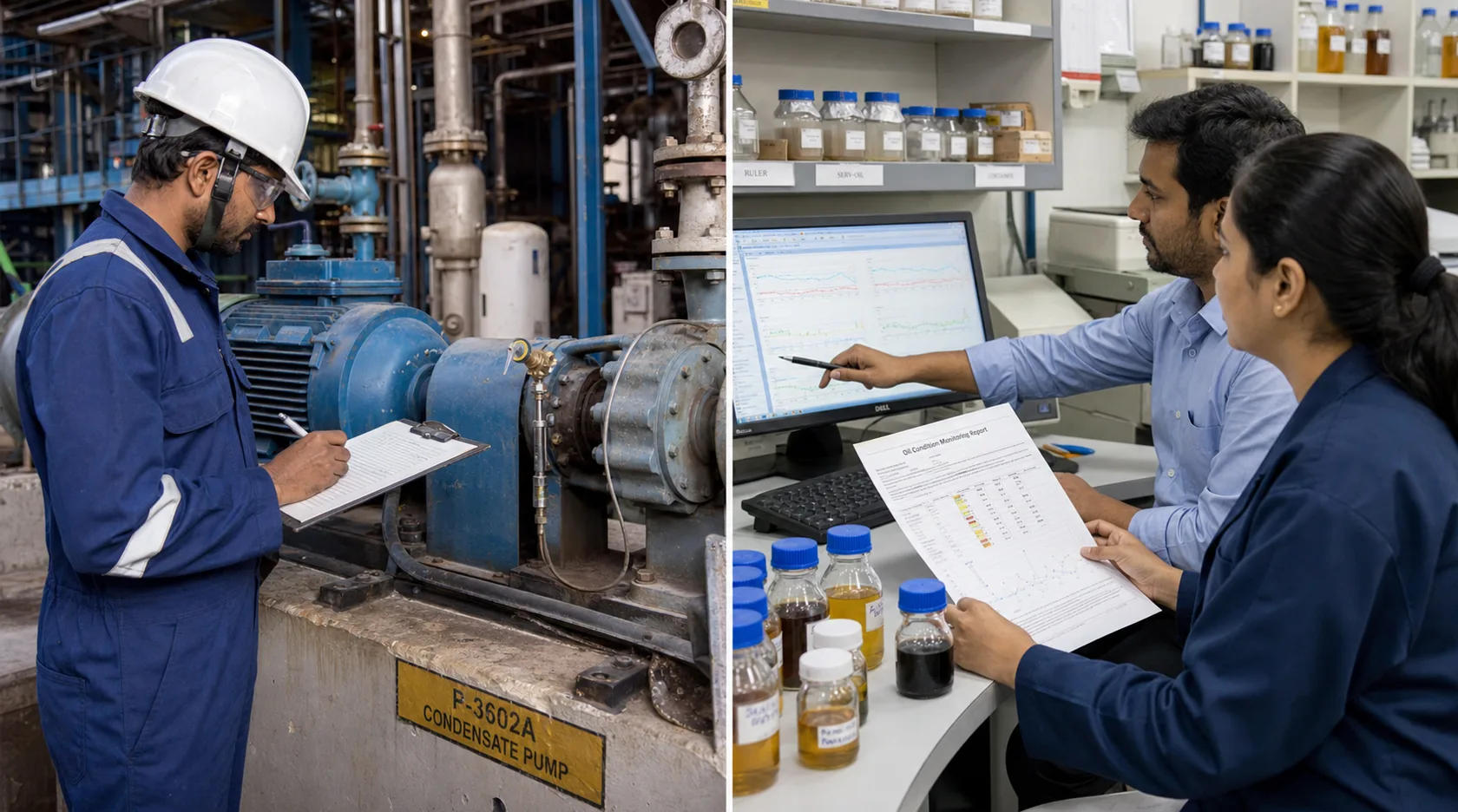
Monitoring context
Equipment and monitoring applications
Avoid Failures
Reduce Maintenance Cost
Increase Equipment Life
Extend operational availability
Reduce maintenance
Improve safety
Industry applications
Oil Condition Monitoring Services for a wide variety of industries
Mining OCM Testing
Construction Machinery OCM Testing
Truck Fleet OCM Testing
Industrial OCM Testing
Marine OCM Testing
Wind Turbine OCM Testing
Power Generation OCM Testing
Automotive Lubricant Testing
Service features
Key Features of Chem-Tech Oil Condition Monitoring Services
24 X 7 access to reports
Diagnosis by Certified Lubrication Professionals
48 Hours Turn Around Time
Trend Analysis
Online Equipment Management
Programme guidance
Start your Oil Condition Monitoring (OCM) Programme
Our testing combines the expertise of the diagnostic engineers with the latest techniques for analyzing lubricating oils, grease & metalworking fluids. Both the physical and chemical characteristics of the lubricants and fluids are checked, identifying information on the wear of metals and the physical properties of the oil itself. We are able to carry out sampling for you, or can provide inexpensive easy-to-use kits. Samples can be shipped after the scope, container and dispatch requirements are confirmed. Turnaround, tribology review and any training requirement are agreed separately for the selected programme.
Programme framework
Oil analysis that connects the sample to the machine
An effective Oil Condition Monitoring programme reviews the lubricant, equipment, operating duty and previous results together. The data helps answer three questions: Is the oil suitable for service? Is contamination present? Is the machine generating unusual wear material?
Lubricant condition
Physical and chemical properties help show viscosity change, reserve depletion and degradation in service.
Contamination control
Water, particles, fuel dilution, soot and external contaminants are reviewed against the oil and operating context.
Equipment wear
Elemental and ferrous-debris data support wear review when compared with metallurgy, maintenance history and earlier results.
Trend-based review
Consistent sampling points, operating hours and repeat data help separate a developing trend from an isolated result.
Managed programme
Six connected stages from maintenance question to verified action
The value of repeat analysis depends on continuity. Asset identity, sampling practice, test scope, trend review and maintenance feedback should remain connected rather than becoming separate records.
- 01
Define the decision
Identify the asset risk, maintenance question and evidence needed before choosing the test scope or interval.
- 02
Register the asset
Preserve the site, equipment, component, lubricant, sampling point and operating-hour identity for every repeat sample.
- 03
Sample consistently
Use a representative point, comparable operating state, clean container and documented sampling procedure.
- 04
Analyse the right signals
Select condition, contamination and wear-related tests for the lubricant, component and monitoring objective.
- 05
Review the trend
Compare the result with the correct baseline, prior samples, intervention history and available operating evidence.
- 06
Act and verify
Assign a controlled next step, record the intervention and resample from the same point when verification is required.
Programme film
See how a controlled OCM workflow fits together
This short Chem-Tech explainer follows the programme from asset registration and sampling through laboratory analysis, trend review, action and verification.

Connected reporting
Keep samples, reports and equipment history in one workflow
Authorised customers can use Chem-Tech's Zylon workflow to support sample submission, progress visibility, report access, trend review, data export and site or equipment organisation. Current features and account access are confirmed during programme onboarding.
- Organise site, asset, component and sample identities.
- Preserve continuity between repeat submissions and reports.
- Review available trends with the maintenance context.
- Export available data for controlled internal follow-up.
Automotive, construction and mining
Mobile-equipment oil testing packages
Packages for engines, hydraulic systems, axles, transmissions, differentials and gear systems used in automotive, construction and mining operations.
Engine Oil — Basic
Routine screening for automotive, construction and mining engines.
- Appearance
- Kinematic Viscosity at 40°C
- Kinematic Viscosity at 100°C
- Viscosity Index
- Water Content
- Total Acid Number
- Total Base Number
- Soot Content
- Elemental Analysis
Engine Oil — Advanced
Expanded engine-oil condition review with degradation and dilution indicators.
- Appearance
- Kinematic Viscosity at 40°C
- Kinematic Viscosity at 100°C
- Viscosity Index
- Water Content
- Total Acid Number
- Total Base Number
- Soot Content
- FTIR — Oxidation / Nitration
- Elemental Analysis
- Fuel Dilution
Engine Oil — Gas Engine
Condition assessment for gas-engine lubricants and their operating environment.
- Appearance
- Kinematic Viscosity at 40°C
- Kinematic Viscosity at 100°C
- Viscosity Index
- Water Content
- Total Acid Number
- Total Base Number
- Soot Content
- FTIR — Oxidation / Nitration
- Elemental Analysis
- i-pH
Hydraulic Oil — Basic
Routine hydraulic-fluid condition and cleanliness screening.
- Appearance
- Kinematic Viscosity at 40°C
- Water Content
- Total Acid Number
- Elemental Analysis
- Particle Count / ISO Cleanliness
Hydraulic Oil — Advanced
Expanded hydraulic-fluid review for cleanliness, degradation and contamination.
- Appearance
- Kinematic Viscosity at 40°C
- Kinematic Viscosity at 100°C
- Viscosity Index
- Water Content
- Total Acid Number
- FTIR — Oxidation / Nitration
- Elemental Analysis
- Particle Count / ISO Cleanliness
Axle Oil
Condition and wear review for axle and final-drive lubricants.
- Appearance
- Kinematic Viscosity at 40°C
- Kinematic Viscosity at 100°C
- Viscosity Index
- Water Content
- Total Acid Number
- Elemental Analysis
- PQ Index
Transmission Oil
Condition and wear review for transmission oils and fluids.
- Appearance
- Kinematic Viscosity at 40°C
- Kinematic Viscosity at 100°C
- Viscosity Index
- Water Content
- Total Acid Number
- Elemental Analysis
- PQ Index
Differential Oil
Condition and wear review for differential and severe-duty gear systems.
- Appearance
- Kinematic Viscosity at 40°C
- Kinematic Viscosity at 100°C
- Viscosity Index
- Water Content
- Total Acid Number
- Elemental Analysis
- PQ Index
Gear Oil
Condition and wear review for industrial and automotive gear oils.
- Appearance
- Kinematic Viscosity at 40°C
- Kinematic Viscosity at 100°C
- Viscosity Index
- Water Content
- Total Acid Number
- Elemental Analysis
- PQ Index
Wind-energy assets
Wind-turbine oil testing packages
Focused monitoring scopes for wind-turbine hydraulic systems and gearbox lubricants.
Wind Turbine Hydraulic Oil — Advanced
Hydraulic-fluid condition and cleanliness monitoring for wind-turbine systems.
- Appearance
- Kinematic Viscosity at 40°C
- Kinematic Viscosity at 100°C
- Viscosity Index
- Water Content
- Total Acid Number
- FTIR — Oxidation / Nitration
- Elemental Analysis
- Particle Count / ISO Cleanliness
Wind Turbine Gear Oil
Condition and ferrous-wear screening for wind-turbine gearbox lubricants.
- Appearance
- Kinematic Viscosity at 40°C
- Kinematic Viscosity at 100°C
- Viscosity Index
- Water Content
- Total Acid Number
- Elemental Analysis
- PQ Index
Industrial plant and machinery
Industrial oil testing packages
Condition-monitoring packages for stationary engines, hydraulic systems, gearboxes, compressors, turbines, thermic-fluid systems and quenching operations.
Industrial Engine Oil
Routine condition monitoring for industrial engine lubricants.
- Appearance
- Kinematic Viscosity at 100°C
- Water Content
- Total Acid Number
- Total Base Number
- Soot Content
- FTIR — Oxidation / Nitration
- Elemental Analysis
Industrial Gas Engine Oil
Condition monitoring for gas-engine oils, including reserve and acidity indicators.
- Appearance
- Kinematic Viscosity at 100°C
- Water Content
- Total Acid Number
- Total Base Number
- Soot Content
- FTIR — Oxidation / Nitration
- Elemental Analysis
- i-pH
Industrial Hydraulic Oil — Basic
Routine hydraulic-fluid condition and cleanliness screening.
- Appearance
- Kinematic Viscosity at 40°C
- Water Content
- Total Acid Number
- Elemental Analysis
- i-pH
- Particle Count / ISO Cleanliness
Industrial Hydraulic Oil — Advanced
Expanded hydraulic-fluid monitoring for degradation, separation and cleanliness.
- Appearance
- Kinematic Viscosity at 40°C
- Water Content
- Total Acid Number
- FTIR — Oxidation / Nitration
- Elemental Analysis
- Foaming Tendency
- Water Separability
- Particle Count / ISO Cleanliness
Industrial Gear Oil — Basic
Routine condition and ferrous-wear screening for industrial gear oils.
- Appearance
- Kinematic Viscosity at 40°C
- Water Content
- Total Acid Number
- Elemental Analysis
- PQ Index
Industrial Gear Oil — Advanced
Expanded gear-oil monitoring with cleanliness and ferrous-debris indicators.
- Appearance
- Kinematic Viscosity at 40°C
- Water Content
- Total Acid Number
- Elemental Analysis
- Particle Count / ISO Cleanliness
- PQ Index
Industrial Gear Oil — Advanced + Ferrography
Advanced gear-oil review with analytical ferrography for wear-particle examination.
- Appearance
- Kinematic Viscosity at 40°C
- Water Content
- Total Acid Number
- Elemental Analysis
- Particle Count / ISO Cleanliness
- PQ Index
- Analytical Ferrography
Industrial Compressor Oil — Basic
Routine condition monitoring for industrial compressor lubricants.
- Appearance
- Kinematic Viscosity at 40°C
- Kinematic Viscosity at 100°C
- Viscosity Index
- Water Content
- Total Acid Number
- Elemental Analysis
Industrial Turbine Oil
Routine turbine-oil monitoring for condition, contamination and separation behaviour.
- Appearance
- Kinematic Viscosity at 40°C
- Water Content
- Total Acid Number
- Elemental Analysis
- Foaming Tendency
- Water Separability
- Particle Count / ISO Cleanliness
- Flash Point
Industrial Turbine Oil — Advanced
Expanded turbine-oil review with oxidation, cleanliness and separation indicators.
- Appearance
- Kinematic Viscosity at 40°C
- Water Content
- Total Acid Number
- FTIR — Oxidation / Nitration
- Elemental Analysis
- Foaming Tendency
- Water Separability
- Oxidation Stability
- Particle Count / ISO Cleanliness
- Flash Point
Industrial Thermic Fluid
Condition monitoring for in-service heat-transfer fluids.
- Appearance
- Kinematic Viscosity at 40°C
- Water Content
- Total Acid Number
- Flash Point
- Sediments
- Initial Boiling Point
Industrial Quenching Oil
Condition and performance monitoring for heat-treatment quenching oils.
- Appearance
- Kinematic Viscosity at 40°C
- Kinematic Viscosity at 100°C
- Viscosity Index
- Water Content
- Total Acid Number
- Cooling Curve
- Flash Point
- Sediments
Programme support
Oil-analysis and allied services
Oil testing services directory
Review Chem-Tech's oil-testing pathways for fresh and in-service lubricants, contamination assessment and equipment-condition analysis.
Explore oil testing servicesSampling and sample identification
Use consistent sampling points and provide equipment, lubricant, operating-hour and maintenance information for meaningful comparison.
Review sampling guidanceOnline submission and reporting
Submit samples, follow progress and access reports through Chem-Tech's connected reporting workflow.
Explore reportingTrend analysis and technical review
Review repeat results with operating and maintenance history to support condition-based maintenance decisions.
Read the oil-analysis guideOil-analysis programme training
Support maintenance and reliability teams with programme setup, sampling discipline and result-interpretation fundamentals.
View training supportFrequently asked questions
Planning and operating an OCM programme
What is the difference between one oil test and an OCM programme?
A single test describes the submitted sample against the agreed scope. An OCM programme adds a stable asset identity, repeatable sampling point, planned interval, comparable test set, historical trend and a documented response to exceptions.
Which information should be registered for each component?
Record the site, asset, component, lubricant product and grade, sampling point, equipment hours, oil hours, top-up history, filter changes and relevant maintenance events. The exact fields depend on the programme and equipment.
How often should oil samples be collected?
Sampling frequency should be risk-based and consistent. Consider component criticality, duty severity, environment, reservoir size, OEM guidance, failure history, access and trend stability. A universal interval is rarely appropriate for every asset.
Can Chem-Tech provide sample containers or a sampling plan?
Container, sample-volume and dispatch requirements can be confirmed with the agreed scope. Ask the Chem-Tech team about a recurring sampling plan and available programme support before collection.
Does an abnormal result identify the exact failing part?
Not by itself. Oil analysis provides lubricant-condition, contamination and wear-related evidence. A specific diagnosis may require metallurgy, trend history, inspection, filter or debris review, vibration, temperature, pressure, telematics or other maintenance evidence.
How does the Zylon portal support an OCM programme?
Authorised users can use Chem-Tech's connected reporting workflow for sample submission, status visibility, report access, trend review, data export and site or equipment organisation. Current account features and access are confirmed during onboarding.
What should happen when a result is outside the expected pattern?
First verify sample identity, sampling quality, lubricant and maintenance context. Review the result pattern and history, then assign the appropriate next step—such as resampling, inspection, filtration, contamination control or targeted diagnostics—before changing a service interval.
What should be recorded after an oil change or repair?
Record the date, action, lubricant or filter change, quantity added, component work and any flushing or purification. A planned follow-up sample should be treated as the start of a documented post-intervention trend phase.
Technical review
Common condition and contamination concerns
Lubricant degradation
Viscosity, acidity and FTIR indicators support review of lubricant change during service.
Water and external contamination
Water, particles and contaminant elements are interpreted with the equipment and sampling context.
Wear-related material
Elemental and ferrous-debris results support condition review when trend history is available.
Trend consistency
Comparable sampling points, operating conditions and intervals are important for meaningful trend review.
Published laboratory capability
Tests and test methods
The methods below are matched to Chem-Tech's controlled technical test lists and published laboratory capability. The final scope is confirmed for the sample, specification and current laboratory capability.
| Test / parameter | Published test method | Technical purpose | Interpretation / high-low context |
|---|---|---|---|
| Appearance | CTP T 112 | Records the visible condition and colour of the submitted sample. | Unexpected haze, sediment, separation or colour change may indicate contamination, degradation or sample-handling effects; compare with the product reference. |
| Density / Specific Gravity | ASTM D1298 / ASTM D4052 | Measures mass per unit volume and supports product identification or specification review. | A result above or below the applicable range may indicate product mixing, contamination, composition change or an incorrect grade. |
| Kinematic Viscosity | ASTM D445 / ASTM D7042 | Characterises resistance to flow and, where applicable, viscosity response to temperature. | Higher viscosity may accompany oxidation, soot or heavier-product contamination; lower viscosity may accompany dilution, shear or lighter-product mixing. |
| Viscosity Index | ASTM D2270 | Characterises resistance to flow and, where applicable, viscosity response to temperature. | Higher viscosity may accompany oxidation, soot or heavier-product contamination; lower viscosity may accompany dilution, shear or lighter-product mixing. |
| Water Content | ASTM E203 / ASTM D1744 / ASTM D6304 | Quantifies water or moisture in the submitted material. | A higher result may indicate ingress, condensation, storage or handling contamination; significance depends on the product and applicable limit. |
| Flash & Fire Point (COC) | ASTM D92 | Determines the temperature at which vapour ignites under the selected procedure. | A lower result may indicate volatile contamination or product change; a higher result is interpreted against the identified grade and method. |
| Total Base Number | ASTM D4739 / ASTM D2896 | Measures reserve alkalinity in applicable lubricants. | A lower result relative to fresh oil or trend data may indicate reserve depletion; an unexpectedly high value may indicate a different formulation or mixing. |
| Total Acid Number | ASTM D664 / ASTM D974 | Measures acidic constituents under the selected method. | An increase from the reference may support oxidation or acidic-contamination review; a single result must be compared with product and service history. |
| Elemental Analysis by ICP | ASTM D5185 / ASTM D4951 | Reports selected wear, contaminant, additive or composition-related elements. | Higher or lower values require comparison with formulation, metallurgy, process inputs and trend history; one result alone does not establish the source. |
| Particle Count / Cleanliness | NAS 1638 / ISO 4406 | Assesses particulate, sediment or insoluble contamination in the sample. | A higher result indicates more suspended or insoluble material; acceptability depends on the equipment, product specification and sampling point. |
| Foaming Tendency & Stability | ASTM D892 | Assesses foam tendency and, where applicable, foam stability. | Higher foam volume or persistence may indicate poorer air-release behaviour, contamination or additive-related change under the test conditions. |
| Water Separability | ASTM D1401 | Assesses separation behaviour between oil and water. | Longer separation time or persistent emulsion may indicate reduced water-separation performance; compare with the applicable product requirement. |
| Soot Content | ASTM D7686 | Measures combustion-derived soot in used engine oil. | A higher result indicates greater soot loading and should be reviewed with engine condition, oil hours and viscosity change. |
| Fuel Dilution | ASTM D7593 | Assesses fuel contamination in used engine oil. | A higher result indicates more fuel in the lubricant and may be associated with viscosity reduction; operating information is needed for diagnosis. |
| PQ Index | ASTM D8184 | Measures or evaluates pq index under the published method. | A higher or lower result is interpreted against the applicable specification, sample type and available reference data; direction alone does not establish conformity. |
| FTIR Condition Monitoring | ASTM E2412 | Assesses oxidation stability or condition-related spectral indicators. | Greater oxidation-related change may indicate degradation; stability results and spectral trends must be interpreted using the applicable method and reference. |
| Pour Point | ASTM D97 | Assesses low-temperature flow or operability characteristics. | A higher temperature generally indicates poorer low-temperature behaviour; compare with the climatic and product requirement. |
| Sulphur Content | ASTM D4294 | Quantifies sulphur in the submitted fuel or material. | A higher result may affect specification compliance, emissions-related requirements or process suitability; compare with the identified grade. |
| Ash Content | ASTM D482 | Measures non-combustible residue remaining after controlled combustion. | A higher result indicates more inorganic residue and may affect fuel quality, deposits or specification compliance. |
| Conradson Carbon Residue | ASTM D189 | Assesses the tendency to leave carbonaceous residue under the selected procedure. | A higher result indicates greater residue-forming tendency; relevance depends on the fuel grade and application. |
| Insolubles | ASTM D893 | Assesses particulate, sediment or insoluble contamination in the sample. | A higher result indicates more suspended or insoluble material; acceptability depends on the equipment, product specification and sampling point. |
| Saponification Value | ASTM D94 | Measures or evaluates saponification value under the published method. | A higher or lower result is interpreted against the applicable specification, sample type and available reference data; direction alone does not establish conformity. |
| Analytical Ferrography | ASTM D7690 | Measures or evaluates analytical ferrography under the published method. | A higher or lower result is interpreted against the applicable specification, sample type and available reference data; direction alone does not establish conformity. |
| Cooling Curve Analysis | ASTM D6200 | Measures or evaluates cooling curve analysis under the published method. | A higher or lower result is interpreted against the applicable specification, sample type and available reference data; direction alone does not establish conformity. |
| Distillation Recovery / Initial Boiling Point | ASTM D86 | Characterises volatility and recovery across the boiling range. | Higher or lower recovery temperatures may indicate composition change, contamination or a different product grade when compared with the applicable specification. |
Before dispatch
Sample-submission guidance
- Use a clean, secure and appropriately labelled container.
- Provide the sample identity, fluid grade and equipment or system details where applicable.
- Share operating hours, maintenance history, the suspected problem and required specification where available.
- Contact Chem-Tech before dispatch so the laboratory can confirm the sample quantity, container and selected testing scope.
Technical output
Reporting and interpretation
The report records results and methods for the agreed scope. Customer-supplied limits or specifications can be considered when provided before testing.
Results should be reviewed with equipment history, operating conditions and previous data; a laboratory result alone does not guarantee a root-cause diagnosis or remaining service life.
Discuss your requirement
Need more information?
Share the lubricant type, equipment and testing objective with the Chem-Tech team.