
Overview
What is turbine oil testing?
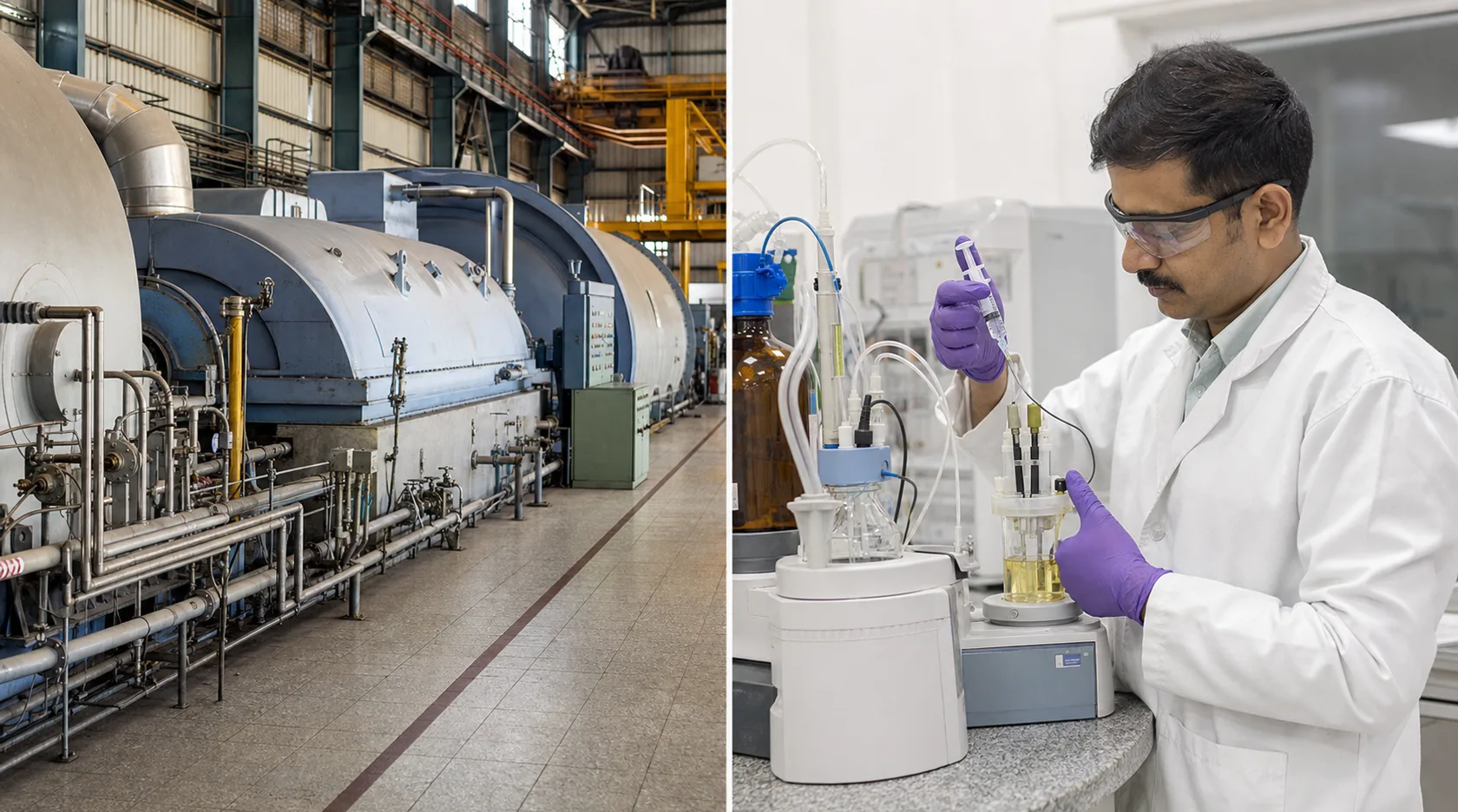
Chem-Tech treats turbine oil as a distinct oil-analysis application. The turbine-oil parameter set includes appearance, viscosity, viscosity index, acid number, oxidation and nitration indicators, water, particle count, elemental analysis, foaming tendency, water separability, membrane patch colorimetry and oxidation stability.
Turbine lubricants may remain in service for extended periods, making consistent sampling context and historical comparison particularly important. The laboratory scope should be selected from the turbine type, lubricant, operating conditions, maintenance question and any customer or equipment requirement supplied for review.
Application context
Applications and equipment
Steam turbine lubrication systems
Gas turbine lubrication systems
Hydro turbine lubrication systems
Reservoir and circulating-oil systems
Fresh-oil assessment and in-service trend monitoring
Testing rationale
Why turbine oil testing is required
Turbine-oil analysis can bring together several types of evidence. Viscosity and acid number address aspects of bulk-oil condition; water and particle count address contamination and cleanliness; elemental data supports a wear, contamination and additive review; and performance tests can address foaming, water separation or oxidation behaviour.
A change in one result does not by itself establish the cause or required maintenance action. Results should be reviewed with previous samples, lubricant age, reservoir history, filtration changes, operating temperature, top-up practices and observations from the turbine system.
Technical review
Common condition and contamination concerns
Oxidation and acidity
Acid number, FTIR indicators and oxidation-stability testing provide different views of lubricant change.
Water and separation behaviour
Water content and water separability support different parts of a moisture or demulsibility investigation.
Cleanliness
Particle count provides cleanliness information that should be compared with the applicable system requirement.
Deposits and varnish-related material
Membrane Patch Colorimetry is present in the approved capability list and may support an appropriate deposit-risk investigation.
Published laboratory capability
Tests and test methods
The methods below are matched to Chem-Tech's controlled technical test lists and published laboratory capability. The final scope is confirmed for the sample, specification and current laboratory capability.
| Test / parameter | Published test method | Technical purpose | Interpretation / high-low context |
|---|---|---|---|
| Appearance | CTP T 112 | Records visible sample condition. | May identify haze, sediment, discolouration or a change requiring further review. |
| Kinematic viscosity and viscosity index | ASTM D445 / ASTM D7042 | Characterises lubricant flow behaviour and temperature response. | Supports comparison with a reference oil or supplied requirement. |
| Total Acid Number | ASTM D664 / ASTM D974 | Measures acidic constituents under the selected method. | May support review of oxidation-related change when a baseline is available. |
| Water content | ASTM E203 / ASTM D1744 / ASTM D6304 | Quantifies water in the turbine-oil sample. | Supports investigation of ingress, condensation or separation concerns. |
| Particle count and cleanliness code | NAS 1638 / ISO 4406 | Reports particles across defined size bands. | Provides cleanliness data for comparison with an applicable system target. |
| Elemental analysis | ASTM D5185 / ASTM D6595 | Reports selected wear, contaminant and additive elements. | Supports review with equipment materials, lubricant formulation and trend history. |
| Foaming tendency and stability | ASTM D892 | Assesses foam response under the selected procedure. | Supports investigation of foaming behaviour where relevant. |
| Water separability | ASTM D1401 | Assesses separation of oil and water. | Supports review of demulsibility performance under the selected procedure. |
| Membrane Patch Colorimetry | ASTM D7843 | Evaluates the colour of insoluble material collected on a membrane. | May support an appropriate varnish or deposit-risk review. |
| Oxidation stability | ASTM D2272 | Assesses oxidation resistance under the selected laboratory procedure. | Provides a controlled test result that must be interpreted with service history and oil condition. |
Before dispatch
Sample-submission guidance
- Use a clean, secure and appropriately labelled container. Identify the sample, lubricant grade and the equipment or system from which it was collected.
- Where available, provide operating hours, oil-change history, top-up information, the suspected problem, previous results and the required specification or parameters.
- The required sample quantity and container depend on the selected test scope and oil type. Contact Chem-Tech before dispatch so the laboratory can confirm the requirement.
Technical output
Reporting and interpretation
The report records the agreed test results and the methods used for the selected scope. Customer-supplied limits or specifications can be considered where they are provided before testing.
Results can support condition assessment and investigation when reviewed with equipment history, operating conditions and previous test data. A laboratory result alone should not be treated as a guaranteed root-cause diagnosis or remaining-life prediction.
Read Basics of Oil AnalysisDiscuss your requirement