
Technical perspective
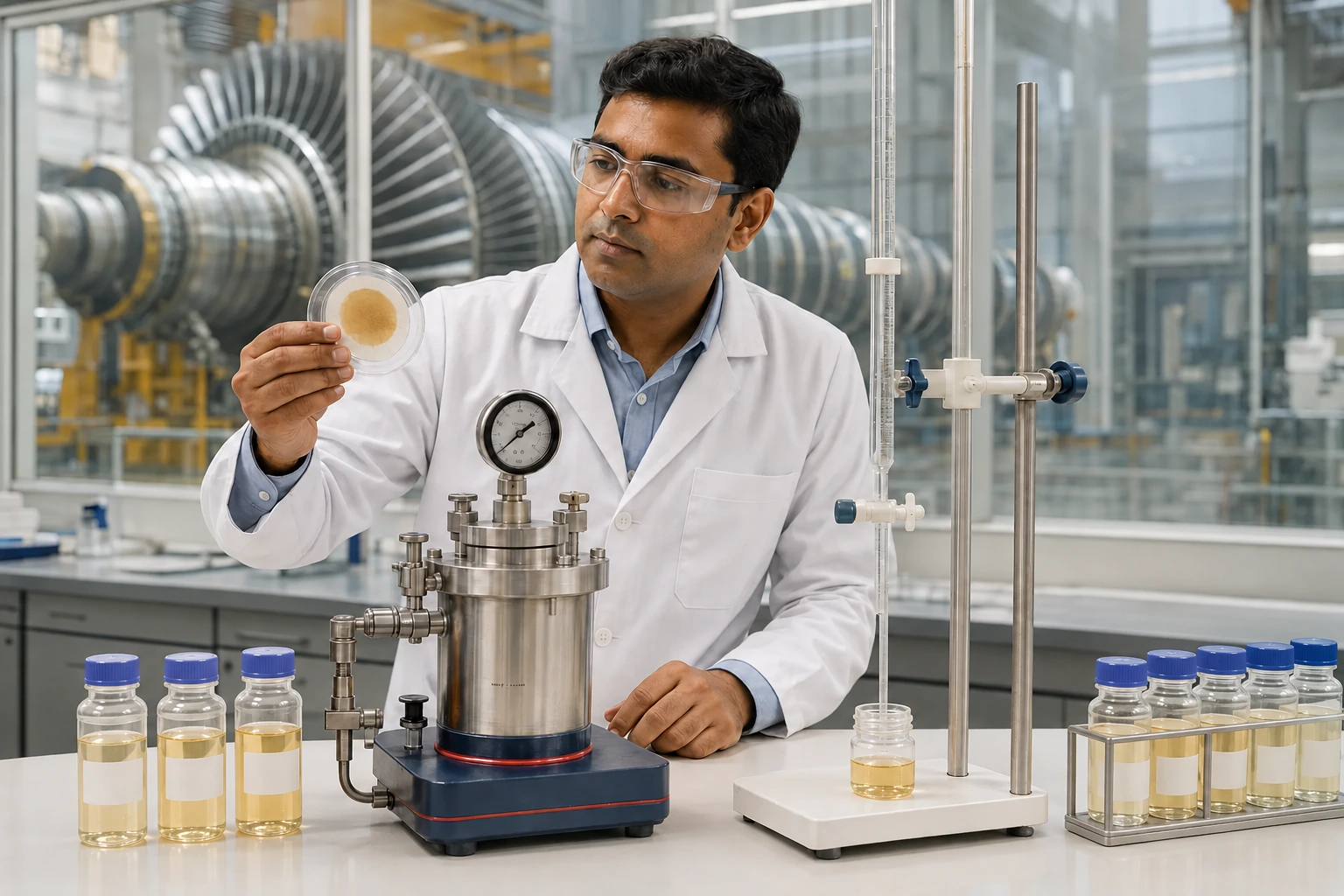
Turbine oil condition cannot be reduced to a single 'life remaining' number. Membrane patch colorimetry addresses insoluble colour bodies, RPVOT assesses oxidation stability under defined test conditions, acid number tracks acidic change, and water separability tests the oil's ability to separate from water. These results can move differently because they represent different aspects of oil and system behaviour.
Chem-Tech builds turbine-oil packages around the maintenance decision: establish a baseline, monitor ageing, investigate varnish or water problems, evaluate a top-up, or plan an outage. The package also includes viscosity, water, particles and wear evidence so a degradation interpretation is not made in isolation.
Article section
Avoid treating unlike indicators as interchangeable
A low or declining RPVOT result does not directly measure deposits already present. A rising MPC trend does not by itself show how much oxidation reserve remains. TAN can stay modest while varnish symptoms develop, and a poor demulsibility result may be driven by contamination or additive disturbance rather than oxidation alone.
Use the oil's formulation, service history and previous results. Newer or different turbine-oil technologies may require method selection and limits that are not identical to a legacy mineral-oil programme.
- MPC trend increases while servo-valve or filter symptoms emerge.
- Water separation slows or persistent emulsions appear after ingress.
- RPVOT or TAN changes after top-up, high temperature or long service.
- Oil replacement is being considered without a complete condition and system review.
Article section
Assign each test a specific maintenance question
MPC by ASTM D7843 supports varnish-potential trending. RPVOT by ASTM D2272 provides an oxidation-stability comparison under accelerated conditions. TAN by ASTM D664 or D974 indicates acid-related change. Water separability by ASTM D1401 measures separation behaviour under the method conditions.
Add viscosity, water, FTIR, particle count and wear metals to capture contamination and mechanical condition. Review top-ups and purification because they can alter several indicators without resetting the condition of surfaces or the full system charge.
MPC
Tracks membrane-patch colour bodies when sampling and preparation are kept consistent.
RPVOT
Compares oxidation stability under defined accelerated conditions; it is not a calendar-life prediction.
TAN
Provides an acid-number trend that needs a product baseline and method consistency.
Demulsibility
Assesses water-separation behaviour relevant to systems exposed to water ingress.
Article section
Indicative turbine-oil condition packages
The panel is selected for the oil type, turbine design, known failure modes and historical baseline. Not every advanced test is necessary at every interval.
| Package | Use when | Indicative tests and methods | Decision supported |
|---|---|---|---|
| Routine condition | Scheduled operating trend | Viscosity — ASTM D445/D7042; TAN — ASTM D664/D974; water — ASTM D6304; particle count — ISO 4406; ICP — ASTM D5185 | Monitor oil, contamination and wear |
| Water and deposit focus | Demulsibility, filter or valve concern | Water separability — ASTM D1401; MPC — ASTM D7843; FTIR — ASTM E2412; PQ/ferrography as relevant | Separate water, soft deposit and wear evidence |
| Life-extension review | Outage, top-up or oil-change planning | RPVOT — ASTM D2272 where applicable; MPC; TAN; viscosity; water separability; full trend review | Support continued use, treatment or replacement planning |
Acceptance and alarm criteria should come from the turbine/OEM, lubricant supplier, applicable practice and the asset's own trend. Chem-Tech reports method-specific evidence and current scope status.
Request a scope and package discussionArticle section
Make the turbine trend comparable
Sample from the same active point under stable operation and document anything that changed the oil population before collection.
- Record oil temperature, load and operating hours at sampling.
- Document all top-ups, purification, filter changes and outage work.
- Use clean containers appropriate to water, particle and chemical testing.
- Avoid cool stagnant drains unless the programme specifically targets that zone.
- Provide prior reports and the unused oil reference for baseline interpretation.
Article section
Use the package to answer one controlled decision
A stable routine package may support continued operation with normal monitoring. A rising deposit trend may require closer sampling and inspection. Declining oxidation reserve, poor water separation or increasing acidity may justify treatment or replacement planning when confirmed by the full evidence.
Define what success looks like after purification, top-up or oil change. Laboratory improvement without restored valve behaviour, filter life or water control is incomplete verification.
- Establish a new-oil and early-service baseline for each turbine charge.
- Trend method-consistent results rather than converting between unrelated indicators.
- Review compatibility before introducing a different top-up oil.
- Verify corrective action through repeat samples and equipment response.
Apply this guidance