
Technical perspective
Compressor oil is exposed to heat, gas contact, condensed moisture and fine contaminants while lubricating bearings, rotors, cylinders or seals. The failure pattern differs between rotary screw, reciprocating, centrifugal, refrigeration and process-gas compressors, so a generic used-oil panel can miss the property that matters.
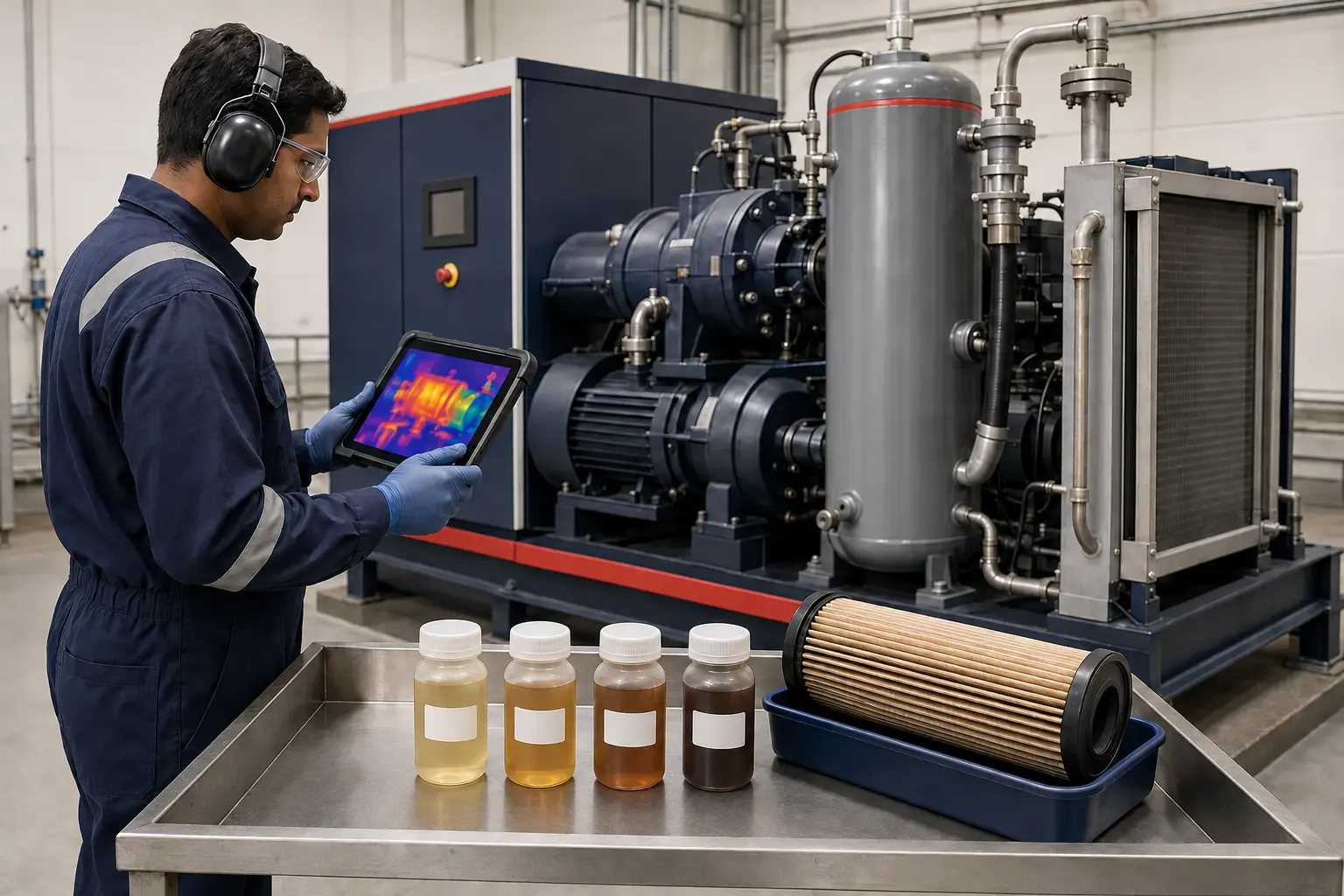
Chem-Tech builds compressor programmes around machine type, lubricant chemistry, discharge temperature, gas composition and separator or filtration design. Routine condition trends are combined with targeted deposit, wear or contamination evidence when operating symptoms change.
Article section
Relate oil condition to compressor design and gas service
Viscosity can rise through oxidation or contamination and fall through dilution or shear. Acid number can change differently across synthetic and mineral products. Water may originate from humidity, cooling leaks or process gas. Deposit formation can affect separators, valves and coolers before the bulk oil looks severely degraded.
Record the exact oil and compressor. A result from a refrigeration compressor using a synthetic lubricant should not be compared with a mineral-oil screw compressor trend.
- Discharge temperature, oil carryover or separator differential pressure rises.
- Oil darkens, thickens or develops deposits before the expected service interval.
- Water, process gas or cleaning chemicals may have entered the oil system.
- Bearing wear or vibration increases without a clear mechanical cause.
Article section
Separate degradation, contamination and mechanical wear
Viscosity, acid number and FTIR support degradation trending. Water and elemental analysis address ingress and wear. Particle, PQ or ferrography evidence is selected for the compressor design and filtration. Flash point may help where dilution by a volatile material is suspected, subject to matrix and safety review.
Use new-oil and early-service baselines for the exact lubricant. Trend oil hours, discharge temperature, top-ups, separator changes and maintenance beside the report.
Degradation
Viscosity, TAN and FTIR trends indicate oxidation or chemical change relative to the product baseline.
Ingress
Water, elements and selected volatility evidence support contamination investigation.
Wear
ICP, PQ and ferrography are selected for bearing, rotor or cylinder wear concerns.
System performance
Temperature, separator life, carryover and deposits connect oil evidence with compressor operation.
Article section
Indicative compressor-oil packages
The compressor OEM, lubricant and gas service determine the applicable panel and limits. Chem-Tech confirms method suitability for the submitted matrix.
| Package | Use when | Indicative tests and methods | Decision supported |
|---|---|---|---|
| Routine compressor health | Scheduled service trend | Kinematic viscosity — ASTM D445/D7042; TAN — ASTM D664/D974; water — ASTM D6304; ICP — ASTM D5185; FTIR — ASTM E2412 | Monitor degradation, ingress and fine wear |
| Deposit/overheating review | High temperature, varnish or separator concern | Routine panel plus MPC — ASTM D7843 where suitable; particle count; insolubles — ASTM D893 as relevant | Investigate degradation products and deposits |
| Mechanical fault investigation | Vibration or component distress | ICP; PQ Index — ASTM D8184; analytical ferrography — ASTM D7690; retained filter/debris review | Support bearing, rotor or cylinder inspection |
Some compressor fluids and process gases require special handling or method review. Declare product chemistry and potential hazardous contamination before dispatch.
Request a scope and package discussionArticle section
Sample the active oil and document operating state
Compressor samples should represent circulating oil, not only settled reservoir residue. Use an engineered safe point and follow the OEM procedure.
- Record compressor type, gas service, oil product, oil hours and machine hours.
- Sample at comparable load and temperature before top-up or oil change.
- Document discharge temperature, separator changes and oil consumption.
- Use suitable clean containers and disclose refrigerant or process contamination.
- Collect deposits, filters and drained water separately when investigating a fault.
Article section
Use trends to manage oil life and compressor inspection
A stable multi-parameter trend can support continued service within the OEM and lubricant guidance. Rapid viscosity, acid, water or deposit changes justify checking temperature, cooling, gas ingress, separator condition and oil compatibility.
After oil change or corrective work, establish a new baseline and confirm that operating symptoms improve. Extending oil life is only beneficial when compressor cleanliness and reliability remain controlled.
- Set different baselines for each compressor and lubricant technology.
- Investigate high oil consumption with separator and carryover evidence.
- Review cooler performance and discharge temperature when oxidation accelerates.
- Verify post-maintenance recovery using oil and machine-condition trends.
Apply this guidance