

Technical perspective
A water-miscible metalworking fluid is a working process bath, not a set-and-forget lubricant. Every shift changes it through water evaporation, top-up practice, tramp oil, chips, cleaner carryover, microorganisms and dissolved salts. By the time odour, foam, corrosion or dermatitis complaints become obvious, the sump may already have moved through several correctable warning stages.
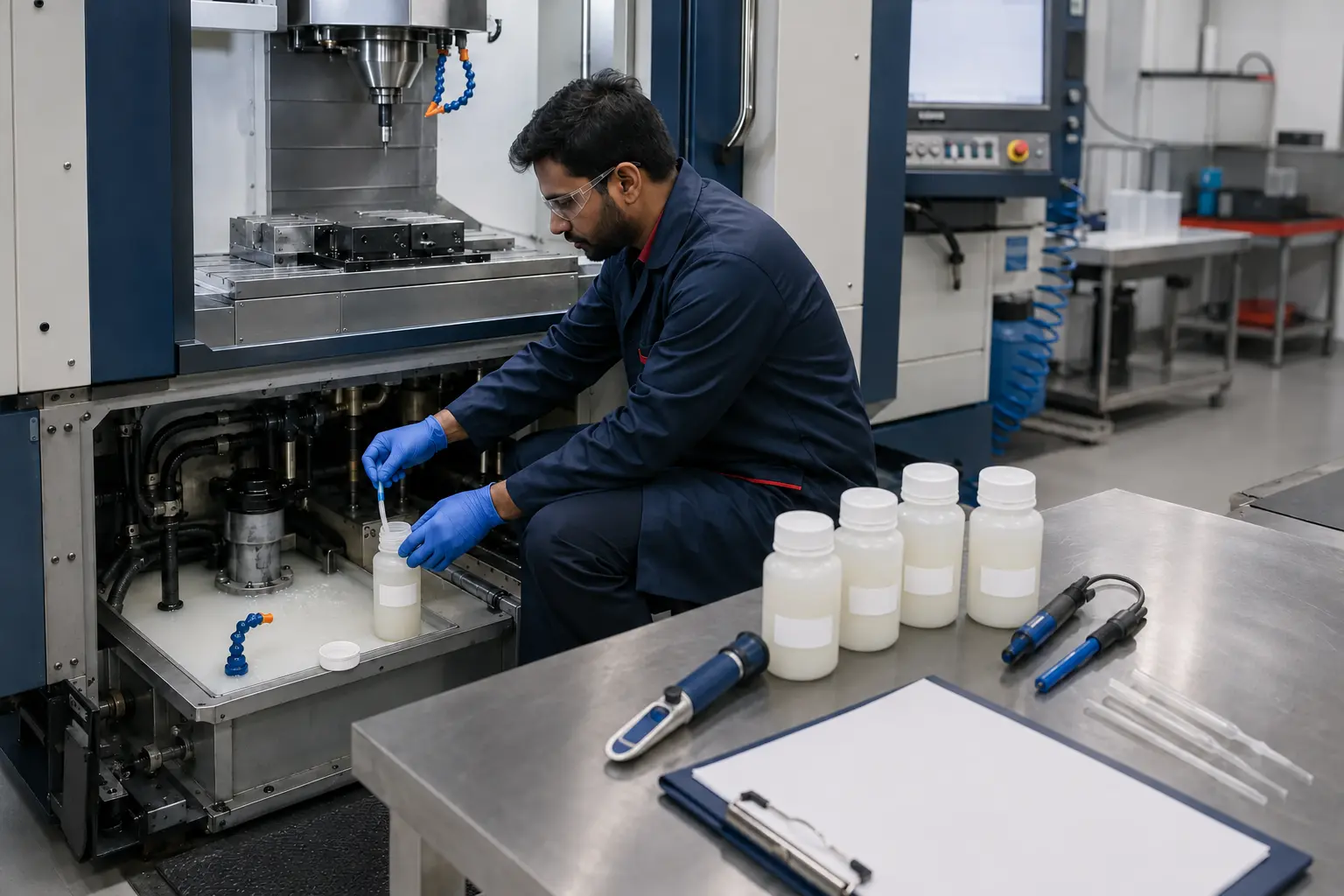
Chem-Tech helps machining plants build a monitoring programme that combines simple in-plant controls with scheduled laboratory evidence. The programme defines which measurements operators make at the machine, which samples come to the laboratory, and how deviations are escalated before an uncontrolled dump becomes the only option.
Article section
Treat the sump as a changing system
A refractometer reading alone does not always equal active fluid concentration. Tramp oil, dissolved solids and product-specific refractometer factors influence interpretation. Likewise, pH can remain apparently acceptable while reserve capacity, microbial population or corrosion performance is deteriorating.
Segment the plant by fluid product, metallurgy, machine type, water source and sump volume. A central system and a small individual machine do not share the same risk or response time. Trending each sump against its own baseline is more useful than comparing unrelated machines.
- Concentration needs frequent correction or varies widely between shifts.
- Foam, odour, tacky residue or unstable emulsion develops in service.
- Parts show staining, flash rust, poor finish or tool-life reduction.
- Operators report skin irritation or the sump develops visible biological film.
Article section
Combine fast plant checks with periodic laboratory depth
Daily or weekly plant measurements create the operational trend: make-up concentration, sump concentration, pH, temperature, appearance and additions. Laboratory testing checks the factors that handheld instruments cannot fully resolve, including tramp oil, microbial burden, hardness, conductivity, elemental contamination and corrosion-related properties.
The programme should include make-up water because the same fluid can behave differently with hardness, chloride, conductivity and microbial quality. When a sump fails repeatedly, compare the machine, the fresh mix and the water source rather than testing used fluid alone.
Control
Concentration and pH trends identify dilution, evaporation and dosing problems early.
Contamination
Tramp oil, bacteria, solids and conductivity show what is accumulating in the system.
Protection
Rust, copper corrosion and reserve-related evidence are selected for the machined metals and fluid.
Process link
Tool life, surface finish, foam and operator observations turn results into production decisions.
Article section
Indicative MWF sump-health packages
Testing frequency is set by sump size, fluid life, production criticality and history. Fresh concentrate, working dilution and make-up water require different panels.
| Package | Use when | Indicative tests and methods | Decision supported |
|---|---|---|---|
| Operator control | Routine machine checks | Concentration — refractometer with product factor; pH — pH meter; appearance/odour; make-up additions | Correct dilution and identify early drift |
| Sump health | Scheduled laboratory trend | Tramp oil — acid split; bacteria — kit method; conductivity — conductivity meter; hardness — titration; concentration — acid split/refractometer | Assess biological and accumulated contamination |
| Process investigation | Corrosion, foam or finish complaint | Elemental analysis — ASTM D5185; chloride — ASTM D4929; copper corrosion — ASTM D130; rust test — ASTM D665; sediments — ASTM D4055, as relevant | Connect sump condition with a specific production failure |
Kit counts and field readings are screening tools. Chem-Tech confirms the appropriate laboratory method, matrix, sample quantity and current accreditation status for the selected investigation.
Request a scope and package discussionArticle section
Sample the circulating fluid and the make-up system
Surface scum or a drain-bottom sample can exaggerate one contamination zone. Use a consistent location after circulation and collect separate evidence when layers are part of the problem.
- Run or circulate the system sufficiently to obtain a representative working-fluid sample.
- Record machine, sump volume, product, target concentration, current reading and last addition.
- Collect separate surface, working-zone or bottom samples when stratification is being investigated.
- Send fresh concentrate, prepared fresh mix and source water during recurring problems.
- Keep microbiology-related samples protected from heat and dispatch promptly under agreed conditions.
Article section
Use control limits to prevent unnecessary dumps
Each result should have a defined response: correct make-up practice, remove tramp oil, improve filtration, clean an idle zone, investigate water, or plan a controlled system clean. Adding biocide or concentrate without confirming the cause can mask symptoms and create a new imbalance.
A stable programme records every correction and verifies recovery. Over time, the plant can identify which machines, water conditions and operating practices shorten fluid life, allowing preventive action rather than reactive disposal.
- Set product- and sump-specific targets with the fluid supplier and process owner.
- Calibrate refractometers and apply the correct product factor.
- Trend additions, downtime, tool life and surface complaints beside laboratory results.
- Verify recovery after cleaning, tramp-oil removal or water-system correction.
Apply this guidance