
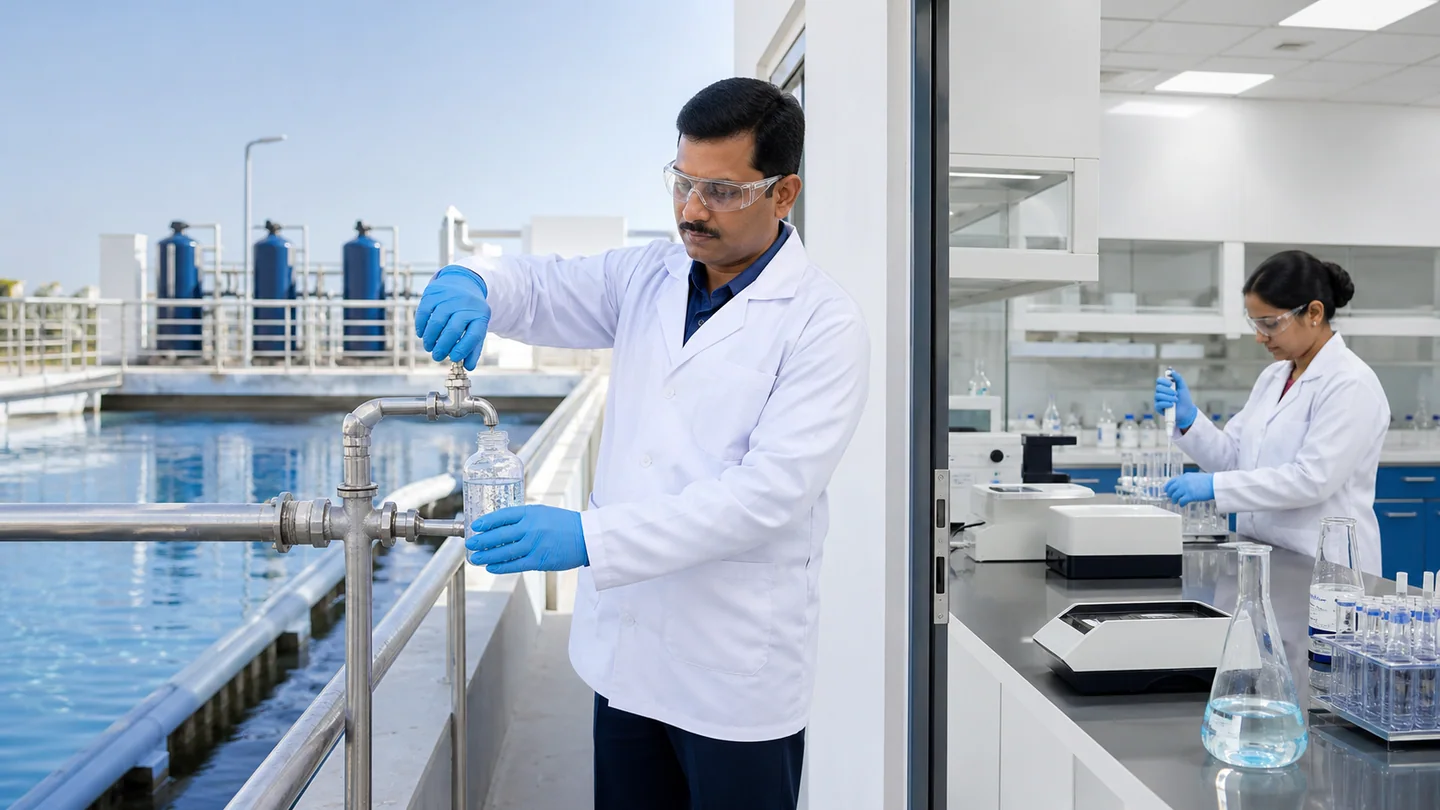

Technical perspective
Drinking-water testing is a conformity and risk-verification exercise, not a single potability test. IS 10500:2012, Drinking Water—Specification (Second Revision), establishes requirements for drinking water and distinguishes acceptable limits from permissible limits in the absence of an alternate source for parameters where that framework applies. The specification has amendments, so the current consolidated requirement and amendment status should be verified whenever a conformity statement is made.
A laboratory plan typically combines organoleptic/physical parameters, general chemistry, inorganic contaminants and microbiological indicators. Which parameters are needed depends on the decision: commissioning a new source, periodic surveillance, investigating taste or odour, verifying a storage tank, checking a treatment plant, or determining why a downstream tap differs from source water. Sampling location and preservation are integral parts of the evidence.
Article section
What the programme must answer
Testing or auditing is valuable only when the result is tied to a defined decision. The questions below should be agreed before sampling so that the sample, method, specification and response are aligned.
Source qualification
Characterize borewell, municipal, tanker or other drinking-water sources against applicable IS 10500 requirements.
Treatment verification
Compare raw and treated water to establish whether filtration, disinfection or other treatment controls intended parameters.
Distribution diagnosis
Compare source, tank and outlet points to identify contamination, corrosion, stagnation or disinfectant loss.
Routine surveillance
Trend high-value indicators and periodic broader panels based on source risk, system history and applicable requirements.
Article section
Water quality can change after it enters the premises
Even a satisfactory incoming source can deteriorate in storage or distribution. Poorly sealed tanks, sediment, infrequent cleaning, dead legs, cross-connections, warm stagnation and low disinfectant residual can create downstream microbiological risk. Conversely, a treatment system can reduce dissolved solids while failing to control microorganisms if maintenance and disinfection are weak.
Physical and chemical results also need context. Turbidity can interfere with disinfection and signal particulate ingress; pH can affect corrosion and treatment; hardness and dissolved solids influence scaling and acceptability; chloride or sulphate can reflect source chemistry; iron can arise from source water or infrastructure; and nitrogen species can suggest source or process changes. No one parameter substitutes for the complete decision panel.
- Map the system before sampling: source, raw tank, treatment inlet/outlet, treated tank and representative distal taps.
- Record recent tank cleaning, treatment maintenance, disinfectant dosing and plumbing changes.
- Use field measurements where holding time makes them preferable, especially for rapidly changing parameters.
- Include microbiology at points that represent actual consumer or food-use exposure, not only at the plant outlet.
- Repeat at the same defined points to create a meaningful trend.
Article section
Standards and method framework
IS 10500 defines the drinking-water specification; the IS 3025 series contains many physical and chemical methods. Relevant current examples include IS 3025 (Part 10) for turbidity, Part 11 for pH, Part 16 for total dissolved solids, Part 17:2022 for total suspended solids and Part 26:2021 for residual chlorine, with newer revisions for several metals and other parameters. Microbiological references include IS 15185:2016/ISO 9308-1 for E. coli and coliform membrane filtration in low-background waters and other current BIS water microbiology standards.
| Reference / method | Role in the testing plan | Important use condition |
|---|---|---|
| IS 10500:2012 + current amendments | Drinking-water specification | Confirm acceptable/permissible-limit framework and latest amendment status. |
| IS 3025 (Part 10) | Turbidity | Use current revision listed by BIS. |
| IS 3025 (Part 11) | pH | Sampling and measurement should preserve representative condition. |
| IS 3025 (Part 16) | Total dissolved solids | Interpret with source and treatment history. |
| IS 3025 (Part 26):2021 | Residual chlorine | Time-sensitive disinfectant residual; sampling/measurement timing matters. |
| IS 15185:2016 / ISO 9308-1:2014 | E. coli and coliform by membrane filtration | Applies to water with low bacterial background under method conditions. |
| FSSAI 15.024–15.034:2024 | Water microbiology methods in FSSAI 2024 manual | Use where FSSAI method framework applies to the programme. |
| APHA/Standard Methods 4500-H+ B (24th ed./current online) | Electrometric pH measurement | Use only where accepted by the applicable specification/accreditation scope; follow current Standard Methods Online text. |
| APHA/Standard Methods 2510 B (24th ed./current online) | Laboratory electrical conductivity | Useful for source/treatment trending; conductivity is not a substitute for ion-specific or microbiological testing. |
| APHA/Standard Methods 2540 C (24th ed./current online) | Total dissolved solids | Use the exact current method and programme acceptance criteria. |
| APHA/Standard Methods 4500-Cl G (24th ed./current online) | DPD colorimetric residual chlorine | Chlorine is time-sensitive; determine promptly and use only where this method is accepted. |
A method number is not, by itself, a product specification or legal limit. The method tells the laboratory how a defined measurand is determined; the applicable regulation, product standard, consent, customer specification or validated internal plan supplies the criterion and decision context.
Article section
Sampling and pre-analytical control
Water sampling can invalidate results if containers, preservation and timing are wrong. Microbiology requires sterile bottles; chlorinated water samples can need a neutralizer in the collection bottle; metals can require different preservation from general chemistry; and residual chlorine should not be interpreted after long uncontrolled transport. IS 17614 (Part 3):2021 / ISO 5667-3 addresses preservation and handling, while IS 17614 (Part 25):2022 / ISO 19458 addresses microbiological sampling.
The tap procedure should reflect the question. A disinfected and flushed sampling point can represent distribution water upstream of the fixture, whereas an as-used consumer outlet can intentionally include fixture condition. The report or sampling record should make this distinction explicit.
- Do not rinse sterile microbiology bottles or bottles containing preservatives or neutralizers unless instructed by the laboratory.
- Disinfect and flush outlets only according to the defined sampling objective.
- Record exact point, date/time, temperature and treatment/disinfection status.
- Keep microbiology samples cooled and transported within validated holding conditions.
- Use separate correctly prepared bottles for metals or other preserved chemistry when required.
Article section
How to interpret results and trends
A water report should not be reduced to safe or unsafe without showing the specification and tested scope. A partial panel can only support conclusions for those parameters. Microbiological detection—especially E. coli in a potable system—requires prompt investigation and appropriate control action; a satisfactory repeat alone should not erase the original event without investigating source and distribution.
Trend patterns can locate the problem. If source water remains stable but a distal tap deteriorates, internal storage or distribution becomes the priority. If raw and treated chemistry move together, the source can have changed. A treatment plant should therefore be reviewed as a sequence of barriers rather than one output number.
| Observed result / pattern | Technical interpretation | Management response |
|---|---|---|
| Source satisfactory, distal tap microbiology adverse | Internal storage/distribution contamination plausible | Inspect tank, plumbing, stagnation, residual disinfectant and cross-connections. |
| Raw high TDS/hardness, treated lower values | Treatment is affecting dissolved mineral load | Trend feed/product performance and downstream suitability. |
| Residual disinfectant decays across system | Demand, stagnation or distribution issue possible | Map residual and microbiology along network. |
| Turbidity rises after tank | Sediment or ingress/internal disturbance likely | Inspect tank condition and recent distribution work. |
| One partial panel satisfactory | Only tested parameters are supported | Do not claim full IS 10500 conformity without the required complete evidence. |
Article section
Build the result into a control programme
A site monitoring plan should separate baseline characterization, routine operational checks and periodic comprehensive verification. Frequency should be based on source variability, treatment complexity, storage volume, consumer vulnerability, regulatory or customer requirements and history. After contamination, remediation should be followed by intensified sampling until sustained control is demonstrated.
Keep tank cleaning, filter changes, source switches and disinfection events on the same timeline as laboratory data. This converts laboratory history into a diagnostic system and prevents unexplained spikes from being treated as random exceptions.
- Create a sampling map and permanent point IDs for trend comparability.
- Trend residual disinfectant, turbidity, conductivity or TDS and microbiology where they are useful process indicators.
- Perform broader chemistry at a justified periodicity and after source changes.
- Escalate after tank contamination, flooding, plumbing repair, treatment failure or adverse microbiology.
- Keep tank cleaning, filter changes and disinfection events on the same timeline as laboratory data.
Apply this guidance
