Technical perspective
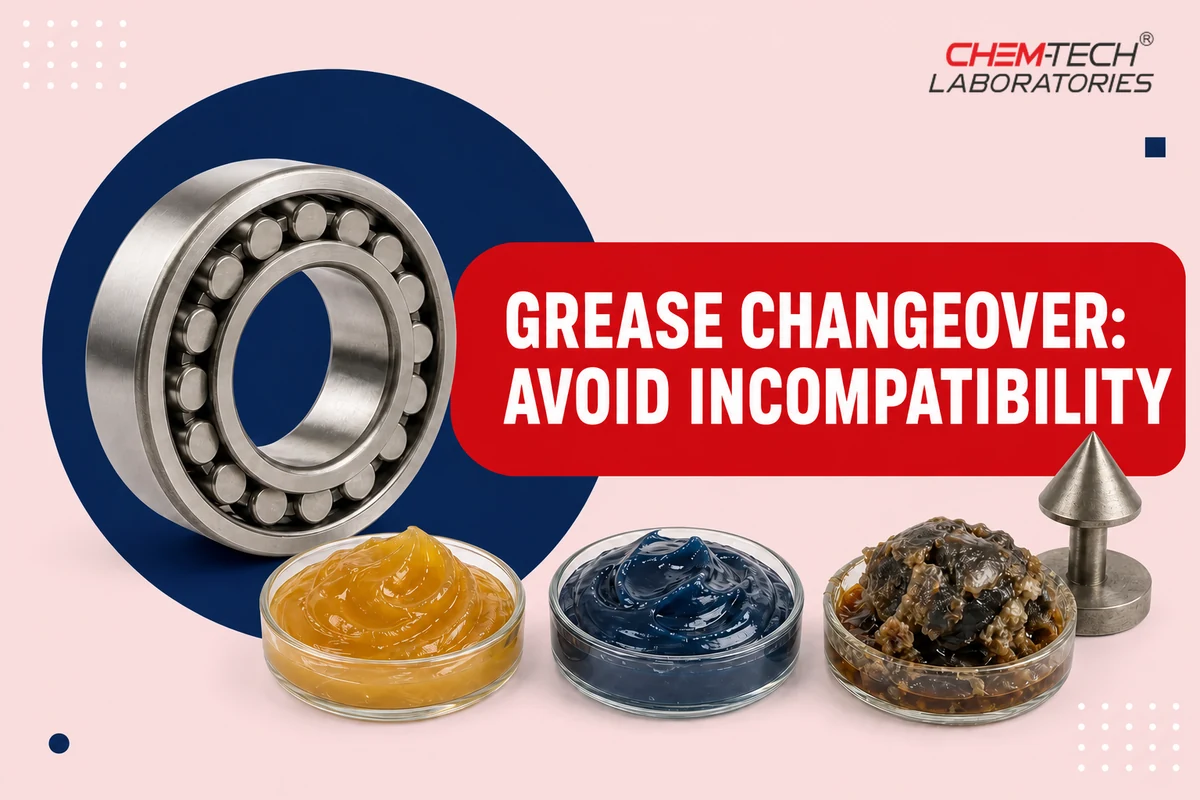
A plant changes grease to simplify inventory, respond to supply constraints or improve an application. Soon afterwards, operators notice leakage, hardened deposits, rising temperature or inconsistent relubrication. The new grease may meet its own specification; the problem can be the transition mixture left inside the bearing, housing and distribution lines.
SKF guidance explains that grease compatibility is assessed by mixing products in different proportions and evaluating mechanical stability, with additional properties considered under ASTM D6185. It also cautions that passing a compatibility assessment does not prove the changing mixture will deliver full application performance.
Investigation guidance
Why thickener names and colour are not enough
Compatibility charts are useful screening tools, not a guarantee for two specific commercial products in a specific application. Base oil, additive system, worked consistency, temperature and mixture ratio can influence the transition. Greases with similar labels may behave differently; different colours may be compatible.
- Identify both products by exact manufacturer and grade.
- Record the bearing, speed, load, temperature and relubrication system.
- Estimate how much old grease remains in the housing and lines.
- Describe the observed change: softening, hardening, oil separation, leakage or temperature.
Investigation guidance
Test the ratios the machine will actually experience
A changeover does not create one fixed composition. The first addition may contact mostly old grease; later additions shift the ratio toward the new product. Compatibility work should therefore include relevant mixtures rather than only a single 50:50 blend.
ASTM D6185 is the active practice for evaluating binary mixtures of lubricating greases. The test plan and acceptance criteria should be agreed with the lubricant supplier and equipment owner. Critical applications may need additional performance evidence beyond consistency change.
Investigation guidance
Plan the physical changeover
- Remove as much old grease as the equipment procedure safely permits.
- Clean or replace contaminated fittings, lines and reservoirs where required.
- Use a documented transition quantity and interval approved for the equipment.
- Inspect purge material for abnormal texture, separation or contamination.
- Trend bearing temperature, vibration and grease condition after the change.
Do not solve a compatibility concern by uncontrolled overgreasing. Excess grease can create its own operating problems. Follow the equipment and lubricant suppliers’ changeover instructions.
Investigation guidance
When the bearing is already showing symptoms
Preserve samples of the old grease, new grease, purged mixture and any abnormal deposit. Keep each separate and record its location. Laboratory evidence can support the investigation, but bearing condition, sealing, contamination, relubrication quantity and operating history must be reviewed together.
Apply this guidance