

Technical perspective
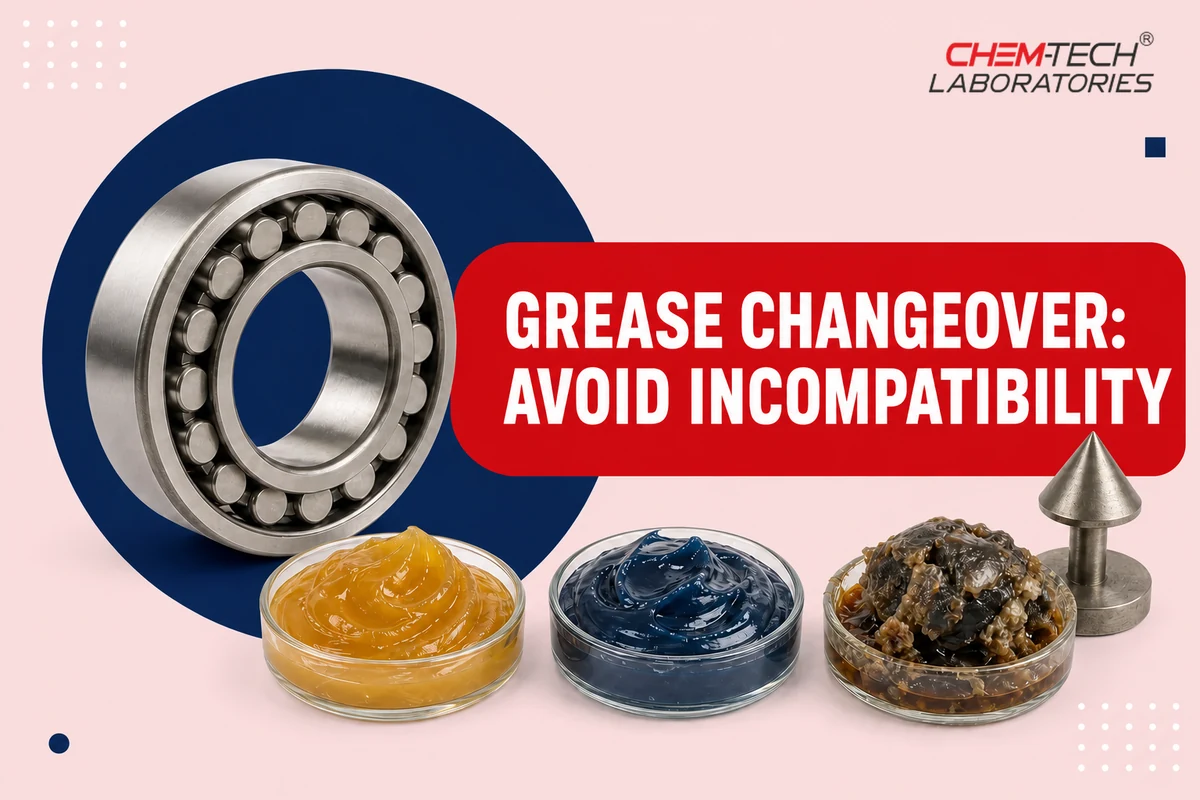
Two greases can share an NLGI grade and still behave poorly when mixed. Thickener interactions, base-oil differences and additive chemistry may change consistency, oil release, stability or corrosion behaviour. During a plant changeover, residual old grease remains in bearings, lines and automatic-lubrication systems, so the mixture—not only the two neat products—needs attention.
Chem-Tech supports compatibility studies that reproduce relevant blend ratios and compare the mixtures with both component greases. The laboratory programme is one control within a wider change plan that also covers OEM approval, purge requirements, line cleaning, relubrication quantity and monitored field rollout.
Article section
Why product-data-sheet comparison is not enough
A thickener compatibility chart is a useful starting screen, not proof for a specific product pair. Commercial greases contain base oils, polymers, solids and additives that can alter mixture behaviour. Charts also do not represent the actual aged grease already in the machine.
Define the reason for change and estimate the residual proportions expected during purge and service. A 90:10 mixture may behave differently from a 50:50 blend. Critical or hard-to-purge equipment deserves a more conservative study and a documented field trial.
- Grease becomes markedly softer, harder or oilier after a product change.
- Automatic lines lose pressure or block during conversion.
- Bearing temperature, leakage or consumption changes soon after relubrication.
- The new and old products use different thickeners, base oils or solid additives.
Article section
Evaluate neat greases and planned mixtures together
ASTM D6185 provides a practice for evaluating compatibility of binary grease mixtures through changes in properties. A useful design normally includes both neat products and several blend ratios chosen around field reality. Visual observation alone is insufficient because a smooth mixture can still lose mechanical stability or release oil differently.
The application determines additional checks. A wet bearing may require water washout or corrosion evidence; a high-shear system may require extended working or roll stability; a central system may focus on consistency and pumpability. Chem-Tech documents the prepared ratios and comparison basis.
Consistency
Worked penetration shows whether the mixture moves materially softer or harder than its components.
Mechanical stability
Extended working or roll stability helps assess shear-related structure change.
Oil release
Oil separation evidence can reveal a mixture that bleeds differently in storage or service.
Application protection
Corrosion, washout or wear tests are added only when the bearing environment requires them.
Article section
Indicative grease compatibility packages
Ratios, conditioning and acceptance criteria are agreed before testing. The field changeover should not begin merely because the neat greases meet their own specifications.
| Package | Use when | Indicative tests and methods | Decision supported |
|---|---|---|---|
| Compatibility screen | Low-criticality, straightforward purge | Prepared mixtures; worked penetration — ASTM D217; dropping point — ASTM D566; visual/oil separation review | Identify major structural incompatibility |
| Mechanical stability | High-speed, centralised or shear-sensitive application | Extended working — ASTM D217; roll stability — ASTM D1831; oil separation — IP 121/ASTM D1742 | Assess mixture stability through service stresses |
| Application verification | Wet, corrosive or heavily loaded bearing | Water washout — ASTM D1264; copper corrosion — ASTM D4048; four-ball wear — ASTM D2266; Emcor — ASTM D6138, as relevant | Verify protection characteristics important to the asset |
Compatibility does not establish that the incoming grease is an OEM-approved substitute or that two products have identical field life. Product approval and changeover instructions remain customer/OEM decisions.
Request a scope and package discussionArticle section
Send the exact products and identify field residue
A compatibility result is specific to the products, batches, ratios and conditioning used. Generic samples or an unknown used residue weaken the conclusion.
- Submit sealed, traceable samples of both new greases and their technical data sheets.
- Provide a representative used old-grease sample when aged residue will remain in critical equipment.
- State expected purge effectiveness and the likely blend ratios during transition.
- Describe bearing speed, temperature, load, water exposure and lubrication system.
- Retain product and prepared-mixture samples for investigation during rollout.
Article section
Move from laboratory screen to controlled field conversion
If mixtures show unacceptable change, avoid uncontrolled mixing and review alternative products, cleaning or complete grease removal. If results are acceptable, begin with a limited group of representative assets and monitor temperature, vibration, purge, consumption and leakage.
Document each converted asset, old and new products, purge quantity and date. A successful small trial does not remove the need for early inspections when the rollout reaches hotter, wetter or more heavily loaded bearings.
- Obtain lubricant supplier and OEM review before substitution.
- Define purge, labelling and contamination-prevention instructions.
- Pilot on representative equipment with measurable acceptance criteria.
- Retain samples and investigate any post-change bearing event against the recorded mix history.
Apply this guidance