
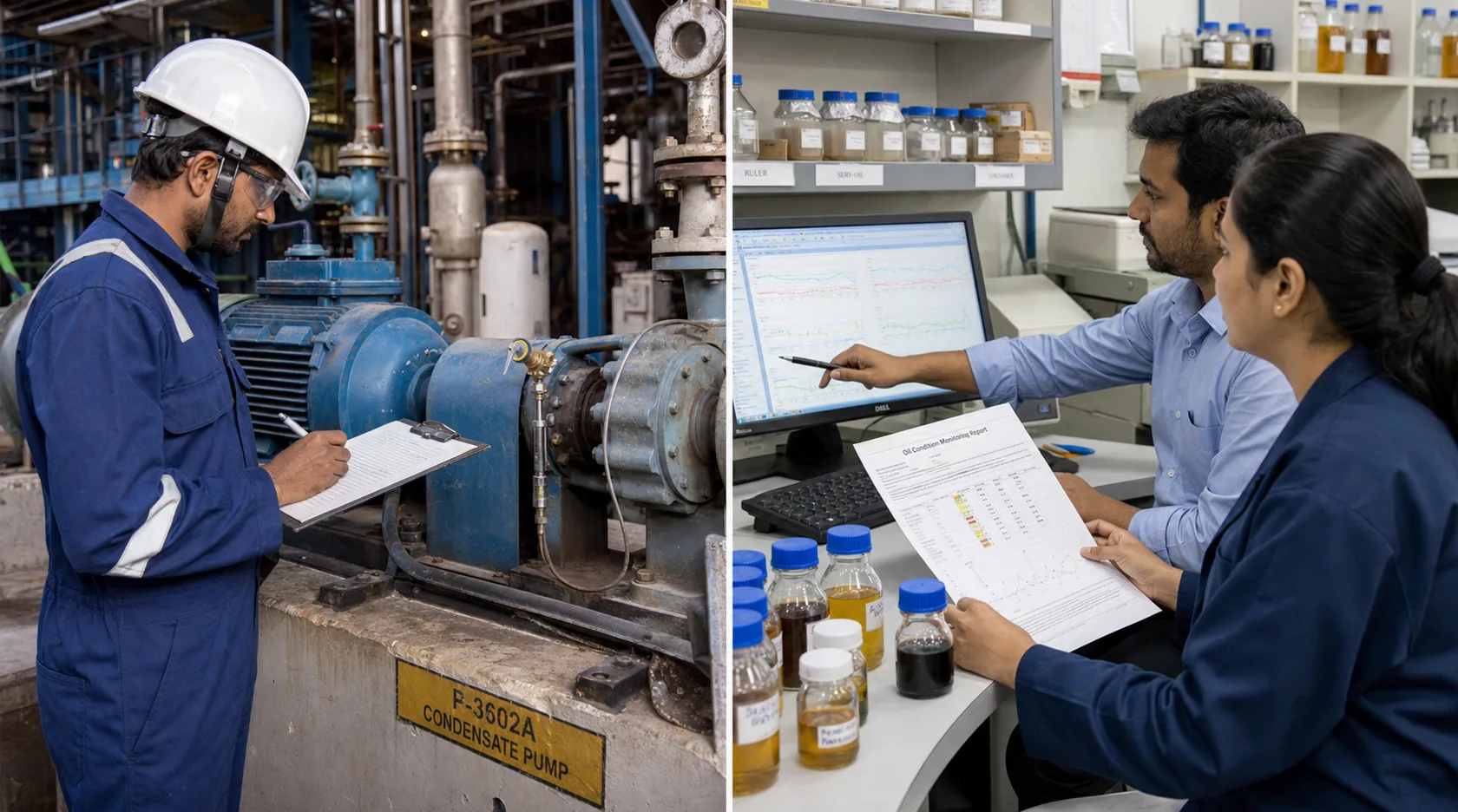
Proactive monitoring
Periodic sampling and trend review help identify gradual changes in oil condition, contamination and wear-related indicators before they become isolated emergency investigations.
Oil testing, analysis and condition monitoring
Chem-Tech Laboratories supports fresh and in-service oil analysis for equipment condition assessment, contamination investigation and planned maintenance decisions. Test selection is matched to the lubricant, equipment history, customer objective and the applicable IS, ASTM, IP, DIN, ISO or OEM specification.
Laboratory capability
Oil analysis is most useful when a result is connected to the asset, lubricant, operating hours, oil-change history and previous samples. Chem-Tech structures the programme around those inputs so laboratory data can support a repeatable maintenance review.
A single result does not establish equipment condition on its own. Results are reviewed with reference oil information, customer-supplied limits, operating context and available trend history.
Condition-monitoring strategy
Periodic sampling and trend review help identify gradual changes in oil condition, contamination and wear-related indicators before they become isolated emergency investigations.
Laboratory evidence can be reviewed alongside scheduled inspection, filtration, lubricant replacement and maintenance planning rather than relying only on fixed intervals.
When abnormal operation is reported, the test scope can be selected around suspected contamination, fluid degradation, wear debris or lubricant-mixing concerns.
Published laboratory capability
Chem-Tech selects the applicable method after reviewing the oil type, equipment, specification and testing objective. The controlled scope may include IS, ASTM, IP, DIN, ISO or OEM methods; the examples below are verified methods already published in Chem-Tech's technical test data.
| Test / parameter | Test method | Technical purpose | Interpretation context |
|---|---|---|---|
| Kinematic viscosity | ASTM D7042 / ASTM D445 | Measures resistance to flow at a defined temperature. | A change from the reference oil may support review of degradation, contamination or mixing. |
| Water content | ASTM D6304 | Measures water present in the submitted oil sample. | An increase may support investigation of ingress, condensation, handling or storage conditions. |
| Total Acid Number | ASTM D664 / ASTM D974 | Measures acidic constituents using the selected method. | A rising trend may support oxidation or acidic-contamination review when compared with the oil and service history. |
| Total Base Number | ASTM D4739 | Assesses alkaline reserve in applicable engine lubricants. | A falling trend may indicate consumption of reserve alkalinity and should be reviewed with operating history. |
| Elemental analysis | ASTM D5185 | Measures selected wear, contaminant and additive elements. | Element patterns can support wear and contamination review when equipment metallurgy and trend data are available. |
| FTIR condition monitoring | ASTM E2412 | Reviews selected infrared condition indicators in used lubricants. | Spectral changes are assessed against the relevant oil reference and operating context. |
| Particle count / cleanliness | ISO 4406 | Reports the distribution of particles in applicable fluid samples. | Results support cleanliness review against the equipment or customer requirement; no universal limit is assumed. |
| PQ Index | ASTM D8184 | Supports assessment of ferromagnetic wear debris in used oils. | A change can support wear-debris investigation alongside elemental analysis and equipment history. |
End-to-end programme
Confirm lubricant, asset, operating history, sampling point and decision objective.
Use the confirmed bottle and sampling procedure; label every sample against the correct asset.
Chem-Tech can coordinate a door-to-door workflow where collection service is available.
Automated and high-throughput instruments support repeatable processing and consistent turnaround.
Results are checked and considered with specification, reference and available trend history.
Reports are delivered through the customer workflow, with a dedicated point of contact for programme queries.
Zylon customer portal
Programme data can be organised and reviewed at multiple operating levels, helping maintenance teams move from individual reports to a consistent fleet or site view.
Explore reporting and trend analysisIndustry programmes
Condition monitoring for engines, hydraulic systems, transmissions, axles, final drives and gear systems operating under dust, load and variable duty cycles.
View programmeOil analysis programmes for mobile plant and construction machinery where contamination, wear and equipment availability must be reviewed together.
View programmeTrend-based review of applicable gearbox and hydraulic oils across turbines, models, wind farms and operating regions.
View programmeFleet oil analysis organised by vehicle, engine model, depot, site and region to support consistent maintenance review.
View programmeProgramme management
Chem-Tech supports condition-monitoring programmes for major global OEM and enterprise customers. Programme scope, sampling frequency, applicable limits, reporting workflow and escalation criteria are agreed for each customer and asset population.
A dedicated single point of contact coordinates programme queries, sample-status follow-up and communication with the laboratory team.
Discuss your programme
Share the lubricant, asset population, operating context and reporting objective with Chem-Tech.