

Industry overview
Oil analysis for mining operations
Mining equipment combines engines, hydraulic circuits, transmissions, axles, final drives and gear systems within one demanding operating environment. Each lubricated compartment has a different failure mode, contamination exposure and maintenance consequence.
A structured programme links repeat oil samples with equipment identity, lubricant grade, component hours, oil hours, maintenance activity and operating observations. Comparable data helps maintenance teams distinguish a developing trend from an isolated result.
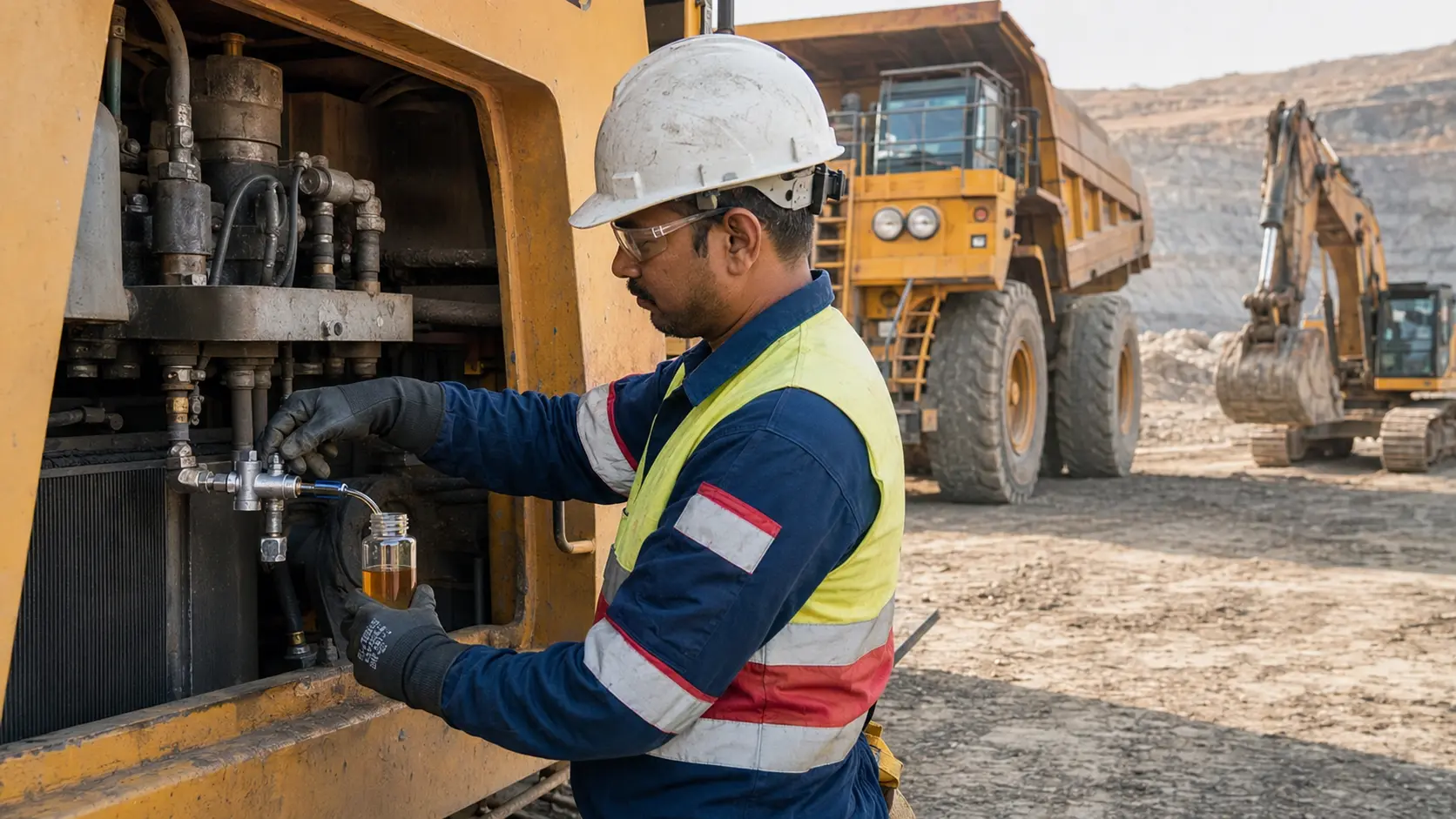
Mine-site sampling must preserve component identity while controlling dust around the sampling point, bottle and closure.
Programme objectives
What a structured lubricant-testing programme can support
Build a comparable lubricant history for every engine, transmission, final drive, axle, differential, gearbox and hydraulic circuit in the monitoring plan.
Separate likely dust ingress, water entry, coolant leakage, fuel dilution and lubricant degradation from wear-related evidence.
Prioritise resampling, filter inspection, contamination control, borescope work or maintenance review using the complete result pattern and operating history.
Compare similar machines by model, component, lubricant, duty and service interval without applying one universal alarm limit to unlike assets.
Assets and systems
Equipment covered by the monitoring programme
- Haul trucks and dumpersEngine, transmission, axle, differential, final-drive and hydraulic-system monitoring.
- Excavators and shovelsEngine, swing-drive, travel-drive and hydraulic-fluid condition assessment.
- Drills, crushers and conveyorsGearbox, bearing-system and hydraulic-oil monitoring for fixed and mobile assets.
- Loaders and support equipmentRoutine screening across engines, powertrains, axles and hydraulic systems.
Who we support
Industry roles the programme is designed around
Mine owners and operators
Build a site-wide view of lubricant condition across production, loading, drilling and support assets.
Equipment OEMs and dealers
Support component-specific monitoring, commissioning baselines and evidence-led service investigations.
Mining contractors
Standardise sampling and reporting across mixed fleets, locations, shifts and maintenance teams.
Reliability and maintenance teams
Connect laboratory exceptions with inspection, filtration, vibration and planned-maintenance workflows.
Technical review
Condition and contamination priorities
Dust and particle ingress
Silicon and cleanliness-related indicators can support investigation of external contamination when reviewed with filters, breathers and sampling practice.
Wear-related material
Elemental and ferrous-debris information supports review of component wear when compared with metallurgy and previous results.
Water and service contamination
Water and other contamination indicators help review storage, washdown, seal and operating-environment concerns.
Lubricant condition
Viscosity, acidity, reserve and spectral indicators are selected for the lubricant and component being monitored.
Test strategy
Core test families and how the results are used
The examples below describe common condition-monitoring tools. The final test method, sample volume and accreditation status are confirmed for the lubricant, equipment and agreed objective before work begins.
| Test family | Why it is included | Interpretation focus | Method example |
|---|---|---|---|
| Viscosity and viscosity change | Checks whether the in-service oil remains consistent with its intended grade and operating role. | A shift can be associated with oxidation, shear, contamination, mixing or fuel dilution; the direction and size of the change must be reviewed against the unused oil and service history. | Kinematic viscosity — ASTM D445 / ISO 3104, where applicable |
| Water content | Screens for moisture from washdown, weather, condensation, damaged seals, coolers or storage and handling. | Water can affect corrosion, additive performance and filter loading. The acceptable level depends on the component, lubricant and equipment requirement. | Water by coulometric Karl Fischer titration — ASTM D6304, where applicable |
| Wear metals, contaminants and additives | Measures selected elements associated with component metallurgy, external contamination and the lubricant additive system. | Iron, copper, lead, tin, chromium, aluminium, silicon, sodium, potassium and additive elements are interpreted as a pattern and trend. ICP results can under-represent larger insoluble wear particles. | Elemental analysis by ICP-AES — ASTM D5185, where applicable |
| Ferrous-debris screening | Adds sensitivity to larger magnetic particles that may not be represented fully by elemental spectroscopy. | A rising PQ response, especially when paired with iron or abnormal inspection evidence, can justify prompt resampling or wear-particle examination. | PQ index and/or analytical ferrography — selected laboratory procedure |
| FTIR degradation and contamination indicators | Supports review of oxidation, nitration, soot and other formulation-dependent spectral changes. | Spectral indicators are strongest when compared with the correct unused oil and previous samples from the same component. | FTIR condition monitoring — ASTM E2412, where applicable |
| Acid or base reserve | Reviews acidic change or remaining alkaline reserve for the relevant lubricant family. | The useful parameter and limit depend on oil type. Engine-oil reserve is not interpreted in the same way as industrial gear-oil acidity. | Acid number by potentiometric titration — ASTM D664, where applicable; base number by the method selected for the lubricant |
| Particle count and cleanliness | Assesses solid contamination in suitable hydraulic and circulating oils. | The reported cleanliness code is compared with the component or OEM target, filter rating and previous trend; opaque or heavily contaminated samples may require an alternative approach. | Particle count with cleanliness coding — applicable laboratory method / ISO 4406 coding |
| Fuel dilution, soot or coolant investigation | Targets engine-oil contamination when operating symptoms or screening results indicate a combustion or cooling-system concern. | These results are reviewed together with viscosity, flash characteristics, sodium, potassium, boron, water, reserve and maintenance observations. | Selected instrumental or laboratory procedures appropriate to the sample and objective |
Advanced diagnostics
Escalation tools for a defined technical question
Routine testing establishes the trend. Advanced diagnostics are selected when the result pattern, inspection evidence or maintenance question requires a more focused investigation.
PQ index and analytical ferrography
Extend wear review beyond small dissolved particles by screening and examining larger ferrous debris.
- Consider when
- Use when PQ, iron, filters, magnetic plugs, vibration or inspection evidence indicates a developing wear concern.
Hydraulic cleanliness investigation
Combine particle count, elemental evidence and sampling context to review ingress and filtration performance.
- Consider when
- Use after hydraulic work, filter distress, dust exposure or an unexpected ISO cleanliness change.
Engine contamination investigation
Review fuel dilution, soot, coolant-related markers, water, reserve and viscosity as one diagnostic pattern.
- Consider when
- Use when oil level, smoke, temperature, coolant loss or routine screening suggests a combustion or cooling-system concern.
Cross-fluid comparison
Compare used oil with the correct unused lubricant and, where relevant, fuel or coolant evidence.
- Consider when
- Use for wrong-oil, lubricant mixing, storage contamination or source-identification questions.
Applicable programme scopes
Oil testing packages for the industry context
The final scope is selected for the lubricant, component, operating context and monitoring objective. The programme options below are drawn from Chem-Tech's published Oil Condition Monitoring scopes.
Engine Oil - Basic
Routine screening for automotive, construction and mining engines.
View included test families
- Appearance
- Kinematic Viscosity at 40°C
- Kinematic Viscosity at 100°C
- Viscosity Index
- Water Content
- Total Acid Number
- Total Base Number
- Soot Content
- Elemental Analysis
Engine Oil - Advanced
Expanded engine-oil condition review with degradation and dilution indicators.
View included test families
- Appearance
- Kinematic Viscosity at 40°C
- Kinematic Viscosity at 100°C
- Viscosity Index
- Water Content
- Total Acid Number
- Total Base Number
- Soot Content
- FTIR — Oxidation / Nitration
- Elemental Analysis
- Fuel Dilution
Hydraulic Oil - Basic
Routine hydraulic-fluid condition and cleanliness screening.
View included test families
- Appearance
- Kinematic Viscosity at 40°C
- Water Content
- Total Acid Number
- Elemental Analysis
- Particle Count / ISO Cleanliness
Hydraulic Oil - Advanced
Expanded hydraulic-fluid review for cleanliness, degradation and contamination.
View included test families
- Appearance
- Kinematic Viscosity at 40°C
- Kinematic Viscosity at 100°C
- Viscosity Index
- Water Content
- Total Acid Number
- FTIR — Oxidation / Nitration
- Elemental Analysis
- Particle Count / ISO Cleanliness
Axle Oil
Condition and wear review for axle and final-drive lubricants.
View included test families
- Appearance
- Kinematic Viscosity at 40°C
- Kinematic Viscosity at 100°C
- Viscosity Index
- Water Content
- Total Acid Number
- Elemental Analysis
- PQ Index
Transmission Oil
Condition and wear review for transmission oils and fluids.
View included test families
- Appearance
- Kinematic Viscosity at 40°C
- Kinematic Viscosity at 100°C
- Viscosity Index
- Water Content
- Total Acid Number
- Elemental Analysis
- PQ Index
Differential Oil
Condition and wear review for differential and severe-duty gear systems.
View included test families
- Appearance
- Kinematic Viscosity at 40°C
- Kinematic Viscosity at 100°C
- Viscosity Index
- Water Content
- Total Acid Number
- Elemental Analysis
- PQ Index
Gear Oil
Condition and wear review for industrial and automotive gear oils.
View included test families
- Appearance
- Kinematic Viscosity at 40°C
- Kinematic Viscosity at 100°C
- Viscosity Index
- Water Content
- Total Acid Number
- Elemental Analysis
- PQ Index
Sampling programme
From asset register to representative repeat samples
Build the asset register
Assign a stable identity to each machine and lubricated compartment. Record make, model, component type, lubricant, reservoir size and criticality.
Choose representative points
Use live-zone or dedicated sample points where practicable. Avoid stagnant drains unless the agreed procedure specifically requires them.
Standardise timing
Collect at a consistent operating state and service interval. A risk-based frequency should consider duty, environment, failure consequence and established trend stability.
Control field contamination
Use clean, compatible containers and tubing, purge sampling hardware appropriately and protect labels and closures from mine-site dust.
Escalate without breaking the trend
When a result is abnormal, verify identity and context, resample from the same point and retain filters or debris if a deeper investigation may follow.
Interpretation workflow
Turn an exception into a controlled next step
Laboratory results become more useful when each signal is verified against sample quality, asset history and independent condition evidence before action is assigned.
Observed pattern
Silicon or particle cleanliness worsens while wear remains stable
- Review
- Check breathers, seals, service practices, storage, sample cleanliness and filter condition.
- Possible next step
- Confirm with a repeat sample after corrective contamination-control work.
Observed pattern
PQ or ferrous debris rises faster than dissolved iron
- Review
- Consider active generation of larger magnetic particles and review alarms, vibration, temperature and filter debris.
- Possible next step
- Prioritise resampling and consider ferrography or physical inspection.
Observed pattern
Viscosity changes with fuel, soot or coolant indicators
- Review
- Review engine duty, injection, combustion, cooling system, top-up and oil-change history.
- Possible next step
- Use targeted confirmation tests and maintenance evidence before extending service.
Observed pattern
Water increases in a hydraulic, axle or gear system
- Review
- Investigate washdown, weather exposure, seals, breathers, coolers and storage transfer.
- Possible next step
- Assess filtration or oil handling actions and verify with a post-action sample.
Sample submission
Information that makes the laboratory result actionable
- Asset, vehicle, vessel or turbine identifier and the exact component sampled
- Lubricant brand, product name, SAE or ISO viscosity grade and whether the oil is mineral or synthetic
- Equipment hours or distance, oil hours or distance, top-up quantity and date of the last oil or filter change
- Sampling point, sample date, operating condition at sampling and any deviation from the normal procedure
- Recent maintenance, filtration, repair or lubricant-mixing activity
- Reported symptoms, alarms, inspection findings and the decision the testing is intended to support
- A representative unused reference oil when formulation comparison is important
Allied work
Programme support beyond laboratory testing
Sampling programme design
Define repeatable sampling points, intervals and labels for each component family.
Explore supportTrend and fleet review
Organise repeat results by asset, component and operating history through the reporting workflow.
Explore supportCoolant testing
Review cooling-system fluid where engine condition or contamination investigation requires it.
Explore supportBefore sampling
Preserve equipment context
Record the asset, component, lubricant grade, sampling point, oil hours, equipment hours, top-up history, filter changes and relevant maintenance activity.
Review sampling guidelinesAfter reporting
Interpret results as a trend
Review repeat data with equipment history, operating conditions, maintenance observations and previous results rather than relying on one value alone.
Read the oil-analysis guideFrequently asked questions
Mining Lubricant Testing FAQs
Which mining equipment fluids can be included?
A programme can cover engine oils, transmission fluids, axle and differential oils, final-drive oils, industrial gear oils and suitable hydraulic fluids. Each compartment should have its own identity, scope and trend.
Can one test package be used for every compartment?
No. Engines, transmissions, axles, final drives and hydraulic systems have different lubricant formulations, contaminants and failure modes. The scope should be selected by component and objective.
How often should mine equipment be sampled?
The interval should be risk-based and consistent. Duty severity, dust and water exposure, component criticality, reservoir size, OEM guidance, failure history and trend stability all matter.
Why can PQ and iron give different signals?
ICP elemental analysis is most responsive to small particles, while PQ screening responds to magnetic debris across a broader size range. A high PQ response with modest iron can indicate larger ferrous particles that deserve further review.
Can the report confirm a specific failing part?
Laboratory data provides condition, contamination and wear-related evidence. A specific diagnosis normally requires component metallurgy, trend history and corroborating inspection, vibration, temperature or maintenance information.
Should a new-oil sample be submitted?
A representative unused reference is valuable when the formulation, additive pattern or baseline viscosity is uncertain, or when cross-contamination and wrong-oil use are being investigated.
Discuss your programme