
Technical perspective
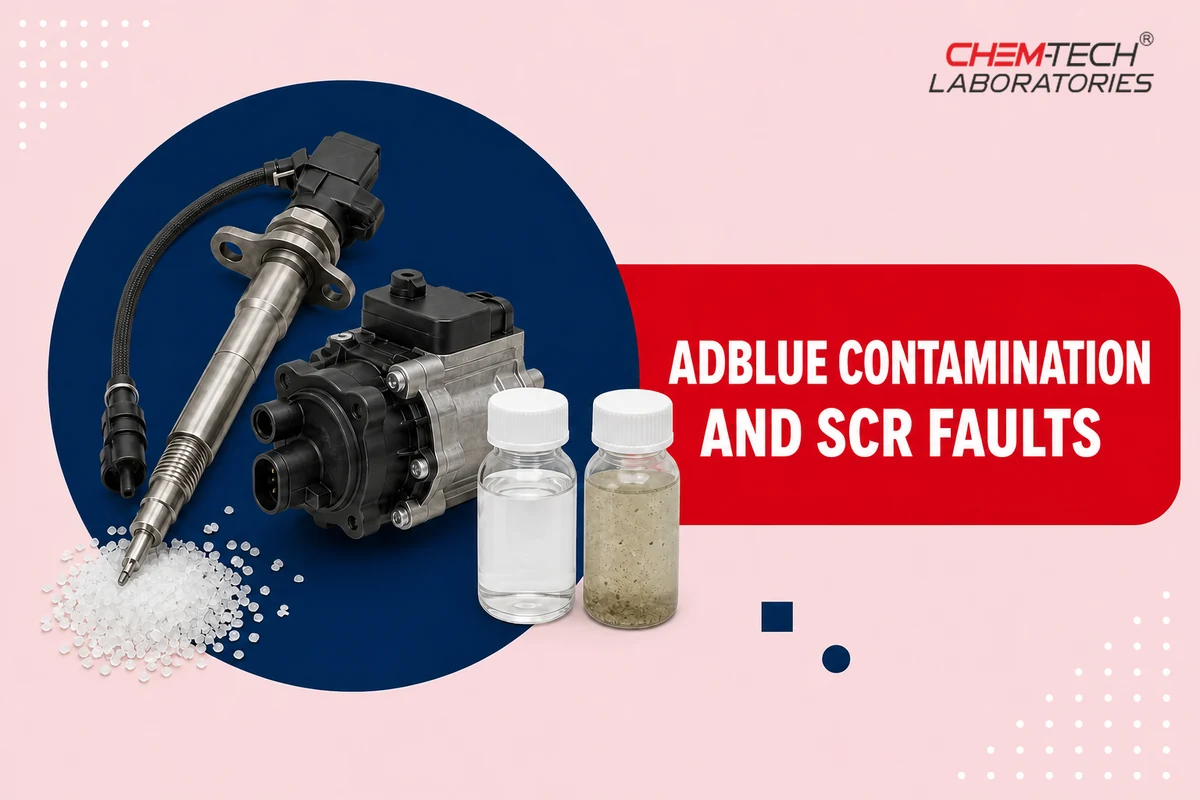
AdBlue / DEF can be visually clear and still contain trace contamination. Metals can enter through unsuitable storage or transfer materials, residues from previous products, dirty fittings, process water or maintenance practices. Because SCR systems rely on controlled dosing and catalyst performance, small contamination sources deserve systematic investigation.
Elemental analysis is therefore not simply a generic metals screen. It is one part of determining whether the fluid continues to meet the applicable AUS 32 quality requirements and whether the handling chain is introducing impurities.
Article section
Map the contamination pathway
- Review bulk tank, intermediate container, pump, hose, nozzle and equipment reservoir materials.
- Check whether transfer equipment has ever carried fuel, coolant, cleaners or other chemicals.
- Verify the water and urea sources used for production where the investigation is at manufacturing stage.
- Compare upstream and downstream samples to locate where the elemental profile changes.
Article section
Do not interpret a metal result without the specification
The relevant elements and limits are defined by the applicable quality specification and test method. A laboratory result should be compared with that requirement, method capability and measurement uncertainty where relevant. Avoid applying arbitrary universal limits copied from unrelated fluids.
Article section
Combine metals with the rest of the fluid quality
If an SCR fault is being investigated, review urea concentration, identity, alkalinity, biuret, insolubles and other required characteristics alongside elemental contamination. A normal elemental profile does not exclude dilution or incorrect fluid, while an abnormal metal does not by itself identify the contamination source.
Article section
Use comparative sampling to find the source
The most informative field investigation often compares the supplier container, site bulk tank, dispensing point and equipment reservoir. If the material is acceptable upstream and abnormal downstream, the handling system becomes a priority. If every point shows a similar profile, the investigation moves back toward supply or production.
Article section
Preventing AdBlue contamination in Indian distribution and fleets
Indian fleets may receive AdBlue through cans, drums, IBCs or bulk dispensing systems. Non-compatible pumps, funnels, containers or contaminated transfer equipment can introduce impurities after the product leaves the manufacturer.
When a trace-metal result is abnormal, review the complete handling chain before concluding that the source product was defective. Comparative samples from unopened product, storage and the dispensing point can help narrow the investigation and prevent the same contamination route from recurring.
Apply this guidance


