

Technical perspective
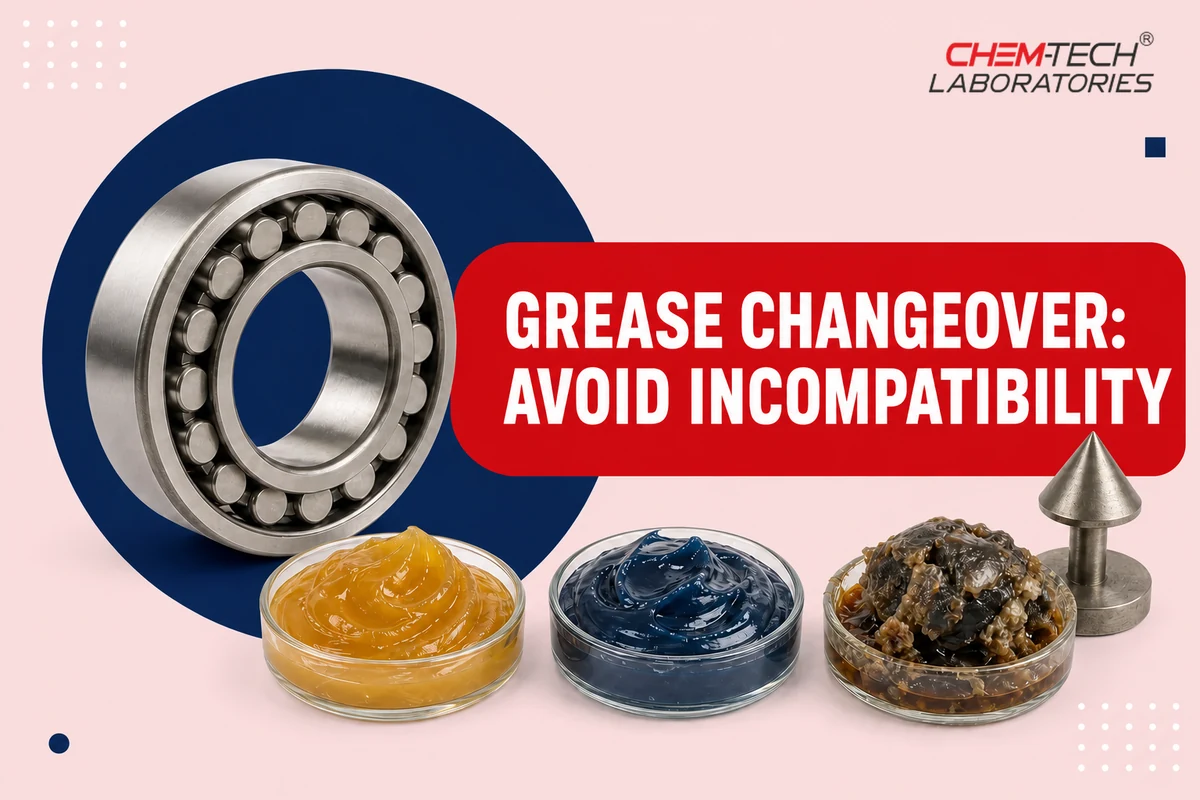
Oil on the surface of a grease container or housing is not automatically a product defect. Controlled oil release is part of grease lubrication, but excessive bleeding can starve one zone and leak into another. Hardening, softening and contamination also have multiple causes that cannot be separated by appearance alone.
Chem-Tech investigates grease failures by comparing the affected material with unused product and, where possible, a normally performing position. Operating temperature, relubrication quantity, bearing design, storage, water and process contamination determine which tests are useful.
Article section
Translate the visible symptom into possible mechanisms
Bleeding may reflect storage temperature, overfilling, vibration, thickener structure or incompatibility. Hardening may result from oil loss, oxidation, high temperature or contamination. Softening may follow mixing, shear, water or process-fluid ingress. Each mechanism points to a different correction.
Do not wash or homogenise the evidence before sampling. Separate free oil, bulk grease, hardened deposits and contaminants when they occupy distinct zones, and document where each portion was found.
- Free oil collects in packaging, lines, seals or bearing housings beyond normal experience.
- Grease becomes dry, cracked or difficult to purge before the planned interval.
- Consistency collapses, leakage increases or central lines lose pressure.
- Water, dust, fibres, process chemicals or metallic debris appear in the grease.
Article section
Compare structure, base oil and contamination
Worked penetration, oil separation and stability tests describe grease structure under defined conditions. Base-oil viscosity and elemental analysis support product and contamination comparison. Water, corrosion and wear tests are added when the application symptom requires them.
New-grease specification methods do not always translate directly to small, heterogeneous used samples. Chem-Tech confirms whether sufficient representative material is available and explains when a result is comparative rather than a formal product-conformance result.
Bleeding
Oil-separation evidence, storage temperature and housing condition help distinguish normal release from excessive separation.
Hardening
Consistency, base-oil loss, oxidation and contamination are reviewed together.
Softening
Mixing, shear, fluid ingress and product mismatch are considered before changing grade.
Contamination
Water, elements, debris and microscopy can connect the grease to an ingress or wear source.
Article section
Indicative grease-failure packages
The package is selected for the symptom, available quantity and comparison samples. It is not necessary to run the full new-grease catalogue for every failure.
| Package | Use when | Indicative tests and methods | Decision supported |
|---|---|---|---|
| Physical condition | Bleeding, hardening or softening | Worked penetration — ASTM D217; oil separation — IP 121/ASTM D1742; base-oil viscosity — ASTM D445; dropping point — ASTM D566 | Assess structure and oil-release change |
| Contamination and corrosion | Water, process ingress or rust | Water — ASTM D95/D1744; elemental analysis — ASTM D7303; copper corrosion — ASTM D4048; Emcor — ASTM D6138, as relevant | Investigate ingress and protection loss |
| Stability and wear | Repeated leakage, shear or bearing damage | Roll stability — ASTM D1831; heat stability — ASTM D6184; four-ball wear — ASTM D2266; debris examination by agreement | Connect grease change with mechanical consequence |
Performance tests on used grease may not have the same interpretation as tests on new product. The report states the sample condition and applicable limitation.
Request a scope and package discussionArticle section
Keep distinct grease zones distinct
A homogenised jar can erase the difference between free oil, working grease and hardened deposits. Collect separate portions when the visual distribution is part of the failure.
- Photograph the container, bearing or lubrication line before collection.
- Use clean tools and wide-mouth containers for each distinct material zone.
- Submit unused product from a traceable container and a normal used comparator.
- Record storage and operating temperatures, relubrication quantity and interval.
- Retain failed bearings, seals and filters until the grease evidence is reviewed.
Article section
Correct the cause rather than changing consistency blindly
A harder or softer NLGI grade is not a universal solution. Address overfilling, heat, seal condition, incompatible products, central-system delivery, water or process ingress according to the combined evidence.
After correction, monitor a small set of representative assets and compare new purge samples with the baseline. Repeat failure after a product change may indicate the application or contamination pathway remains unresolved.
- Review storage and handling when separation begins before service.
- Check product compatibility before mixing or changing supplier.
- Adjust quantity and interval only with bearing and lubrication-system evidence.
- Verify improved temperature, leakage and grease condition after action.
Apply this guidance