

Technical perspective
Grease contamination analysis is the structured review of foreign material, unwanted fluids, wear debris or an unintended second grease within a lubricating grease sample. In industrial equipment, contamination can change grease consistency, interfere with oil release from the thickener system, promote corrosion, accelerate abrasive wear and make the grease less representative of the product originally installed. The useful question is therefore not simply whether a grease looks dirty, but what may have entered it, whether the evidence is representative of the component, how the condition is changing and what maintenance action should follow.
Grease is harder to sample and interpret than a circulating oil because it does not continuously homogenise through a reservoir. Grease near a seal, raceway, purge outlet or housing pocket can experience different contamination, temperature and shear. A defensible contamination investigation therefore combines repeatable sampling, equipment history, fresh-grease comparison where available and only those laboratory parameters that Chem-Tech has confirmed for the submitted sample and current facility capability.
Article section
What grease contamination analysis should answer
A good grease contamination analysis separates four questions that are often mixed together. First, has an external contaminant such as water, dust or process material entered the component? Second, is the machine generating wear debris? Third, has the grease changed in consistency or oil-release behaviour during service? Fourth, has another grease or lubricant been introduced during relubrication, storage or changeover? A single result rarely answers all four questions, so the investigation should be built around the suspected failure mechanism rather than a fixed universal panel.
Water or process-fluid ingress
Review moisture exposure, wash-down, condensation, damaged seals and nearby process-fluid sources together with the available laboratory evidence.
Dirt and hard particles
Investigate dust, sand, scale, fibres and other solids that may enter through seals, open fittings, storage or maintenance activity.
Wear debris
Compare wear-related evidence with component metallurgy, operating history, vibration, temperature and inspection findings.
Mixed or wrong grease
Check relubrication records, grease-gun control, storage practices, product identity and changes in consistency or chemistry against an unused reference where practical.
Article section
Why contamination matters in grease-lubricated equipment
A lubricating grease is a semi-solid system in which base oil is retained by a thickener and released into the lubricated contact during operation. Foreign material can disturb this structure or create a separate damage mechanism. Water may promote corrosion and alter consistency; hard solids can enter rolling or sliding contacts; process chemicals may affect the thickener or additives; and another grease can change consistency or oil separation depending on the formulations and the mixing ratio.
The operating consequence depends on bearing design, speed, load, temperature, seal condition, purge path and relubrication interval. This is why visual appearance alone is unreliable. Dark grease can result from wear, oxidation, solid contamination or normal additive colour. Softened grease can result from water, mechanical shear, heat or incompatible mixing. Grease analysis is most useful when the laboratory evidence is treated as one part of a cause-and-effect investigation.
- Record abnormal bearing temperature, noise, vibration, relubrication frequency and purge condition.
- Record wash-down, dust exposure, seal damage, recent maintenance and any known process leak.
- Retain an unused sample of the correct grease whenever product comparison or contamination investigation is important.
- Treat sudden changes after relubrication or changeover as a potential mixing or application-control issue until investigated.
Article section
Water and moisture contamination
Water is one of the most important contaminants to investigate in grease-lubricated bearings exposed to wash-down, outdoor service, steam, condensation or cooling-water systems. The practical significance is not only the amount of moisture detected. Maintenance teams need to know when the condition began, whether it is localised to one side of the bearing, whether it appears after a particular process event and whether it returns after the presumed ingress route has been corrected.
A repeatable sampling position is therefore essential for trend interpretation. If one sample is taken from purged material and the next from a different internal location, the apparent change may reflect sampling position rather than equipment condition. When moisture is suspected, pair the laboratory result with inspection of seals, covers, vents, wash-down direction, nearby piping and storage or handling practices. Correcting the ingress route and then resampling from the same location provides stronger evidence than relying on a single before-and-after visual inspection.
Article section
Dirt, dust and process contamination
Hard particles can enter grease during storage, transfer, relubrication or operation. Dusty plants, mining and cement equipment, open conveyors and poorly protected grease fittings are particularly vulnerable. The contamination may remain concentrated near the entry route or become embedded in the grease close to the rolling contact. External solids can contribute to abrasive wear, damage seals and alter the appearance or texture of the grease.
Elemental or other laboratory evidence should always be compared with the unused grease because some elements can originate from the formulation rather than from dirt or wear. Silicon, calcium, aluminium, iron and other elements cannot be assigned to a source solely from their presence. Maintenance history, component materials and the pattern across repeated samples are needed to distinguish a formulation characteristic from environmental ingress or machine-generated debris.
Article section
Wear debris and machine-generated contamination
Wear debris is technically different from external contamination, but in practice the two can interact. Dirt ingress can promote abrasive wear, while a damaged bearing can generate metallic debris that becomes retained in the grease. Used grease therefore acts as a repository of both lubricant-condition evidence and material generated by the equipment. The interpretation should ask whether the wear-related evidence is increasing, whether the component metallurgy provides a plausible source and whether other condition-monitoring technologies support the same concern.
A maintenance decision should not be based on a single wear-related number without context. A grease charge can trap material unevenly, a recent relubrication can dilute the sampled grease, and the sample location can change the observed debris concentration. When an abnormal result is found, review vibration, temperature, noise, bearing clearance, seal condition and inspection findings before deciding whether the machine requires immediate intervention or a controlled repeat sample.
Article section
Mixed grease and cross-contamination
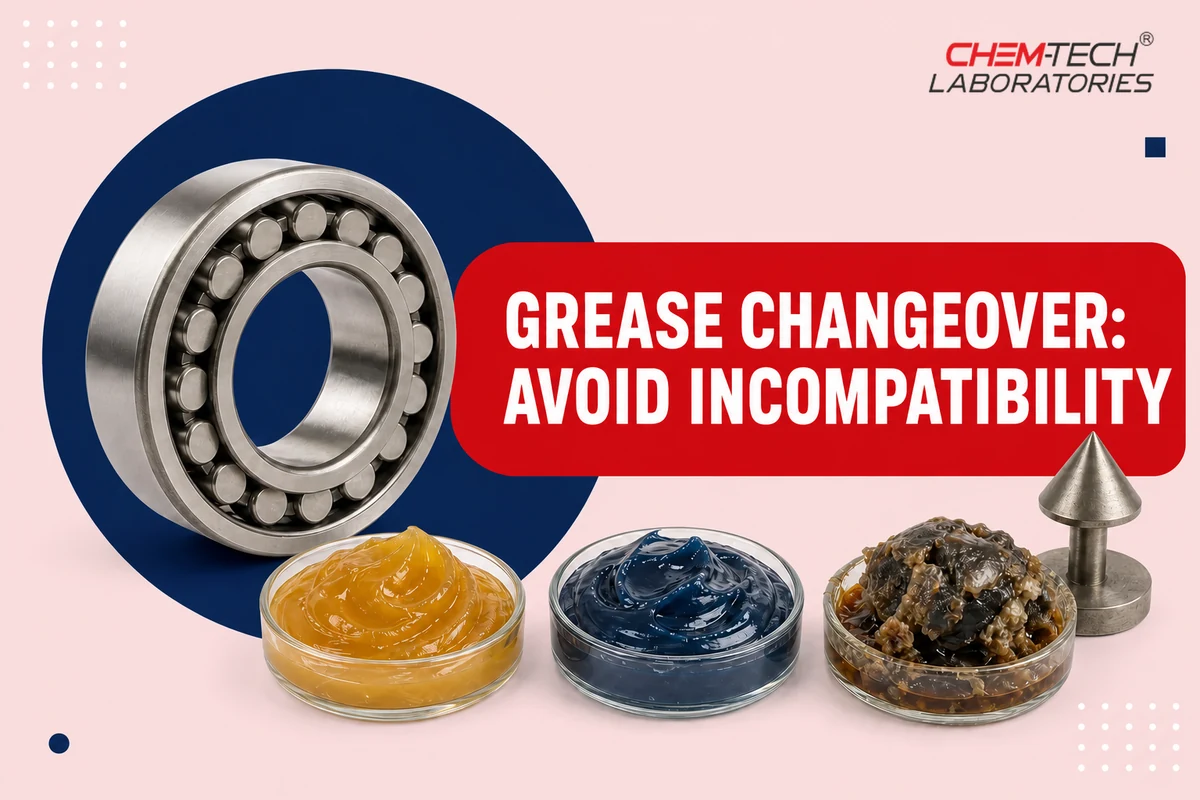
Grease cross-contamination commonly occurs through the wrong grease gun, shared transfer tools, incorrectly labelled containers, a centralised system filled with the wrong product or incomplete changeover from one grease to another. Two greases that are individually acceptable can produce an undesirable mixture because their thickener systems, base oils and additives may respond differently when combined. The mixture can soften, harden, separate oil or change mechanical behaviour.
A useful mixing investigation starts with product identity and maintenance records. If possible, compare the in-service grease with unused samples of both candidate products. Consistency, base-oil characteristics, thickener or soap information and other confirmed parameters can then be interpreted together. Colour, brand name or identical NLGI grade are not sufficient evidence of compatibility. The existing Chem-Tech compatibility guide explains this distinction in more detail.
Article section
Select only tests that answer the actual contamination question
Grease testing should be selected from the contamination hypothesis and the current laboratory capability confirmed by Chem-Tech. Depending on the sample, quantity and agreed scope, the laboratory may be able to review properties such as consistency, water, selected elemental information, base-oil characteristics, thickener or soap information, dropping point or other grease parameters. The applicable test method is confirmed before testing and is the method stated in the laboratory report; this article does not create or expand the laboratory's approved test scope.
| Question | Potential evidence to discuss with the laboratory | Interpretation caution |
|---|---|---|
| Has moisture entered? | Water-related testing, appearance, consistency and exposure history | A moisture result does not identify the source by itself. |
| Is environmental dirt present? | Available contaminant indicators plus fresh-grease comparison and inspection | Formulation elements can overlap with contaminant elements. |
| Is the component wearing? | Available wear-related evidence plus metallurgy, vibration and inspection | One grease sample may not represent the whole component. |
| Was the wrong grease introduced? | Consistency, product comparison, thickener/base-oil evidence and maintenance records | Colour or NLGI grade alone cannot establish compatibility. |
| Has service changed the grease? | Consistency and other confirmed condition/performance parameters | Heat, shear, contamination and mixing can act together. |
Article section
Sampling quality controls the value of grease analysis
A contamination result is only as good as the sample. Because grease can be non-uniform within a bearing or housing, the exact collection point should be documented. Purged grease, grease from a fitting, grease near a seal and grease taken from an internal raceway can represent different zones. For routine trend analysis, use the same safe and practical location and collect under comparable equipment conditions whenever possible.
- Identify the asset, component, bearing position, grease product, equipment hours and grease service interval.
- Record exactly where the sample was taken and whether the equipment was running, stopped, hot or recently relubricated.
- Use clean tools and containers and avoid adding dirt from exposed fittings or housing surfaces unless that material is the subject of the investigation.
- Collect enough representative grease for the tests agreed with the laboratory before dispatch.
- For troubleshooting, consider paired samples from an abnormal and apparently normal location plus unused grease from the correct product.
Article section
Interpret grease contamination as a trend
The strongest grease contamination analysis converts laboratory results into a testable maintenance hypothesis. If water-related evidence increases after wash-down and damaged seals are found, the ingress mechanism becomes more credible. If dirt-related indicators and wear evidence rise together, abrasive contamination deserves attention. If consistency changes immediately after a different grease was added, mixing becomes a stronger hypothesis. Each conclusion should state what supports it, what remains uncertain and what follow-up evidence would confirm or reject it.
| Observed pattern | Possible interpretation | Practical response |
|---|---|---|
| Moisture increases while wear evidence remains stable | Ingress may be present before measurable damage increases | Inspect exposure and seals, correct the route and resample from the same position. |
| Dirt-related evidence and wear rise together | Abrasive contamination may be contributing to machine wear | Correct ingress and review bearing condition with complementary monitoring. |
| Consistency shifts after a grease change | Mixing, shear or temperature effect is possible | Compare product references and changeover history before assigning cause. |
| One bearing position is abnormal and another is normal | Contamination may be localised | Map additional locations instead of averaging the result. |
| Results improve after corrective action | The action may be effective | Continue the trend to verify sustained control. |
Article section
Prevent recurrence through lubrication control
Laboratory testing is most valuable when it leads to prevention. Use dedicated and clearly identified grease guns, protect bulk containers from dirt and water, keep transfer tools clean, close fittings and ports, maintain seals and covers, and document the exact product approved for each asset. Where wash-down or process exposure is unavoidable, review shielding, seal design and relubrication practice rather than relying only on more frequent grease addition.
For critical equipment, connect grease results to the maintenance system. Record the contamination finding, suspected route, corrective action, date of repair or lubrication change, and the follow-up sample result. Over time, this creates an evidence trail showing whether contamination is recurring, whether a specific asset family has a sealing problem and whether the lubrication-control programme is improving equipment reliability.
Apply this guidance