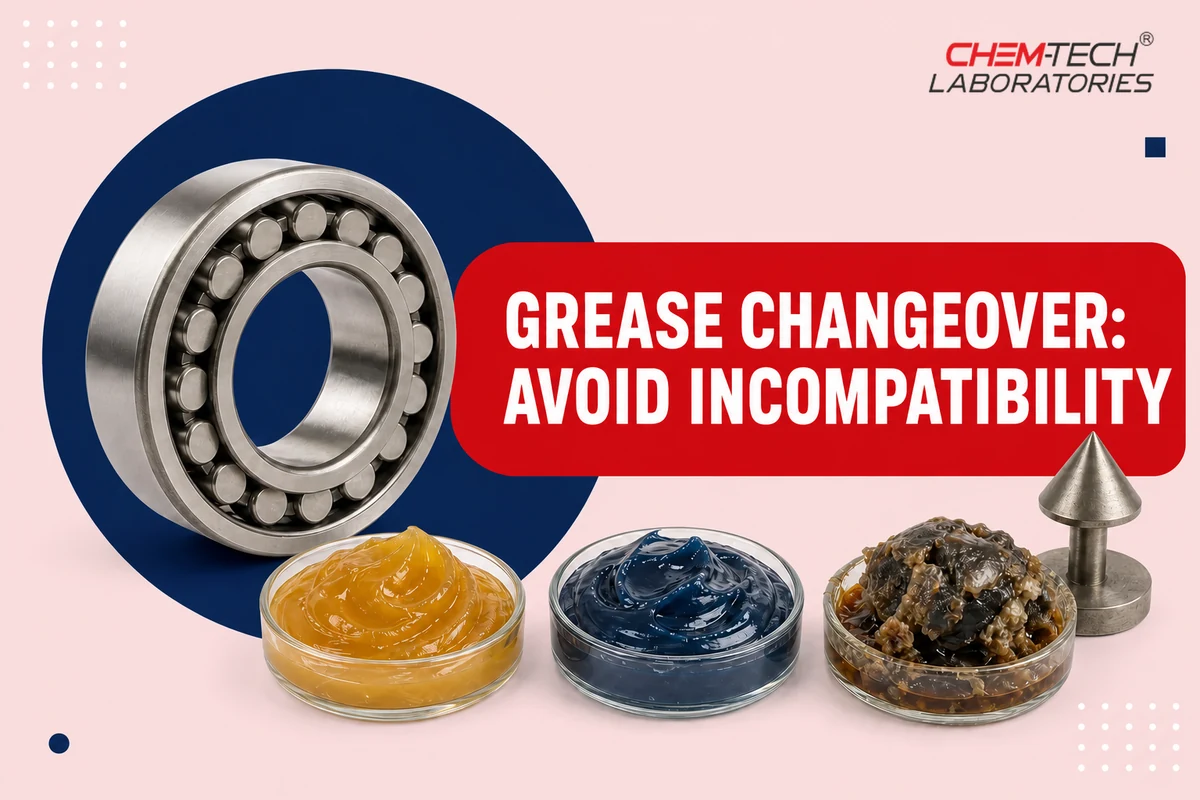


Technical perspective
Grease analysis of industrial equipment applies laboratory evidence to grease-lubricated bearings, electric motors, gearboxes, open gears, conveyors and heavy machinery where the lubricant is difficult to inspect during normal operation. The objective is not merely to report a grease property. A useful programme asks whether the grease has materially changed, whether contamination has entered the component and whether the equipment is generating abnormal wear evidence. Those questions become maintenance information only when the laboratory results are combined with asset identity, operating history and other condition-monitoring data.
Industrial grease analysis differs from routine circulating-oil analysis because a grease charge can be highly non-homogeneous. Grease near the rolling contact, seal, purge path or outer housing can experience different heat, shear and contamination. The programme therefore depends heavily on sample location and repeatability. Chem-Tech should confirm the sample quantity, tests and methods that are currently available before the sample is collected or dispatched; this guide does not imply availability of any unquoted method or specialised grease-analysis facility.
Article section
What industrial equipment grease analysis can tell maintenance teams
Grease condition
Compare available consistency and other confirmed properties with unused grease or historical data to identify material change.
Contamination
Investigate water, dirt, process material or unintended grease mixing using the laboratory evidence available for the sample.
Wear evidence
Review available wear-related information with component metallurgy, temperature, vibration and inspection.
Maintenance effectiveness
Use repeat comparable samples after seal repair, relubrication, purge or changeover to see whether the abnormal pattern is recovering.
The strongest use case is trend monitoring on critical assets. A one-time sample can support troubleshooting, but repeated samples from a controlled location make it easier to separate a normal grease characteristic from a developing contamination or machine problem. Where practical, retain unused grease from the approved product as a reference and record major maintenance or relubrication events on the trend.
Article section
Industrial assets where grease analysis is useful
Grease analysis can support equipment where grease is a critical lubricant and a representative sample can be obtained safely. The sampling method and interpretation should reflect the component. A small electric-motor bearing, a slow conveyor pillow block, a grease-lubricated gearbox and a large slew ring do not contain the same grease volume or experience the same contamination routes, shear or wear mechanisms.
- Rolling-element and pillow-block bearings in conveyors, fans, crushers, screens, pumps and process equipment.
- Electric-motor bearings where relubrication quantity, temperature and contamination control affect reliability.
- Grease-lubricated gearboxes and enclosed components where used grease can retain condition and debris evidence.
- Open gears, slew rings and large bearings where different positions can experience different contamination and load.
- Mining, cement, steel, construction and material-handling machinery exposed to dust, water, shock load and heavy duty cycles.
- Failed bearings or components where retained grease can contribute evidence alongside physical inspection and other failure-analysis information.
Article section
Start with the asset and failure mode, not a generic test package
A grease-analysis programme should begin with the machine question. If the concern is water ingress, the selected scope should support a moisture investigation. If a bearing is overheating after relubrication, review quantity, grease identity, compatibility, consistency and mechanical condition. If wear is suspected, combine available grease evidence with vibration, temperature and inspection. If a new grease was introduced, product comparison and changeover records become particularly important.
The Chem-Tech Grease Testing & Analysis service page remains the controlling source for the current laboratory offering. Before quoting a method, parameter or accreditation status, the sample and requirement should be checked against the current controlled test list and laboratory capability. SEO content should never be treated as an expansion of the actual facility scope.
Article section
Grease analysis for bearings
Rolling-element bearings are a common application because the grease can retain contamination and wear evidence close to the contact. The interpretation should distinguish between the grease near the raceway, material expelled during relubrication and material collected from around a seal or housing. These zones may show different conditions. A trend is strongest when the same position is sampled under comparable operating and relubrication conditions.
For a bearing with rising temperature or vibration, grease testing can support the investigation but should not replace mechanical inspection. Review the correct grease product, NLGI grade, relubrication interval, quantity, seal condition, contamination exposure and loading. If the grease appears abnormally soft, hard, wet or heavily contaminated, select only the confirmed laboratory parameters that can help discriminate among these possible causes.
Article section
Grease analysis for electric motors
Electric-motor bearings often contain a relatively small grease volume, so recent relubrication can strongly affect the sample. Overgreasing can increase churning and temperature, while undergreasing, contamination or incorrect grease can also contribute to bearing distress. Record the motor bearing position, grease product, relubrication date, quantity, operating temperature and any vibration or ultrasound observations before interpreting the result.
When comparing motors across a plant, group comparable motor sizes, bearing arrangements and grease products rather than applying one alarm to every motor. A fleet trend can identify which assets repeatedly show abnormal contamination or consistency changes, but the maintenance response should still account for each motor's duty, environment and lubrication practice.
Article section
Grease analysis for gearboxes, open gears and large bearings
Some gearboxes and geared mechanisms use grease instead of circulating oil, while open gears and large bearings can retain substantial grease volumes across a broad surface. In these applications, one sample may not represent the entire component. Different locations can experience different loads, contamination, temperature and purge behaviour. Mapping the sample position is therefore important when comparing results over time.
For large bearings or slew rings, consider whether multiple positions are needed to understand localised ingress or wear. For open gears, note environmental dust, spray application, exposed surfaces and any process contamination. For grease-lubricated gearboxes, record whether the sample was taken near the active gearing, the housing or a purge area. This location information can be as important as the laboratory number when the grease is non-uniform.
Article section
Grease analysis for heavy industrial machinery
Mining, cement, steel, ports, construction and bulk-material-handling equipment often combine heavy load, shock, dust, water and difficult access. Grease analysis can help maintenance teams determine whether relubrication practice and contamination control are effective, particularly on bearings where failure has high production consequences. The programme should focus first on critical assets and known contamination routes rather than attempting to sample every grease point in the plant.
A useful criticality screen considers safety, production loss, repair time, replacement cost, redundancy and historical failure. High-criticality assets justify more disciplined sample identification, shorter review intervals and stronger follow-up after abnormal results. Lower-criticality points may be managed primarily through correct lubrication practice and inspection unless a recurring problem justifies laboratory analysis.
Article section
Selecting a practical industrial grease test scope
A practical scope should answer the maintenance question using only parameters and methods that Chem-Tech has confirmed as currently available. Depending on the sample and objective, discussion may include consistency, water, selected elemental information, base-oil characteristics, thickener or soap information, dropping point or other grease properties present in the current controlled test list. The required sample quantity can differ substantially between tests, so the laboratory should confirm the scope before collection.
| Maintenance question | Evidence to discuss | Why context matters |
|---|---|---|
| Has consistency changed? | Available consistency testing plus unused-grease comparison | Heat, shear, water and mixing can all change consistency. |
| Is water entering? | Available water-related testing plus seal and exposure history | The result does not identify the ingress route by itself. |
| Is environmental dirt present? | Available contaminant indicators plus fresh-grease comparison | Some elements originate from the grease formulation. |
| Is the component wearing? | Available wear-related evidence plus component metallurgy and condition monitoring | Grease can retain debris unevenly within the component. |
| Was the wrong grease added? | Product identity, consistency and other available comparison parameters | Colour and NLGI grade alone are insufficient. |
Article section
Sampling strategy by equipment type
Sampling is often the limiting factor in industrial grease analysis. The sample must represent the operating question without introducing dirt from fittings, housings or tools. A trending programme should use the same safe collection position and comparable equipment state whenever practical. If a component is large or the grease does not circulate, multiple defined positions may be more informative than one blended sample.
| Asset | Sampling consideration | Trend note |
|---|---|---|
| Electric motor bearing | Small grease charge and recent relubrication can dominate the sample | Record date, quantity and bearing position. |
| Pillow-block bearing | Different sides of the bearing may retain different contamination | Keep position and collection depth consistent. |
| Grease-lubricated gearbox | Material near gears and housing may not be homogeneous | Record exact collection point and operating state. |
| Large bearing / slew ring | Spatial variation can be significant | Map sample positions where multiple locations are justified. |
| Failed component | Cleaning or dismantling can disturb evidence | Document where each retained grease sample was obtained. |
- Label each sample with asset ID, component position, grease product, equipment hours and estimated grease service time.
- Record top-ups, regreasing, repairs, overheating, wash-down and abnormal operating events.
- Use clean sampling tools and containers and avoid collecting unrelated dirt from exposed housing surfaces.
- Confirm the sample amount required for the agreed test scope before collecting from small bearings.
Article section
Interpret trends rather than isolated numbers
Grease analysis becomes more useful when successive samples are comparable. Plot the selected results against equipment hours or grease service time where possible and annotate relubrication, grease changes, seal repairs, bearing replacement and abnormal process events. A moderate value that rises steadily may deserve more attention than a higher but stable value on another asset with different duty and grease volume.
Universal limits should be avoided unless they come from an applicable OEM, grease supplier, customer specification or an internally validated asset baseline. Used grease behaviour varies substantially with product type, application and sample location. The objective is to detect meaningful deviation from the correct reference and then investigate whether the change is caused by lubricant condition, contamination, machine wear or maintenance practice.
Article section
Combine grease analysis with vibration, temperature and inspection
Grease analysis is one evidence stream within condition monitoring. Vibration can identify dynamic mechanical changes; ultrasound can support lubrication and bearing assessment; temperature can show friction or process loading; inspection can reveal seal damage and purge condition; and grease analysis can retain evidence about the lubricant and contamination inside the component. Combining these sources reduces the risk of over-interpreting any single result.
Abnormal grease + abnormal vibration
The combined evidence supports a more focused bearing or component inspection.
Contamination without wear escalation
This can be an opportunity to correct ingress before measurable mechanical deterioration increases.
Wear-related evidence without other symptoms
Verify sample representativeness and review the trend before dismissing or escalating the result.
High temperature after relubrication
Review quantity, grease identity, compatibility, bearing condition and load rather than assuming grease chemistry alone is responsible.
Article section
Build a closed-loop industrial grease analysis programme
A mature programme begins with criticality. Identify grease-lubricated assets whose failure matters most, define a repeatable sample position and interval, confirm the correct grease product and reference, and select a focused laboratory scope tied to known failure modes. The report history should preserve asset identity so that maintenance teams can see whether a condition is stable, deteriorating or recovering after intervention.
The programme should also close the loop. When a report leads to seal repair, lubrication correction, grease changeover, purge or bearing inspection, record the action and obtain follow-up evidence at an appropriate interval. If the abnormal pattern persists, the original cause hypothesis may be incomplete. If the pattern returns toward baseline and other condition-monitoring indicators also improve, the corrective action is better supported. This turns grease analysis into a reliability process rather than a sequence of disconnected certificates.
Apply this guidance