Technical perspective
Engine oil can carry evidence from combustion, cooling, air intake and fuel systems at the same time. Soot, coolant and fuel dilution all change lubricant performance, but their signatures and corrective actions differ. Treating every viscosity or wear change as a generic oil problem can delay the mechanical diagnosis.
A better approach is to read contamination indicators as a pattern and compare them with wear metals, viscosity, additive chemistry, service hours and engine symptoms.
Article section
Fuel dilution tends to reduce oil viscosity
Unburned fuel can enter the crankcase through injection, combustion or operating issues. Significant dilution can reduce viscosity and flash point and may weaken lubricant film strength. Gas chromatography is commonly used when a quantitative fuel-dilution result is required.
Article section
Soot can drive thickening and abrasive loading
Combustion soot is expected in many diesel engine oils, but excessive loading can thicken the oil, increase deposits and contribute to abrasive conditions when dispersion capacity is exceeded. Soot should be interpreted with engine load, combustion condition, air filtration, drain interval and viscosity trend.
Article section
Coolant ingress creates a different chemical risk
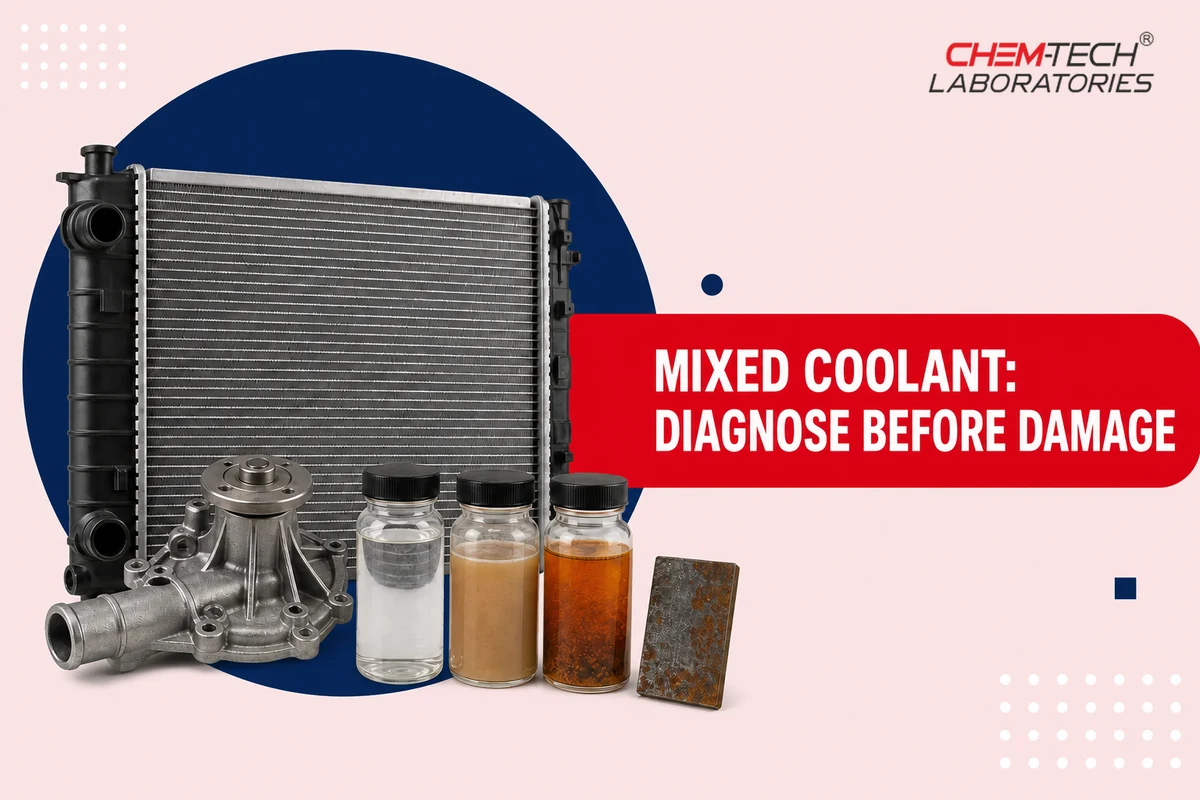
Coolant contamination can introduce water and coolant-related constituents, promote corrosion and disrupt lubricant chemistry. Depending on the coolant formulation and engine, elemental markers and spectral evidence can support the diagnosis, but the pattern should be compared with the actual coolant used in that equipment.
Article section
Use a differential-diagnosis mindset
Thinning + fuel evidence
Investigate injection, combustion, operating temperature and fuel-system causes.
Thickening + high soot
Investigate combustion quality, air handling, loading and drain interval.
Water/coolant markers + corrosion
Investigate cooling-system leakage, seals, heat exchangers and related engine condition.
Mixed pattern
Do not force one diagnosis; multiple faults can occur simultaneously and may accelerate wear together.
Article section
Engine-oil contamination in Indian fleets and DG sets
Commercial vehicles, earthmoving equipment and standby or prime-power DG sets in India can experience very different duty cycles, idling patterns and maintenance conditions. Soot, fuel dilution and coolant contamination can therefore appear in different combinations and should not be interpreted independently of operating history.
A useful investigation connects the oil results with fuel consumption, coolant loss, injector work, overheating, load pattern and recent service. Where the evidence suggests an active leak or combustion problem, the laboratory result should trigger inspection and a follow-up sample after corrective work.
Apply this guidance