

Industry overview
Oil analysis for automotive operations
Automotive lubricant testing links the condition of the oil with the operating history of the engine, transmission, axle or differential from which it was sampled. The objective may be routine fleet monitoring, an extended-drain review, incoming lubricant verification, warranty investigation or evidence gathering after an abnormal operating event.
Useful interpretation depends on repeatable sampling, correct lubricant identification and accurate service data. Results are reviewed as a connected set: viscosity and degradation indicators describe fluid condition; water, fuel, soot or coolant markers describe contamination; and elemental or ferrous-debris results provide wear-related evidence.
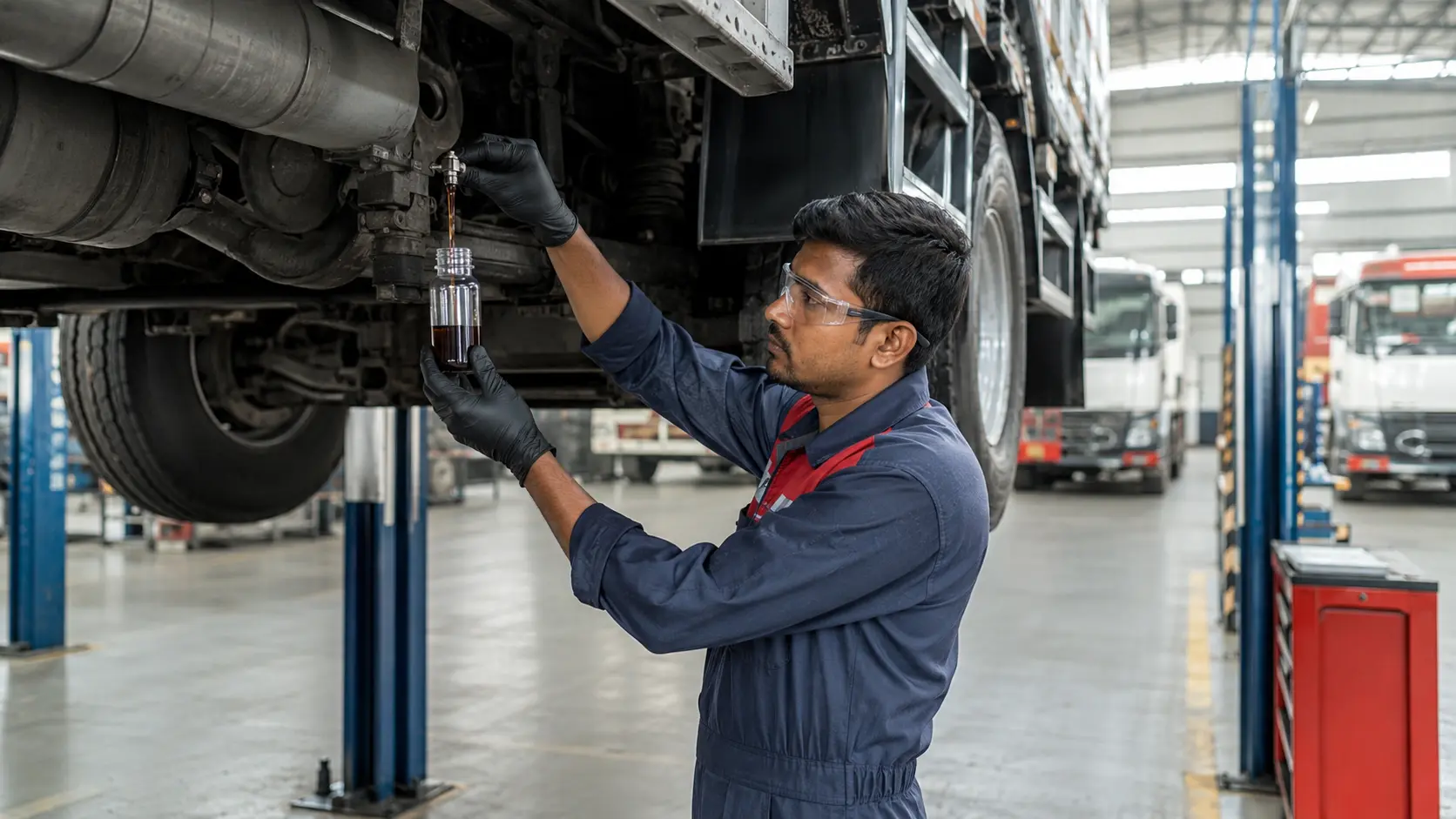
Engine, transmission, axle and differential results are interpreted with the correct fluid, service interval and vehicle duty.
Programme objectives
What a structured lubricant-testing programme can support
Track lubricant condition by vehicle, powertrain component, lubricant grade and service interval.
Investigate viscosity change, oxidation, soot, fuel dilution, water, coolant markers and wear-related elements as a connected result pattern.
Support fleet maintenance prioritisation, extended-drain studies, lubricant comparison and technical failure investigations with traceable sample context.
Distinguish a fleet-wide formulation or operating issue from an isolated vehicle or sampling event.
Assets and systems
Equipment covered by the monitoring programme
- Passenger and light commercial vehiclesEngine-oil, transmission-fluid, axle-oil and differential-oil condition assessment.
- Heavy commercial fleetsRepeatable lubricant monitoring across vehicles, depots, routes and duty cycles.
- Off-highway and special vehiclesComponent-specific scopes for engines, hydraulics, transmissions and final drives.
- Development and failure investigationsBaseline comparison, lubricant verification and targeted diagnostic testing for a defined technical question.
Who we support
Industry roles the programme is designed around
Fleet owners and operators
Monitor engines and driveline components by vehicle class, route, duty and service interval.
Vehicle and component OEM teams
Structure baseline, development, warranty and returned-component investigations around a defined technical question.
Lubricant manufacturers and suppliers
Support fresh-oil comparison, field trials and application-specific in-service performance review.
Workshops and technical service teams
Add laboratory evidence to inspection, scan-tool, cooling-system and mechanical findings.
Technical review
Condition and contamination priorities
Fuel dilution, soot and coolant markers
Contamination indicators support investigation of combustion, injection, cooling-system or operating-condition concerns.
Viscosity and lubricant degradation
Viscosity, acidity, reserve and spectral indicators are reviewed with oil grade, service distance, hours and top-up history.
Component-specific wear
Elemental and ferrous-debris findings are interpreted against component metallurgy, lubricant additives, filtration and prior results.
Fleet comparability
Consistent sampling timing, asset naming and maintenance records make vehicle-to-vehicle and interval-to-interval comparisons more meaningful.
Test strategy
Core test families and how the results are used
The examples below describe common condition-monitoring tools. The final test method, sample volume and accreditation status are confirmed for the lubricant, equipment and agreed objective before work begins.
| Test family | Why it is included | Interpretation focus | Method example |
|---|---|---|---|
| Kinematic viscosity | Checks the in-service oil against the intended grade and its own baseline. | Lower viscosity can be associated with dilution or shear; higher viscosity can be associated with oxidation, soot loading or mixing. Temperature and test basis must be consistent. | Kinematic viscosity — ASTM D445 / ISO 3104, where applicable |
| Elemental analysis | Screens selected wear, contaminant and additive elements in engine, transmission, axle and differential oils. | The pattern is reviewed with component metallurgy and the unused-oil additive profile. A single metal result does not identify a failure by itself. | Elemental analysis by ICP-AES — ASTM D5185, where applicable |
| FTIR oil-condition indicators | Supports trending of oxidation, nitration, soot and formulation-dependent contamination indicators. | Comparison with the correct unused oil and earlier samples improves confidence; mixed oil formulations can complicate spectral interpretation. | FTIR condition monitoring — ASTM E2412, where applicable |
| Water and coolant-related evidence | Investigates moisture or possible cooling-system ingress. | Water is reviewed with sodium, potassium, boron, viscosity, glycol-related indicators and cooling-system history before a conclusion is drawn. | Water by coulometric Karl Fischer titration — ASTM D6304, where applicable |
| Fuel dilution | Assesses whether unburned fuel may be reducing engine-oil viscosity and lubricating margin. | The result should be compared with operating pattern, idle time, injection condition, regeneration events, oil level and viscosity trend. | Selected instrumental procedure appropriate to the fuel and lubricant matrix |
| Soot, oxidation and nitration | Reviews combustion loading and thermal or chemical degradation in engine oils. | Trend direction, oil hours, engine duty, reserve and viscosity are considered together rather than applying an isolated number. | FTIR condition monitoring — ASTM E2412, where applicable |
| Acid and base reserve | Reviews acidic change and the remaining detergent or neutralising reserve of applicable engine oils. | Fresh-oil baseline, lubricant formulation, fuel type, service interval and OEM guidance determine how the values are interpreted. | Acid number by potentiometric titration — ASTM D664, where applicable; base number by an applicable ASTM procedure selected for the sample |
| Ferrous-debris screening | Adds evidence for larger magnetic wear material in gear, axle, differential and transmission applications. | PQ and ferrography results are reviewed with iron, viscosity, component history, magnetic-plug observations and noise or temperature reports. | PQ index and/or analytical ferrography — selected laboratory procedure |
Advanced diagnostics
Escalation tools for a defined technical question
Routine testing establishes the trend. Advanced diagnostics are selected when the result pattern, inspection evidence or maintenance question requires a more focused investigation.
Fuel dilution and combustion review
Combine fuel dilution, viscosity, soot, oxidation, nitration and reserve indicators for engine-oil interpretation.
- Consider when
- Use for short-trip duty, injector concerns, regeneration events, rising oil level or unexplained viscosity loss.
Driveline wear-particle analysis
Use PQ screening and ferrography to add particle-size and morphology evidence for axles, differentials, gears and transmissions.
- Consider when
- Use when iron, noise, temperature, filter debris or magnetic-plug findings require a deeper wear review.
Controlled lubricant comparison
Compare candidate or in-service oils against suitable unused references and consistent operating groups.
- Consider when
- Use for field trials, formulation changes, wrong-oil concerns or extended-drain programme design.
Fleet exception segmentation
Separate peer-group behaviour from a vehicle-specific exception using component, lubricant, duty and interval data.
- Consider when
- Use when one vehicle diverges from comparable units or a pattern appears across a depot or duty cycle.
Applicable programme scopes
Oil testing packages for the industry context
The final scope is selected for the lubricant, component, operating context and monitoring objective. The programme options below are drawn from Chem-Tech's published Oil Condition Monitoring scopes.
Engine Oil - Basic
Routine screening for automotive, construction and mining engines.
View included test families
- Appearance
- Kinematic Viscosity at 40°C
- Kinematic Viscosity at 100°C
- Viscosity Index
- Water Content
- Total Acid Number
- Total Base Number
- Soot Content
- Elemental Analysis
Engine Oil - Advanced
Expanded engine-oil condition review with degradation and dilution indicators.
View included test families
- Appearance
- Kinematic Viscosity at 40°C
- Kinematic Viscosity at 100°C
- Viscosity Index
- Water Content
- Total Acid Number
- Total Base Number
- Soot Content
- FTIR — Oxidation / Nitration
- Elemental Analysis
- Fuel Dilution
Axle Oil
Condition and wear review for axle and final-drive lubricants.
View included test families
- Appearance
- Kinematic Viscosity at 40°C
- Kinematic Viscosity at 100°C
- Viscosity Index
- Water Content
- Total Acid Number
- Elemental Analysis
- PQ Index
Transmission Oil
Condition and wear review for transmission oils and fluids.
View included test families
- Appearance
- Kinematic Viscosity at 40°C
- Kinematic Viscosity at 100°C
- Viscosity Index
- Water Content
- Total Acid Number
- Elemental Analysis
- PQ Index
Differential Oil
Condition and wear review for differential and severe-duty gear systems.
View included test families
- Appearance
- Kinematic Viscosity at 40°C
- Kinematic Viscosity at 100°C
- Viscosity Index
- Water Content
- Total Acid Number
- Elemental Analysis
- PQ Index
Gear Oil
Condition and wear review for industrial and automotive gear oils.
View included test families
- Appearance
- Kinematic Viscosity at 40°C
- Kinematic Viscosity at 100°C
- Viscosity Index
- Water Content
- Total Acid Number
- Elemental Analysis
- PQ Index
Sampling programme
From asset register to representative repeat samples
Define the monitoring objective
Separate routine fleet trending from drain-extension, lubricant comparison, warranty or failure-investigation work; each objective needs different controls.
Keep component identities separate
Record engine, transmission, axle, differential or hydraulic component individually, even when multiple samples come from one vehicle.
Sample consistently
Collect warm, well-circulated oil from the same representative point and at a comparable service interval whenever safe and practicable.
Capture service context
Record odometer or equipment hours, oil distance or hours, top-up, filter changes, lubricant grade, duty cycle and recent repairs.
Retain references for investigations
Preserve unused oil, filters, drain debris and relevant fuel or coolant samples when a technical investigation may require comparison.
Interpretation workflow
Turn an exception into a controlled next step
Laboratory results become more useful when each signal is verified against sample quality, asset history and independent condition evidence before action is assigned.
Observed pattern
Viscosity falls and fuel dilution increases
- Review
- Check short-trip or idle duty, injection condition, regeneration activity, oil level and sampling timing.
- Possible next step
- Confirm the trend and coordinate the result with engine diagnostics before changing the service interval.
Observed pattern
Soot and viscosity rise together
- Review
- Review combustion, air handling, duty cycle, oil hours, filtration and the applicable engine-oil formulation.
- Possible next step
- Prioritise the vehicle for maintenance review and use repeat data to verify the response.
Observed pattern
Sodium, potassium, boron or water changes unexpectedly
- Review
- Compare with the fresh-oil additive pattern and coolant chemistry; inspect the cooling system and top-up history.
- Possible next step
- Use targeted confirmation and a repeat oil sample before assigning the source.
Observed pattern
Wear-related elements rise in one vehicle but not its peers
- Review
- Validate component identity, oil interval, repair history, metallurgy and operating severity.
- Possible next step
- Resample and correlate with inspection, filter debris, noise, temperature or performance evidence.
Sample submission
Information that makes the laboratory result actionable
- Asset, vehicle, vessel or turbine identifier and the exact component sampled
- Lubricant brand, product name, SAE or ISO viscosity grade and whether the oil is mineral or synthetic
- Equipment hours or distance, oil hours or distance, top-up quantity and date of the last oil or filter change
- Sampling point, sample date, operating condition at sampling and any deviation from the normal procedure
- Recent maintenance, filtration, repair or lubricant-mixing activity
- Reported symptoms, alarms, inspection findings and the decision the testing is intended to support
- A representative unused reference oil when formulation comparison is important
Allied work
Programme support beyond laboratory testing
Fleet sampling protocol
Standardise sample points, labels, service data and dispatch across workshops and depots.
Explore supportFuel and coolant investigation
Extend the review when operating evidence indicates a related diesel, petrol or coolant concern.
Explore supportAsset-level reporting
Organise repeat samples and reports by vehicle, component and service interval.
Explore supportBefore sampling
Preserve equipment context
Record the asset, component, lubricant grade, sampling point, oil hours, equipment hours, top-up history, filter changes and relevant maintenance activity.
Review sampling guidelinesAfter reporting
Interpret results as a trend
Review repeat data with equipment history, operating conditions, maintenance observations and previous results rather than relying on one value alone.
Read the oil-analysis guideFrequently asked questions
Automotive Lubricant Testing FAQs
Can automotive oil analysis support extended drain intervals?
It can provide evidence about lubricant condition and contamination, but an extension programme should be controlled, risk-based and aligned with OEM, warranty and operational requirements. One satisfactory sample is not enough.
Can engine oil reveal a coolant leak?
Water and selected elemental or spectral indicators can support investigation of coolant ingress. Confirmation requires comparison with the oil and coolant formulations plus cooling-system evidence.
Do you test transmission, axle and differential oils as well as engine oil?
Yes. These components need their own scope because their lubricants, wear metals, contamination risks and interpretation differ from engine oil.
Is a high wear-metal result proof of component failure?
No. Results must be checked against the component metallurgy, oil formulation, sample history, particle-size limitations and corroborating maintenance evidence.
Can oils from different vehicle makes be compared?
They can be grouped only when the component type, lubricant, duty and service interval are sufficiently comparable. Fleet dashboards should avoid combining unlike engines or lubricant formulations into one baseline.
What is needed for a failure investigation?
Submit the failed and comparison samples where available, unused oil, component details, service history, repair evidence, symptoms and the specific question the investigation must address.
Discuss your programme