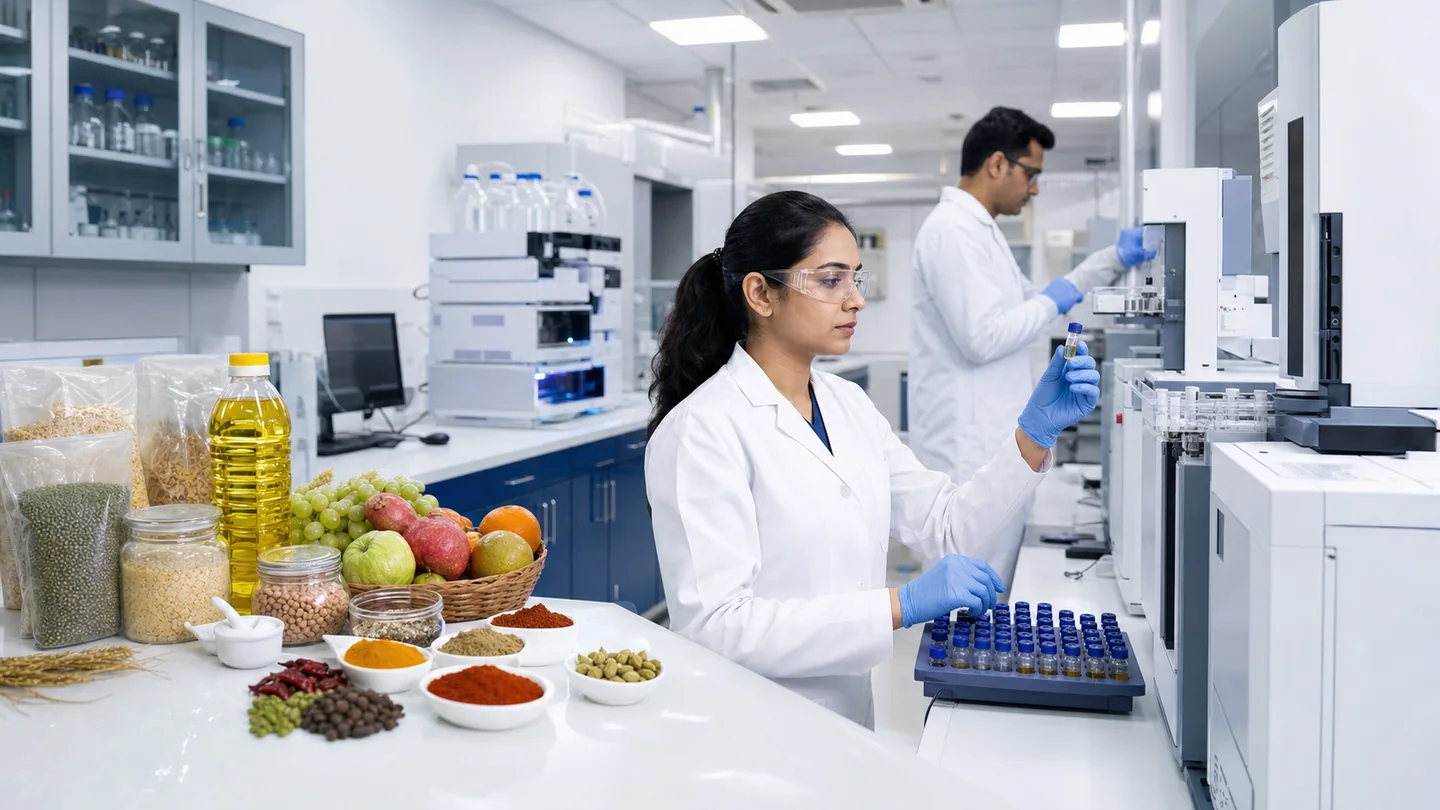

Technical perspective
Microbiological testing is essential for identifying pathogens, indicator organisms and spoilage risks, but a microbiologically acceptable food is not automatically chemically safe, compositionally correct or accurately labelled. Food quality and compliance depend on multiple classes of evidence.
A complete risk-based testing programme therefore combines microbiology with chemical analysis selected for the product, ingredients, process, claims and supply chain. FSSAI's regulatory framework itself treats product standards, additives, contaminants and residues, and labelling as distinct compliance dimensions, which is why a microbiology-only approach cannot answer every food-safety question.
Article section
Microbiology answers biological-hazard questions
Microbiological analysis can look for pathogens such as Salmonella or relevant E. coli, hygiene indicators, total counts, yeasts and moulds depending on the food and regulatory requirement. These results support process hygiene, release decisions and shelf-life assessment.
However, microbes do not reveal whether a spice contains excessive lead, an edible oil is oxidised, a nutrition label is inaccurate or a raw material contains an undeclared chemical adulterant.
Article section
Chemical testing addresses different hazards and quality attributes
Composition
Moisture, protein, fat, ash, acidity, salt, sugars and other product-specific properties help verify identity and quality.
Nutrition
Laboratory measurement supports declared energy, macronutrients, minerals, vitamins and product claims where applicable.
Contaminants
Heavy metals, pesticide residues, mycotoxins and other regulated substances require chemical or instrumental analysis.
Stability
Oxidation, rancidity, pH, water activity and preservative-related chemistry can change before a microbiological failure occurs.
Article section
The test plan should follow the food's risk profile
A ready-to-eat dairy product, spice powder, edible oil and fortified cereal do not need identical panels. The risk assessment should consider raw materials, water, processing, packaging, storage, target consumer, shelf life, legal standard and label claims. That prevents both under-testing and expensive panels that do not answer a real decision.
Article section
Use chemistry and microbiology together for stronger decisions
- Product release: combine applicable composition, contaminant and microbiological criteria.
- Shelf life: track microbial growth alongside chemical and sensory deterioration.
- Supplier approval: verify raw-material identity, contaminants and relevant microbiological risks.
- Label verification: measure nutritional and compositional parameters independently of pathogen testing.
- Complaint investigation: choose tests from the symptom instead of repeating only the routine microbiology panel.
Article section
Building a complete food-testing plan in India
For an Indian food manufacturer, private-label brand, restaurant chain or ingredient supplier, a microbiology pass answers only the microbiological part of the quality question. It does not establish that the nutrition declaration is correct, that chemical contaminants are within applicable limits, or that the product is free from oxidation or adulteration concerns.
A stronger testing plan starts with the food category, ingredients, process, packaging, shelf life and applicable FSSAI or customer requirement. Chemical and microbiological tests are then selected for the actual risk rather than combined into the same generic package for every product.
- Use microbiology for relevant pathogens, hygiene indicators and spoilage organisms.
- Use chemistry for composition, nutritional parameters, residues, contaminants, adulteration and deterioration.
- Confirm the laboratory's current applicable accredited scope when accreditation is required for a specific parameter and method.
Article section
Apply this guidance to your product
Apply this guidance