

Technical perspective
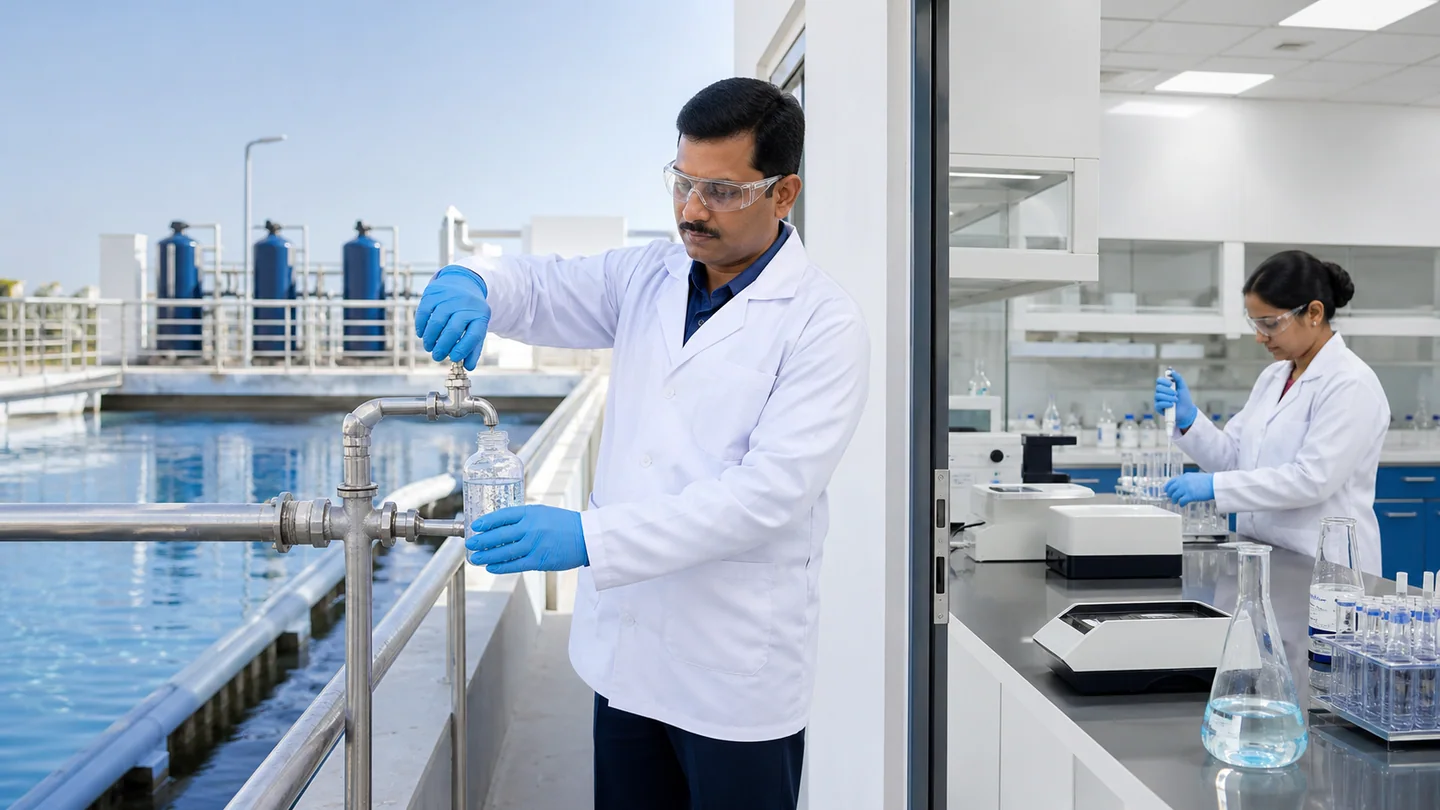
Water in a food business can be an ingredient, beverage component, ice source, washing or rinsing medium, cleaning utility, steam or processing input, or handwashing supply. These uses do not all create the same exposure, but water that directly contacts food or food-contact surfaces can become a significant contamination route. A strong FSMS therefore maps where water comes from, how it is treated and stored, and where it contacts product.
FSSAI's Schedule 4 hygiene framework requires food businesses to control water quality as part of good hygienic practice. For potable uses, IS 10500 provides the principal Indian drinking-water specification; FSSAI also publishes a water-analysis manual and a 2024 microbiological food/water manual. Monitoring should combine source qualification, treatment verification, storage and distribution hygiene, and process-specific suitability rather than testing only one office tap.
Article section
What the programme must answer
Testing or auditing is valuable only when the result is tied to a defined decision. The questions below should be agreed before sampling so that the sample, method, specification and response are aligned.
Ingredient / direct-contact water
Verify that the water specification protects product safety, composition and quality at the actual use point.
Ice and beverage water
Treat ice as food-contact product water; include source, machine/storage and handling hygiene.
Cleaning / final rinse
Ensure final-rinse water does not recontaminate cleaned food-contact equipment.
Utility/process suitability
Where water feeds boilers, CIP, cooling or equipment, define additional process chemistry separately from potable criteria.
Article section
Map water as a process ingredient
A water schematic should show external source, raw storage, treatment, treated storage, distribution loops and point-of-use outlets. It should also show where potable and non-potable systems are separated. This makes cross-connections, dead legs and vulnerable tanks visible and gives the sampling plan a scientific basis.
Food-contact risk often occurs downstream. A filtered source can be satisfactory but an ice machine, hose, storage tank or low-use outlet can harbor contamination. Conversely, a process can require stricter chemistry than drinking water for reasons such as scale, flavour, fermentation or formulation. Meets drinking-water specification and suitable for this process are related but not identical statements.
- Classify every outlet by intended use and food-contact exposure.
- Maintain source, tank, treatment and point-of-use IDs on a water schematic.
- Include ice machines, beverage dispensers and final-rinse points in risk assessment.
- Physically identify and protect non-potable lines to prevent cross-connection.
- Link water failures to affected product batches and sanitation events through traceability.
Article section
Standards and method framework
IS 10500 and relevant IS 3025 parts can support potable-water physical and chemical testing; IS 15185 and related BIS standards support water microbiology. FSSAI 15.024–15.034:2024 provides water microbiological methods in the food/water manual. APHA Standard Methods can be appropriate for process or wastewater parameters where accepted by the specification or monitoring programme.
| Reference / method | Role in the testing plan | Important use condition |
|---|---|---|
| FSSAI Schedule 4 / Hygiene Requirements | Preventive control of water within FSMS/GMP/GHP | Defines system expectation; does not replace an analytical specification. |
| IS 10500:2012 + amendments | Potable water quality | Use at source/point of use when drinking or food-contact potability is required. |
| IS 3025 series | Physical and chemical water parameters | Select relevant current parts. |
| FSSAI 15.024–15.034:2024 / IS 15185 etc. | Water microbiology | Choose organisms and method appropriate to water use/specification. |
| APHA Standard Methods, 24th ed. | Broad process-water and wastewater framework | Use where accepted and fit for the process decision. |
| APHA/Standard Methods 2510 B / 2540 C | Conductivity and total dissolved solids examples | Applicable to process-water monitoring only where accepted by the specification and laboratory scope. |
| APHA/Standard Methods 4500-Cl G | DPD colorimetric residual chlorine | Useful where disinfectant residual is part of the control plan; analyse promptly. |
| APHA/Standard Methods Part 9000 | Water microbiological methods | Use the exact current method accepted for the intended water use and regulatory framework. |
A method number is not, by itself, a product specification or legal limit. The method tells the laboratory how a defined measurand is determined; the applicable regulation, product standard, consent, customer specification or validated internal plan supplies the criterion and decision context.
Article section
Sampling and pre-analytical control
Sampling points should isolate system stages. One sample at a cafeteria tap cannot validate a whole factory network. A baseline programme can include incoming or source water, raw storage, treatment outlet, treated tank and selected high-risk or distal use points. When a failure occurs, add upstream and downstream samples around the suspected section.
Sampling should represent actual use. Water feeding an ice machine, beverage dispenser, final rinse or ingredient line should be tested at the point that answers the risk question. A nearby washroom tap may be easier to access but can be supplied by a different branch of the distribution system.
- Sample the actual water used in food or ice, not only a convenient nearby outlet.
- Record whether filters, aerators or hoses are part of normal use and how the sampling procedure treats them.
- Use sterile neutralized bottles for microbiology as instructed by the laboratory.
- Record tank cleaning, filter change, UV/disinfection maintenance and plumbing events.
- Separate process-chemistry bottles from microbiology and preserved trace-analysis bottles.
Article section
How to interpret results and trends
Interpret water results together with product and hygiene data. If hand or equipment swabs worsen at the same time as water microbiology, water can be a common route—but causation still requires mapping. If product failures occur only on one line and shared water is satisfactory, the investigation should look elsewhere. Integrated trend review prevents tunnel vision.
A source-to-point trend can distinguish treatment performance from internal-distribution hygiene. It can also identify whether a filtered point is actually improving relevant parameters or merely changing TDS while leaving the microbiological risk unmanaged.
| Observed result / pattern | Technical interpretation | Management response |
|---|---|---|
| Water adverse at several points + food-contact swabs rising | System-wide water or hygiene contribution possible | Contain water use and map source, treatment and distribution. |
| Source satisfactory + one outlet adverse | Local plumbing or fixture issue | Inspect outlet or dead leg and sample adjacent points. |
| Water chemistry drift + product composition change | Ingredient-water/process effect possible | Review dosing, source and formulation/yield. |
| Ice adverse + source water satisfactory | Ice-machine or storage contamination | Inspect, clean and sanitize machine and handling. |
| All water results stable + food pathogen event | Water less likely as current route | Continue ingredient, environment and handling investigation. |
Article section
Build the result into a control programme
Monitoring should assign frequencies by risk. Daily or shift operational checks can include treatment alarms or residuals; microbiology can be scheduled at defined points and intensified after maintenance or failures; broader chemistry can be periodic and triggered by source changes. The precise frequency should be justified and documented rather than copied from another facility.
Water performance belongs in the site's food-safety management review. Repeated tank problems, filter failures or point-of-use microbiology are not solely engineering maintenance issues when the water contacts food, hands or cleaned equipment.
- Define operational, verification and comprehensive testing tiers.
- Set immediate response for microbiological potable-water failures before results occur.
- Trend by sampling point so recurring local problems are visible.
- Requalify after a new source, tank modification, treatment change or extended shutdown.
- Include water performance in hygiene audit and management review rather than keeping it as a separate engineering file.
Article section
Apply this guidance to your product
Apply this guidance
